A press release needs a concrete news item, verifiable data, and a structure that allows the essentials to be understood from the first paragraph. Its purpose is to facilitate the work of journalists and readers, not to disguise a commercial advertisement as news.
What a press release is and when it should be written
A press release is a communication used by a company, institution, or organisation to announce news. It can report on a launch, an event, an opening, an agreement, a corporate change, an initiative, or a verifiable recognition.
Not every business activity is news. Before writing, ask four questions:
- **Is there concrete news?** There must be an identifiable event, not a general description of the business.
- **Is it of interest to a defined audience?** The relevance can be sectoral, local, professional, or social.
- **Is the data verifiable?** Dates, participants, locations, characteristics, and conditions must be able to be checked.
- **Is it a current event?** The information must be linked to a recent launch, decision, event, or change.
A release informs; an advertisement seeks to sell. The communication can explain the utility of a product or service, but it must do so with facts and context, without promotions, commercial urgency, or bombastic claims.
Before writing: gather the necessary information
Writing with incomplete data produces vague and repetitive texts. Prepare a fact sheet that answers the basic questions:
- **Who:** issuing company, participating organisations, and spokesperson.
- **What:** main event.
- **When:** date of launch, celebration, or entry into force.
- **Where:** location, geographical scope, or channel.
- **Why:** reason and relevance of the news.
- **How:** operation, development, or essential conditions.
Check names, positions, dates, locations, and figures. Statements must come from real people, be well attributed, and have their approval.
Also prepare a professional contact and, if available, photographs, logos, or supplementary documents. Verify that the company has the rights to distribute those materials.
How to find a news angle without sounding like advertising
The angle must start from what happened and its consequences for the public, not from the company's praise of itself.
“The company presents a tool for booking appointments from a mobile phone” describes a fact. “The company revolutionises the market with a unique solution” offers an evaluation that is not proven.
To define the angle:
1. Choose a single main piece of news.
2. Identify who it affects or may be useful to.
3. Explain its practical consequence.
4. Provide the necessary context.
5. Replace terms like “leader”, “innovative”, or “revolutionary” with verifiable characteristics.
If the news loses all its value upon removing the praise, there is likely a lack of a relevant fact.
Structure of a press release
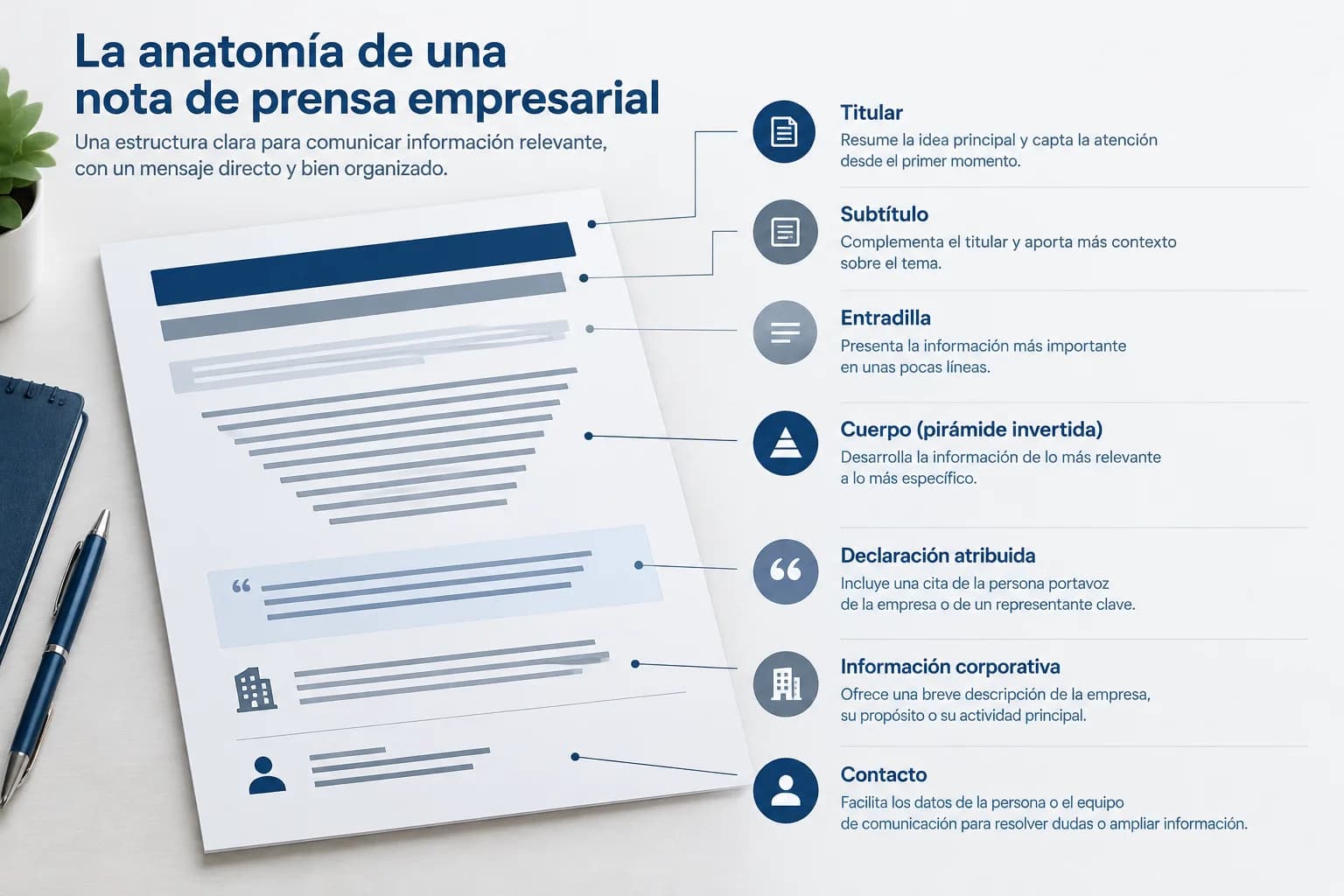
Although it can be adapted to the subject and the recipient, a release usually includes date and location, headline, intro, body, statements, corporate information, and contact details.
The information follows the inverted pyramid: the essential appears first; then explanations and secondary details are added. This way, the reader can understand the news without reaching the end.
Headline: summarise the event
The headline must identify the news with precision. It may include the name of the company when it helps to understand who the protagonist is.
Avoid ambiguous puns, unnecessary capitalisation, exclamation marks, and claims that the text cannot support. This formula can serve as a starting point:
[Empresa] + [acción o novedad] + [dato que concreta su alcance]
It is not a rule, but it helps to avoid generic headlines like “A new way to move forward”.
Sub-headline and intro: add essential context
The sub-headline is optional. Include it only if it provides a relevant fact without repeating the headline.
The intro or lead must present the news autonomously. It can answer who, what, when, where, why, and how, selecting the questions necessary to understand the event. The news must appear from the first sentence, not after a long history of the company.
Body: order the data by importance
After the intro, develop the event and its direct implications. Then add the operation, dates, conditions, background, and other context data.
Clearly distinguish between:
- Confirmed facts.
- Attributed opinions.
- Future forecasts or plans.
This separation avoids presenting expectations as results. If a figure requires a source or a methodological explanation, include it instead of leaving the data isolated.
Statements: identify the spokesperson
A quote can explain a decision or provide the organisation's perspective. It should not be limited to expressing satisfaction or qualifying the launch as “a big step”.
Indicate the name and position of the spokesperson. Confirm the content and attribution before publishing. Do not turn approximate ideas into statements or quote texts that no one has approved.
Corporate information, contact, and resources
The closing can include a brief corporate text or boilerplate that explains what the company does, who it targets, and what its scope of activity is. It must be factual and shorter than the communication.
Add:
- Name of the contact person.
- Role or department.
- Email or other professional channel.
- Graphic material available, if any.
- Verified links that provide information.
Avoid closing with several calls to buy, register, or request an offer. If the news requires a practical indication, one is enough.
Press release template
> [Lugar], [fecha]
>
> [Titular que resume el hecho principal]
>
> [Subtítulo opcional con un dato complementario]
>
> [Entradilla] Explain who is communicating the news, what it consists of, when or where it is happening, and why it may be relevant.
>
> [Segundo párrafo] Expand on the event with its characteristics, operation, or direct consequences.
>
> [Tercer párrafo] Add dates, conditions, background, or context.
>
> “[Declaración aprobada que aporte una explicación o perspectiva]”, points out [nombre y cargo del portavoz].
>
> [Párrafo final] Include next steps or supplementary information without opening a second piece of news.
>
> About [empresa]
>
> [Descripción corporativa breve y verificable].
>
> Press contact
>
> [Nombre y función]
>
> [Canal de contacto]
>
> [Recursos o enlaces, si procede]
Delete the instructions, brackets, and empty fields before sending or publishing the document.
Fictional press release example
The company, spokesperson, and initiative in the example do not represent real events.
> Example City, fictional date
>
> Demonstration Company launches a workshop booking service for local businesses
>
> The platform will allow users to check activities and request a place from a single digital space.
>
> Demonstration Company has presented an online service for businesses in Example City to publish workshops and manage attendance requests. The initiative will initially be aimed at establishments and users in the municipality.
>
> The service will show the topic, location, schedule, and conditions of each activity. Participating businesses will be able to update availability and communicate changes from their management area.
>
> “We want to simplify the publication of activities and prevent information from being scattered across different channels”, explains Fictional Name, fictional head of the project.
>
> The company will provide supplementary information and a support channel to resolve questions about the operation of the service.
>
> About Demonstration Company
>
> Demonstration Company is a fictional organisation created exclusively for this example.
>
> Contact
>
> Fictional Name — Fictional communication department
>
> [Canal de contacto de ejemplo]
The headline identifies the company, the action, and the service. The intro concentrates the news, the audience, and the scope; the following paragraphs explain the operation. The statement exposes the motive for the initiative without resorting to praise.
Length and tone
There is no one-size-fits-all length for press releases. The text must contain the necessary information to understand and verify the fact without hiding what is essential. If a paragraph can be removed without losing relevant information, it is unnecessary.
Use an informative tone, direct sentences, and understandable vocabulary. The third person usually facilitates journalistic presentation, while quotes can appear in the first person.
Explain the necessary technical terms and eliminate internal jargon, slogans, and repetitions. Clarity matters more than an overly formal tone.
Common errors
- Confusing a commercial offer with news.
- Hiding the main fact behind an extensive introduction.
- Gathering several news items without hierarchy.
- Abusing adjectives, capitalisation, or exclamation marks.
- Publishing figures, dates, or names without verifying.
- Using quotes without attribution or approval.
- Presenting forecasts as results.
- Repeating information to lengthen the text.
- Omitting context, date, or contact details.
- Attaching non-existent images or images without usage permission.
- Promising coverage, traffic, sales, or positioning.
Checklist
Before sending or publishing the release, check:
- [ ] The headline explains the main fact.
- [ ] The intro is self-explanatory.
- [ ] The basic questions are answered when relevant.
- [ ] Names, positions, dates, locations, and figures are verified.
- [ ] The statements are approved and well attributed.
- [ ] Facts, opinions, and forecasts are clearly distinguished.
- [ ] There is no praise, jargon, or unnecessary repetition left.
- [ ] Links and contact channels work.
- [ ] Graphic resources exist and can be distributed.
- [ ] Spelling, punctuation, and formatting are reviewed.
- [ ] The text explains why the news may matter to its audience.
After writing
Save a final version and gather supplementary resources separately. Adapt the presentation to the channel or the recipient, but do not alter the facts to exaggerate their relevance.
You can send the communication to suitable contacts, publish it in the company's news section, or use a publishing platform. Once the communication has been reviewed, you can also consider PublicaGratis.es as an option to publish it.
Publishing is part of dissemination, but it does not guarantee journalistic coverage, commercial results, or positioning. The basis remains real, clear news backed by verifiable information.