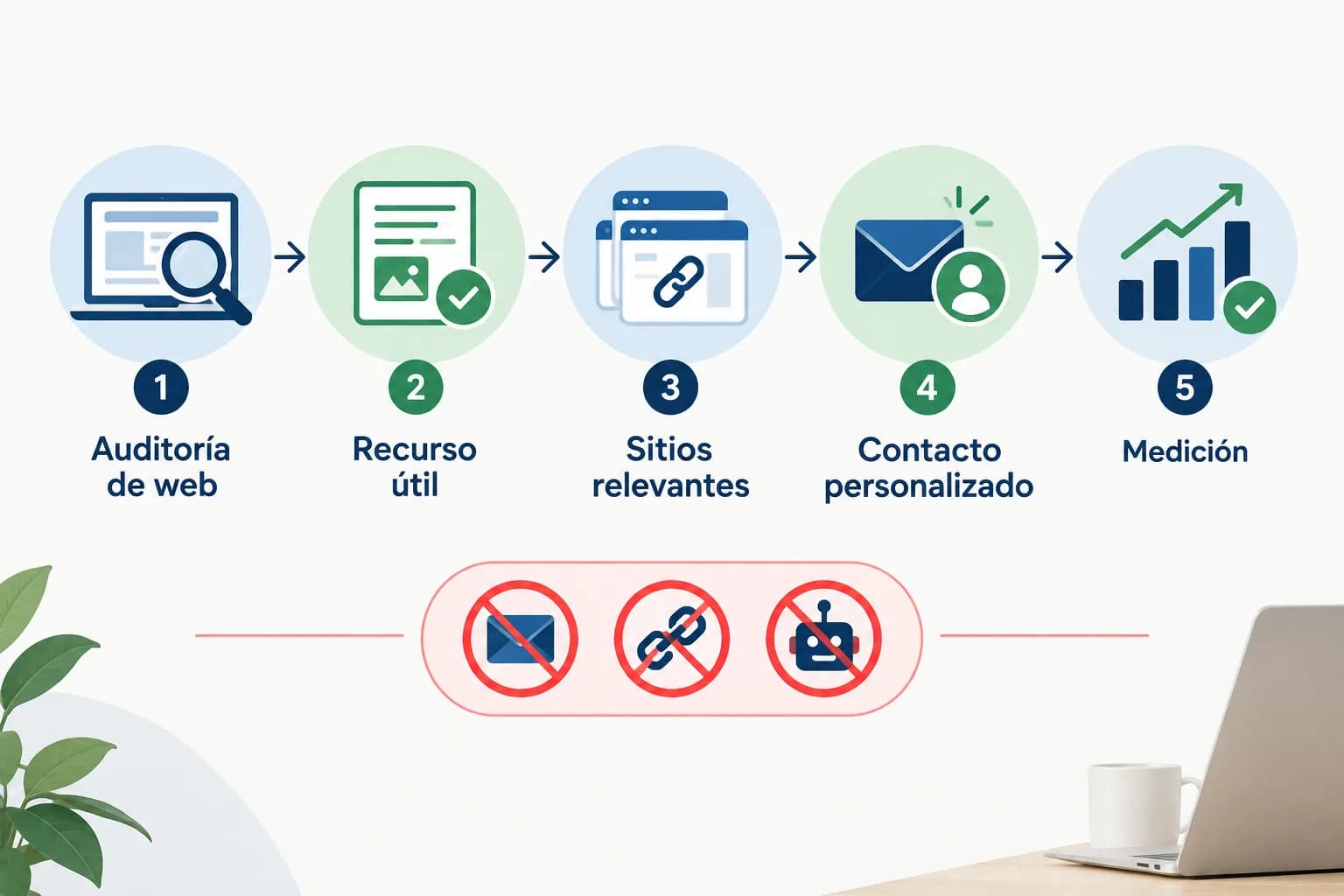
A new website does not need to chase hundreds of links to get started. It needs to prove it deserves to be discovered: by having useful pages, explaining clearly what it offers, and appearing in places where its audience can find it.
Backlinks or incoming links can help a page be discovered, receive visits from other websites, and provide context about its subject matter. However, they are not a guaranteed shortcut to top rankings. A link from a relevant and well-integrated page usually makes more sense than dozens of links created on sites without an audience, unrelated to the business, or saturated with advertising.This guide proposes a
prudent initial link building approach: few actions, selected and sustainable. The goal is not to “manufacture authority”, but to obtain mentions and links that also have an editorial, professional, or commercial reason.Backlinks for a new website: what to expect at the beginning
A backlink is a link from another website to yours. It can point to the homepage, a service, a product page, a guide, or any published resource.
For a website that has just launched, the first links can serve several functions:
Help users and search engines find new pages.
- Generate referral traffic from a relevant community, media outlet, or collaborator.
- Support a mention of a brand, business, or professional.
- Give visibility to a useful resource that deserves to be cited.
- Quantity, on its own, says little. A link from the website of a professional association in your sector can be reasonable if you have a relationship with it. Conversely, a link in a generic directory full of disconnected categories provides little utility for a visitor and can be a poor investment of time.
Before seeking links for a new website, it is worth accepting a simple idea:
a link does not fix a poorly prepared website. If the destination page is confusing, slow, inaccessible, or does not address the user's need, achieving mentions will be more difficult and their commercial effect will be limited.What to check before starting link building
Link building works best when it directs to a page that deserves to receive visits. First, dedicate time to reviewing the foundation.
Check important pages
Ensure that service pages, categories, products, or main content can be opened without errors and are accessible to search engines. Google Search Console can help you observe if there are indexing problems or pages that are not being processed as you expected.
There is no need to turn every URL into an encyclopaedic page. It must, however, be clear what it offers, for whom, what problem it solves, and how to contact or proceed. A service page with concrete information is usually a more defensible destination than a generic homepage.
Organise your brand presence
Prepare a complete contact page and maintain consistent data in your corporate profiles. If you have local activity, also check your business profile on Google Business Profile where applicable. Consistency does not create links by itself, but it avoids friction when someone wants to verify who is behind the website.
Identify linkable assets
Not all pages have the same potential for getting links. Make a list of resources that could be useful outside your own website: a practical guide, a downloadable template, a glossary, a methodological comparison, a simple calculator, or clear answers to frequently asked questions in your sector.
Linkable content does not need to be spectacular. It must solve something better than a promotional page. The easier it is to understand its utility in a few seconds, the easier it will be to propose it to a media outlet, collaborator, or community.
The first ways to get links without spamming
The most sensible free opportunities usually stem from relationships, real membership in a sector, and content that provides value. Start with those that have an evident justification.
Relevant profiles and professional directories
Directories are not good or bad by definition. They can make sense if they are specialised, moderate their listings, and users consult them to find suppliers, businesses, or professionals. Also reasonable are the pages of associations, professional bodies, business networks, local markets, or sectoral platforms in which you are actually involved.
Before creating a listing, ask yourself: could a potential client arrive here? Does the category describe my activity? Does the site publish carefully curated and updated content? If the answer is no, it is probably not worth it.
Existing relationships
Review suppliers, clients, distributors, entities with which you collaborate, events in which you participate, and professional communities. Perhaps there is a page for collaborators, use cases, members, or resources where your website fits in naturally.
It is not about asking for links indiscriminately. You can propose a mention when it provides useful information: for example, to identify a supplier, expand on a collaboration, or direct to the page where a specific service is explained.
Recovery of unlinked mentions
If a media outlet, blog, or entity already mentions your brand, a product, or someone on your team without linking, a legitimate opportunity for contact exists. Thank them for the reference and ask if it would make sense to add the link to the page that helps readers find more information.
The key is that the mention already exists and that the URL improves the experience. Do not turn this approach into a campaign of claims about minimal or irrelevant references.
Resources that others want to cite
Useful guides are a more solid base than any list of sites where you can drop a URL. Think about the recurring needs of your clients: processes that generate questions, confusing concepts, documents that are repeated, or difficult decisions to compare.
A good piece can include clear definitions, verifiable steps, limits, examples of use, and a revision date if the subject changes frequently. Afterwards, share it with people or organisations for whom it might genuinely be useful; not with a massive database of unfiltered contacts.
Guest articles with editorial criteria
Guest posting
can fit when you have useful expertise for another media outlet's audience. The value lies in the article, not in placing a link. Look for publications that deal with topics close to your activity, have a recognisable editorial line, and take care of their content.A well-planned collaboration can allow for a contextual mention towards a guide, tool, or page that expands on a specific point. Publishing generic texts on dozens of websites just because they accept collaborators is the exact opposite of an editorial strategy.How to choose a link opportunity
You do not need a secret formula or an isolated metric to decide. Use a qualitative review before investing time in each opportunity.
The following table serves to prioritise actions according to your situation and available resources. It does not intend to assign an absolute SEO score: the value of each opportunity depends on its relevance, its context, and whether it can be useful for a real audience.
| Opportunity | Priority | Effort | Cost | Risk | |---|---|---|---|---| | Relevant professional profiles | High | Low | Low | Low | | Unlinked brand mentions | High | Low | Low | Low | | Collaborations with existing entities or contacts | High | Medium | Low | Low | | Guest articles with editorial criteria | Medium | Medium | Low | Low | | Relevant sectoral or local directories | Medium | Low | Low | Medium |
Thematic relevance:
the website deals with matters related to your activity or the problem your content solves.- Geographic fit: if your business is local, an entity or publication in your area can be especially pertinent.
- Real audience: value whether there are readers, clients, members, or professionals who might be interested in your proposal.
- Editorial quality: review if the pages are well-maintained, signed where appropriate, and updated with some regularity.
- Link context: it matters that it appears in a comprehensible and related text, not isolated in a link block.
- Legitimate reason: there must be a reasonable reason for that website to mention you.
- Tools like Ahrefs, Semrush, or Majestic can provide data to analyse domains and link profiles, but their metrics are their own estimates. Use them as support, not as an automatic verdict.Distrust pages with totally disconnected topics, sections filled with sponsored articles, poor texts published at high speed, or promises to publish any content in exchange for a link. It is also a risk signal to receive automated messages offering large volumes of links in a very short time.
How to ask for a link naturally
The best contact is brief, specific, and respectful. Before writing, read the media outlet or website, identify the right person, and decide which specific page can help their audience.
Do not ask for “a backlink”. Explain the editorial utility of the resource. Do not impose an exact
anchor text
or request changes repeatedly. The link text should emerge naturally from the content being published.Message exampleSubject: Resource to expand your guide on __PG_TOKEN_0__
Hello, __PG_TOKEN_0__:
I have seen your guide on [tema] and I found the section on __PG_TOKEN_1__ especially useful. We have prepared a resource on __PG_TOKEN_2__ that explains __PG_TOKEN_3__ and could serve as an extension for those who want to delve deeper.
I am sharing it with you in case it fits editorially: [nombre]. If it is not relevant to the guide, there is no need to reply.
Thanks for your work,
[URL]
This type of message works better if the resource is truly pertinent. Personalising is not just about adding the recipient's name: it implies referring to a piece you have read and making a concrete proposal.
Guest articles, press releases, and collaborations: when they fit
An editorial collaboration makes sense when both parties gain something: the media outlet gets useful content and the author reaches a suitable audience. Review the publication conditions, the policy on links, and the context where any reference to your website will be included.
Press releases
should not be used as a link machine. They can be appropriate if there is real news: a relevant launch, a public initiative, a verifiable business milestone, or a collaboration that has news value. If there is no novelty, it is preferable to work on a useful article, a collaboration, or direct communication with relevant media and communities.
Online media can provide visibility, but only if the approach fits with their audience. A commercial proposal without editorial interest rarely becomes a good publication, even if it includes a URL.What practices to avoid when getting free backlinksHaste usually leads to tactics that generate noise, not value. Google Search Essentials contains guidelines on spam practices, so it is advisable to avoid schemes designed primarily to manipulate results.
Irrelevant directories created to accumulate links.
Excessive and reciprocal exchanges without a clear editorial reason.
Comments on blogs, forums, or profiles used solely to insert URLs.
- Duplicated or mass-produced articles to place them anywhere.
- Networks of pages with disconnected topics and artificially cross-linked sites.
- Massive purchase of links or services that promise fast and guaranteed results.
- A link with a
- nofollow
- attribute should not be automatically discarded either. It can attract visits, give visibility to a brand, or open a professional relationship. Its utility depends on the context, not on a universal promise about its SEO effect.
Plan for __PG_TOKEN_0__ days for a new websiteA reasonable first month does not seek volume. It seeks to build a process you can repeat.Week __PG_TOKEN_0__:
review indexing, navigation, priority pages, and contact data. Choose two or three resources that deserve to be recommended.
Week __PG_TOKEN_0__:
- create a short list of associations, professional directories, collaborators, communities, and sectoral media that have a real relationship with your project.Week __PG_TOKEN_0__:
- complete profiles that provide value and prepare personalised proposals for a few collaborations or guest publications.Week __PG_TOKEN_0__:
- publish or request the agreed actions, record each contact, and analyse which opportunities generate responses, mentions, or visits.Document the source URL, destination page, type of relationship, date, and result. That information will allow you to detect which initiatives work for your sector and which ones only consume time.
- How to measure progress without obsessing over the number of linksThe link count does not summarise a strategy. Observe which domains mention you, which pages they point to, and if there is a reasonable relationship between those references and your activity.
Google Search Console allows you to review queries, pages, and signals related to your site's presence in Google Search. Google Analytics, if you have it configured, can help identify referral traffic and subsequent visitor actions.
In addition, it is advisable to value less visible issues:
Does the linked page receive visits from interested people?
Does the link come from a source relevant to the business?
Has it generated a new conversation, request, or collaboration?
- Do strategic pages receive varied and consistent mentions?
- Is your content being cited for its utility, not just for a dissemination action?
- Results can be gradual and non-linear. A collaboration may not send many visits the first day and, nevertheless, become a useful reference over time. Prioritise the quality of relationships and content over a striking figure.
- Frequently asked questions about backlinks for new websites
- How many backlinks does a new website need?
There is no universal number. It depends on the sector, competition, type of project, and the utility of each link. It is preferable to start with a few relevant mentions than to seek an artificial volume.
Are free directories still useful?
Some can be if they are professional, sectoral, or local, have real users, and fit your activity. A low-quality generic directory does not become useful just by being free.
Can you achieve authority without publishing guest articles?
Yes. You can work on relevant professional profiles, citable resources, brand mentions, relationships with collaborators, local presence, and your own content that responds well to specific needs.
What do I do if a website links to the wrong page?
If there is a clearly better alternative for their readers, contact them politely and explain the reason. If they do not accept the change, avoid insisting: the editorial decision rests with the site that publishes the link.
Is it advisable to always ask for a specific link text?
No. The text must fit the sentence and naturally describe the destination. Forcing exact repetitions can make the content seem unnatural and does not improve the quality of the collaboration.
In summary, to
get links
on a new website, it is advisable to start by making it recommendable. A correct technical base, useful content, legitimate relationships, and well-chosen contacts are slower than spam, but they build a more defensible presence that is useful for the public.
metaDescriptionmetaTitlesegments