Publishing a press release online can help a company, SME, freelancer, or entrepreneur provide context and visibility to a relevant development. It could be a launch, an event, a collaboration, an opening, or an initiative of interest to a specific community.
The first decision should not be to search for the largest possible number of sites. It is advisable to ask where the audience that might care about the news is and what function each channel serves. A press release portal, a digital media outlet, a business directory, and an in-house press room do not offer the same thing.
Furthermore, there is an important distinction: just because content is published does not mean it will receive journalistic coverage, generate contacts, or appear before a large number of readers. Publication is one step; the relevance of the news and well-focused dissemination determine the rest.
Where to publish press releases: what options do you have
There are various ways to publish a press release online. The choice depends on the reach sought, the sector, the location, and the available resources.
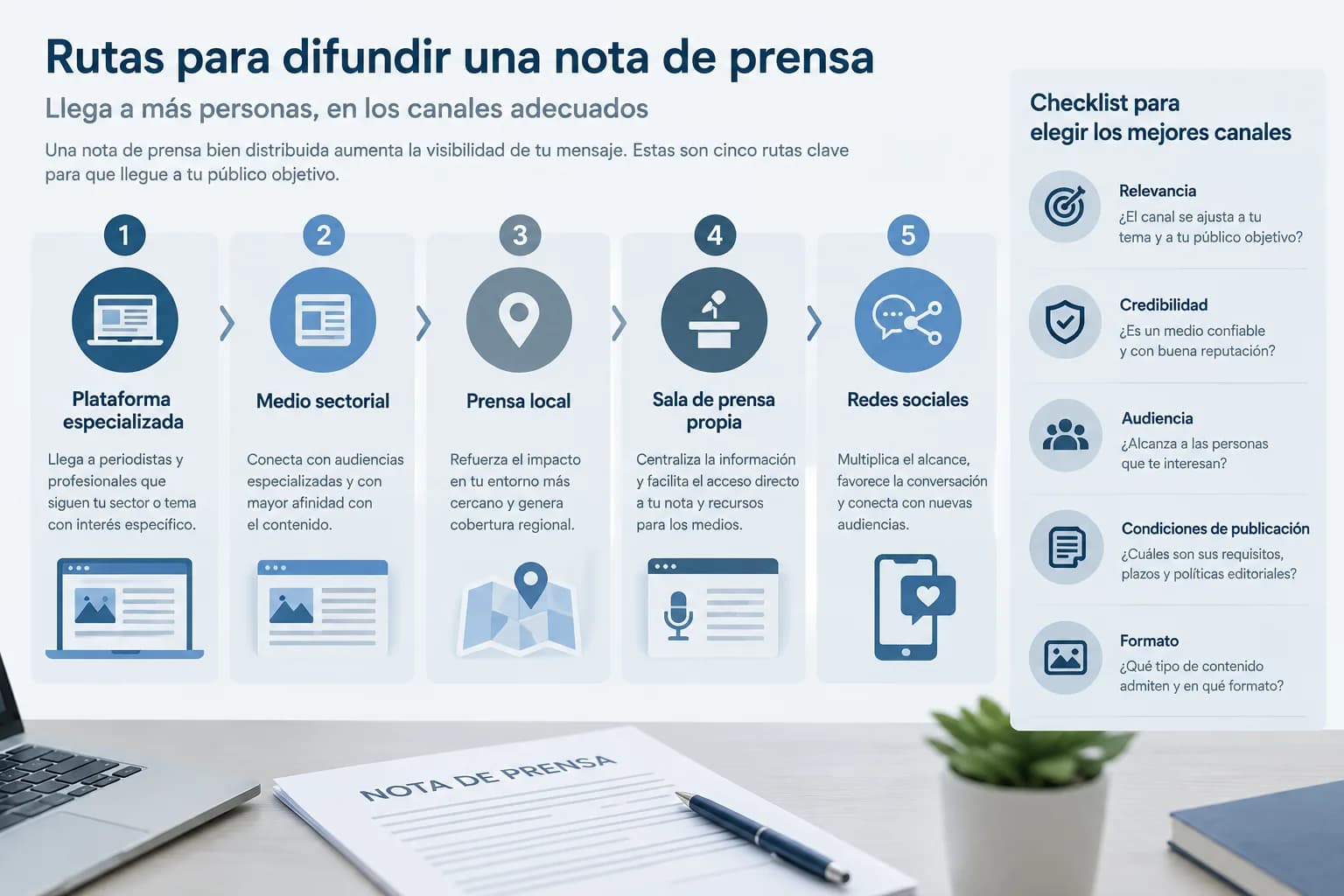
Platforms specialising in press releases
These are portals designed to host and organise releases from companies and organisations. Their main utility is to offer a specific space to publish news in an editorial format, with a headline, text, date, and contact details.
They can be suitable when looking for a basic online presence for a business development and a shareable point of reference. Before sending the content, review the publication guidelines, the type of information accepted, and whether the portal makes it clear how it treats promotional texts.
Digital media and trade press
A general, local, or specialised outlet can be a good option if the news truly fits their editorial line and the interests of their audience. The trade press is especially relevant for technical, professional, or specific sector-linked matters.
In these cases, it is not enough to send the same text to all contacts. It is preferable to adapt the focus: highlight the fact, the novelty, or the impact that might be relevant to that outlet's readers. The outlet decides if it publishes and in what format; sending a release does not equate to contracting an insertion or guaranteeing coverage.
Local press
For openings, events, community initiatives, projects linked to a territory, or developments that affect a specific area, local press is usually more relevant than a wide-reach channel.
The value lies in proximity. Explain clearly where it is happening, who it affects, and why the community might be interested. If the news has a real local dimension, this approach is usually more useful than trying to present it as a matter of universal interest.
Business directories and corporate press rooms
Business directories serve to reinforce a company's informational presence, although they do not replace a digital media outlet. They can complement a company profile, a corporate website, or an in-house online press room.
The press room on your website is, however, the place where you keep the reference version of each release. It allows you to archive files, update data when necessary, and direct journalists, clients, or collaborators to an official source.
Social media and in-house channels
A newsletter, the corporate profile on social media, the blog, and other in-house channels can amplify a release, but they do not replace its publication in an editorial space when that format is necessary.
It is not advisable to copy the full release without adaptation. On social media, a clear synthesis, a relevant image, and a link to the full version work better. Each channel requires a different language and length.
What to value before choosing a medium or platform
Free-of-charge is a legitimate criterion, especially for small businesses, but it should not be the only one. Before deciding where to publish a press release, compare these aspects.
Relevance to the audience
The best channel is not always the widest one. A trade outlet can provide more context for specialised news; a local one may be more appropriate for a nearby event. Ask yourself who should know this information and where they usually look for related content.
Credibility and editorial quality
Review the site before sending anything. Check if it identifies the person responsible, if it displays a publication policy, if its content has an understandable structure, and if it distinguishes information from advertising.
Be wary of spaces that accept any text without apparent criteria, are saturated with commercial messages, or make it difficult to know who manages the publication. The reputation of the environment where a piece of news appears also influences how it is perceived.
Visibility and indexing, without false promises
Just because a page is accessible to Google Search does not guarantee rankings, visits, or impact. Online visibility depends on many factors: the interest of the news, competition for the topic, the quality of the content, the site's audience, and how it is shared afterwards.
Nor is it advisable to choose a channel solely for links. Include useful links to your own sources or supplementary information, but avoid turning the release into a piece designed to accumulate links. The SEO of a press release should be a reasonable consequence of useful communication, not its only goal.
Conditions and format of publication
Check if the site moderates submissions, what type of content it rejects, if it allows images, how it manages authorship, and what contact details can be included. Also check if the text can be corrected after being published and if there are length or category requirements.
These conditions change between platforms and can be updated, so it is better to verify them just before publishing.
Real cost and permanence
A free option can cover a specific need, while a broader distribution service might make sense when the news requires a coordinated campaign or a very defined reach. Compare what you need, not just what each proposal includes.
It is also advisable to know if the publication will remain available, if you will be able to update important information, and if the page is easy to share. Do not take these features for granted without reviewing the current terms and conditions.
Publishing for free: advantages and limits
A free press release allows you to communicate a development without allocating a budget for every publication. For an SME or independent professional, it can be a reasonable way to start building an informational presence on the internet and to have a public page to share.
Its limits are just as important:
- It does not ensure that journalists or media outlets will see the content.
- It does not guarantee editorial coverage, mentions, or business leads.
- It does not turn uninteresting news into a matter of public interest.
- It does not replace direct and personalised contact with media outlets when this is necessary.
The dissemination of press releases works better when the content provides a verifiable and relevant fact: a specific development, practical information, a clear call to action, or data that helps to understand a project. A purely advertising message usually has less reach, even if it is published in several places.
How to choose according to the objective of your press release
The objective dictates the most reasonable combination of channels.
- Launch of a product or service:prioritise a clear explanation of what is changing, for whom it is, and what problem it addresses. Combine online publication with your own channels and, if applicable, media outlets related to your activity.
- Local event:give priority to local press, relevant event listings, and community channels. Include venue, date, time, access, and contact details without forcing the reader to search for them.
- Agreement, project, or business initiative:explain the real scope of the announcement. If it affects a specific sector, look for media and communities that follow that area.
- Activity of an SME or freelancer:a release platform and an in-house press room can serve as a base. Reinforce dissemination with social media, newsletters, and contacts that have a real connection to the news.
- Specialised news:concentrate the effort on trade and professional media. A selective and adapted submission is usually preferable to mass distribution.
In many cases, the most sensible formula combines a full version on your own website, a publication on a press release portal, and direct contact with the media or people for whom the matter may be relevant.
Checklist before publishing a press release
Before disseminating it, check the essentials:
- Informative headline, understandable and faithful to the content.
- Date and location when they provide context.
- Lead paragraph that explains the main fact from the start.
- Ordered body with verifiable data and without exaggerated claims.
- Images only if they are relevant and you have the right to use them.
- Name, role, or contact area, along with a valid communication channel.
- Links that expand useful information, without overloading the text.
- Review of the audience, editorial policy, and conditions of the chosen site.
If you are still preparing the content, it may help to review a guide on [qué debe incluir una nota de prensa](/que-debe-incluir-una-nota-de-prensa/) before choosing the dissemination channels.
How to publish a press release without duplicating efforts
Publishing the same release in several media is not necessarily a problem, but replicating it without criteria can reduce its utility. Prioritise the channels where it fits and adapt the headline, the lead, or the highlighted information when the audience is different.
Maintain a full and updated version in your online press room or on your website. From there, create brief pieces for social media and specific communications for journalists or media outlets. This way you avoid contradictions and can direct each person towards an official source.
Measure the results with caution. Visits, received contacts, mentions, and quality enquiries offer more useful signals than publishing on many sites without knowing what effect it has had. If there is no response, first review the newsworthiness and the fit of the channel before increasing the volume of submissions.
PublicaGratis.es as an option to disseminate a press release online
PublicaGratis.es is an alternative to consider if you are looking for a platform geared towards publishing press releases online. It can fit as part of a simple visibility strategy: prepare a clear release, verify that it meets the portal's current conditions, and use it alongside your own channels or targeted dissemination.
Before publishing, review the applicable policy and ensure that the text contains complete, verifiable, and easy-to-understand information. If you have already assessed the previous criteria and decide to use the platform, you can consult the page for [enviar una nota de prensa](/publicar-nota-de-prensa/).
The choice should not be based on generic promises of reach or positioning. What is important is that the channel is consistent with your news, allows information to be presented in a professional way, and forms part of a realistic communication plan.
Conclusion: the best place depends on the news and the audience
There is no single ideal place for all press releases. A specialised platform can solve an online publication need; a local media outlet can be decisive for a nearby event; and a trade outlet can provide context to professional news.
Choose by relevance, trust, editorial conditions, and utility to the audience, not just by free-of-charge. A well-prepared release, hosted in a suitable place and shared with the right people, will have more chances of fulfilling its function than an indiscriminate distribution.