Publishing frequently is not enough for a content strategy to help a business. An article can attract people who barely recognise a problem, while a service page can be useful for someone already comparing providers. Both pieces fulfil a function, but they should not ask for the same thing or be measured in the same way.
The TOFU, MOFU and BOFU model helps to organise that journey. It allows you to decide what content to create based on the audience's intent: discovering a problem, evaluating alternatives or taking a step towards a purchase. For an SME, it is not about producing dozens of pieces or building a rigid funnel. It is about better answering the questions that really arise before hiring.
TOFU, MOFU and BOFU: what they mean
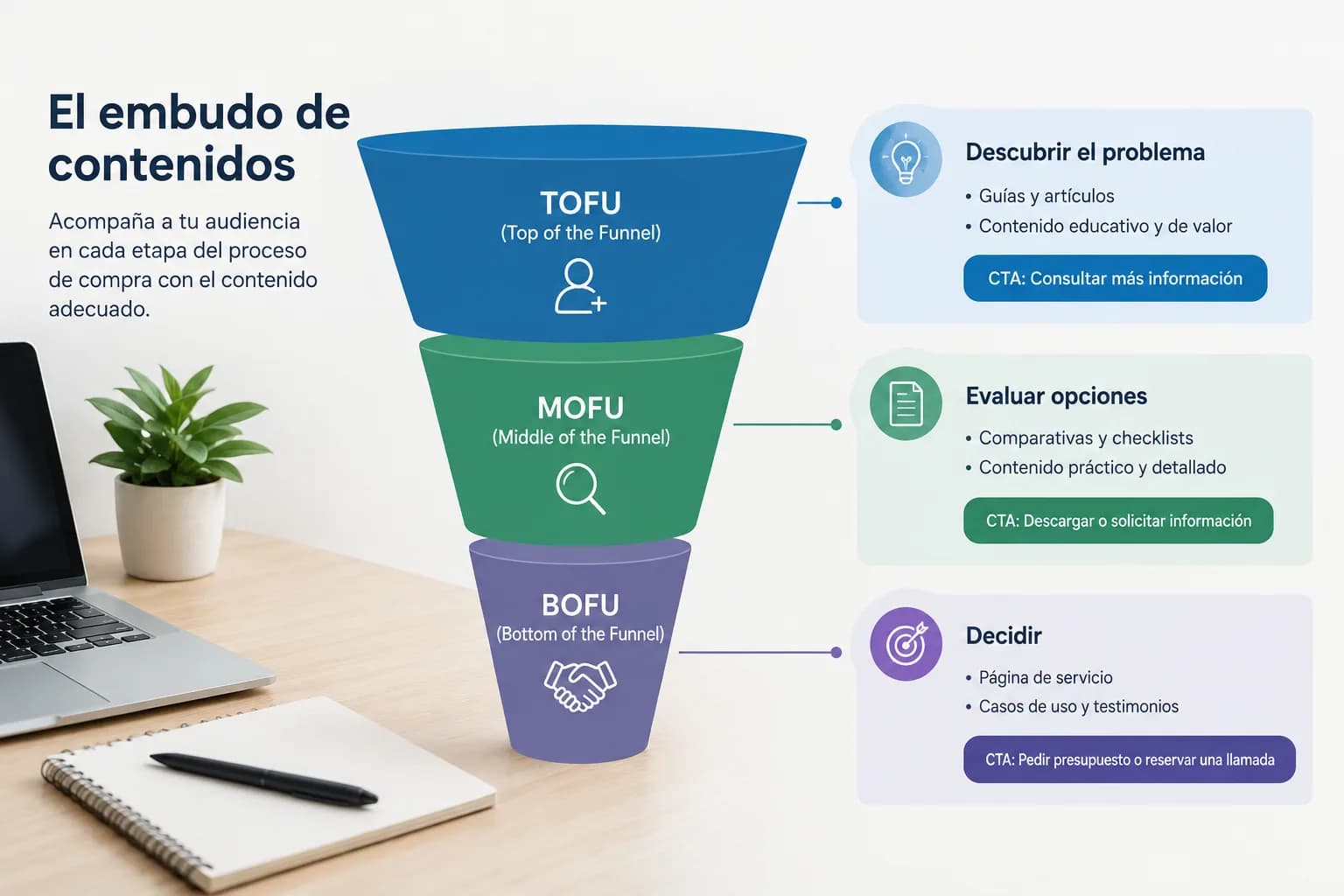
The acronyms come from the English expressions top of funnel, middle of funnel and bottom of funnel. In Spanish, they correspond, approximately, to the top, middle and bottom of the marketing funnel.
- TOFU is the discovery stage. The person is trying to understand a problem, a need or an opportunity.
- MOFU is the consideration stage. They already know their situation better and are evaluating possible ways to solve it.
- BOFU is the decision stage. They are looking for information that will allow them to choose a solution, a provider or a service.
The content funnel is a useful simplification, not an exact description of human behaviour. A person can arrive directly at a commercial page because they have an urgent need. Another can read several guides, disappear for months and return when their priority changes. They can also alternate between informative content and comparisons before talking to a company.
The usefulness of the model lies in aligning three elements: search intent, content and the call to action. If someone is searching for how to detect a problem, they need guidance; if they are looking to compare services, they need criteria; if they are requesting prices or a demonstration, they need clarity to move forward.
What content to create at each stage of the funnel
TOFU: helping to recognise the problem
At the top of the funnel, the goal is to gain relevance and initial trust. The audience does not always know the solution or the technical vocabulary. They usually ask broad questions: "why it happens", "how to know if I need" or "what options exist".
Educational content that resolves a specific doubt without requiring an immediate decision works especially well:
- Introductory guides and explanatory articles.
- Glossaries of frequent concepts.
- Lists of errors, signs or symptoms.
- Simple templates and self-diagnostic resources.
- Brief videos or posts that clarify a common doubt.
For example, a marketing consultancy could publish a guide on how to identify if a website is receiving poorly qualified traffic. A labour consultancy could explain which situations make it necessary to review certain internal processes. The focus is not on selling immediately, but on making the reader understand their context better.
The appropriate CTAs in TOFU are low-commitment: reading a related article, consulting a more comprehensive guide, subscribing to news or downloading a checklist. Asking for a sales meeting at the end of every piece of informative content can be premature.
MOFU: facilitating the evaluation of alternatives
In MOFU, the person already understands the problem and begins to value solutions. They look for method, selection criteria, advantages and disadvantages, use cases or differences between approaches. It is the time to demonstrate practical knowledge without turning the content into a sales pitch.
MOFU content usually answers questions such as "which option suits me", "what should I assess before hiring" or "how to compare proposals". Some useful formats are:
- Comparisons explained with transparent criteria.
- Checklists to evaluate a service or prepare a project.
- Implementation guides and roadmaps.
- Use cases that describe problems, decisions and processes.
- Frequently asked questions about methodology, deadlines or scope.
- Webinars, information sessions or downloadable resources when they provide real value.
Here it is advisable to help the reader make a better decision, even if they do not end up hiring. A useful comparison does not need to present one's own company as an automatic answer: it must explain when each alternative fits, what limits it has and what questions the buyer should ask.
The CTAs can invite the user to download a template, request information, review a service page or briefly explain their case to receive initial guidance. The key is that the next step is related to the doubt that the content has resolved.
BOFU: reducing friction before deciding
At the bottom of the funnel, the audience is close to choosing. They need to verify if the proposal fits their case, what the service includes, what the process would be like and how to start the relationship. They are not looking for a general explanation: they are looking for security and concreteness.
BOFU content usually includes:
- Clear and updated service pages.
- Use cases linked to specific needs.
- Frequently asked questions about hiring and operation.
- Information about the work process, deliverables and prerequisites.
- Demonstrations, diagnostic sessions or budget requests, when they are a real part of the offer.
A good BOFU page avoids both vague promises and insufficient information. It must explain who the service is for, what problem it addresses, what the client can expect and what step they must take to contact you. If there are conditions that depend on the project, it is preferable to indicate this transparently rather than give a false sense of precision.
The same topic adapted to TOFU, MOFU and BOFU
A practical way to plan the content funnel is to work on the same topic from the three stages. This avoids publishing isolated ideas and creates natural paths between pieces.
Let's imagine a small business that offers web design services for local businesses. The starting topic is the lack of leads from the website.
- TOFU: "Signs that your website is not helping you generate leads". The content explains common problems, such as confusing messages, poorly visible forms or a lack of essential information.
- MOFU: "Redesigning a website or making adjustments: how to decide what your business needs". The piece proposes evaluation criteria, the scope of each option and preliminary questions to ask before requesting proposals.
- BOFU: "Web redesign service for local businesses: process, deliverables and first steps". The page specifies the offer and facilitates contact.
The connection between the pieces must be useful. From the TOFU guide, you can link to the comparison for someone who has already detected a problem. From the comparison, to the service page for someone who is clear that they need external support. It is not about forcing clicks, but about offering the next logical resource.
How to design a content funnel with few resources
An SME does not need to cover every format or publish daily. It is more effective to build a small, updated and connected system than to accumulate articles without a purpose. The starting point should be the information that already exists within the business.
- Collect real questions. Review enquiries received by email, sales calls, meetings and customer service conversations. Separate initial doubts, objections and buying questions.
- Group topics by intent. Doubts about the problem are usually TOFU; comparisons and criteria, MOFU; questions about the service, BOFU.
- Prioritise according to the commercial situation. If the offer is poorly explained, it may be better to improve the BOFU pages first. If the business depends on recommendations and needs to expand reach, it may be a priority to create TOFU content.
- Create small thematic groups. A guide, an evaluation piece and a well-linked service page can be a good starting point.
- Reuse the research, not the text. The same research can feed an article, a checklist, an email sequence or an FAQ page, adapting the approach to each channel and stage.
The editorial calendar does not have to assign a fixed proportion between TOFU, MOFU and BOFU content. As a flexible starting point, it can be useful to create a TOFU piece, a MOFU piece and a BOFU piece in each cycle, provided it responds to the actual needs of the business. It is not a universal formula: a long sales cycle may require more consideration content, while a new or poorly explained offer may need more decision-making pieces.
To adjust the proportion, observe where the blockage is occurring. If there is already relevant traffic but it generates few opportunities, it is worth reinforcing BOFU with service pages, hiring information and clear CTAs. If there are leads who show interest but remain undecided, prioritise MOFU with comparisons, evaluation criteria and answers to objections. If qualified visibility is lacking, dedicate more effort to TOFU to answer your audience's initial doubts. The distribution depends on the maturity of the offer, the existing demand and the actual capacity to produce and update content.
What CTAs to use in TOFU, MOFU and BOFU
The call to action works best when it responds to the person's moment. Not all readers want to talk to sales, but almost everyone appreciates knowing what to do next if the content has been useful to them.
- In TOFU: "Check out the related guide", "download the checklist", "receive useful content" or "review these signs".
- In MOFU: "Compare the options", "use this evaluation template", "see how we work" or "tell us what you are considering".
- In BOFU: "Request a proposal", "book an initial conversation", "ask for a demonstration" or "start the hiring process".
A CTA does not need to be spectacular to be effective. It must be clear, visible and consistent with the page. If the next step requires time or personal data, it is advisable to explain what the person will receive and avoid unnecessarily long forms.
How to measure each stage of the funnel
Content metrics must relate to the goal of each piece. Measuring only visits can hide the fact that an article attracts curiosity without connecting with the target audience. Measuring only commercial requests can undervalue content that generates discovery and trust before a later conversion.
- TOFU: impressions in search engines, queries for which the content appears, relevant traffic, new visits and progress towards related resources.
- MOFU: downloads, subscriptions, interaction with comparisons, visits to service pages and leads asking for more information.
- BOFU: forms submitted, budget requests, meetings, trials if they exist and commercial opportunities generated.
Tools such as Search Console, Google Analytics or a CRM can help observe the journey, provided the measurement is configured consistently. Even so, it is advisable to interpret the data with caution: a conversion can rarely be attributed with absolute certainty to a single piece. The channel, time elapsed, recommendations and other interactions also influence it.
Frequent errors when applying TOFU, MOFU and BOFU
- Publishing only informative content. Attracting an audience is useful, but a bridge to consideration resources and offer pages is needed.
- Turning every article into an ad. Early commercial pressure reduces the utility of content designed to resolve initial doubts.
- Confusing traffic with commercial intent. Many visits do not necessarily equal suitable leads.
- Copying a universal proportion of formats. There is no valid distribution for all sectors, sales cycles and production capacities.
- Forgetting to update links and CTAs. An offer changes, a page is renewed and old content may stop guiding the reader well.
- Treating the buyer journey as a straight line. People can skip stages, go back or consult several sources before deciding.
How to start this week
To get a content strategy based on TOFU, MOFU and BOFU up and running, you do not need to redesign the entire website. Start with a short exercise:
- Note down three problems that your audience is trying to solve.
- Write down three objections or comparisons that arise before hiring.
- Collect three questions that appear when a person is close to deciding.
- Assign each subject to the most likely stage of the funnel.
- Choose a priority topic and create one piece per stage, linking them meaningfully.
- Check after some time if they attract the right audience, if related resources are being consulted and if the commercial pages answer the buying doubts.
The best content strategy is not the one that accumulates the most publications, but the one that best accompanies a real decision. When each piece has a clear function —discover, evaluate or decide— it is easier to prioritise, measure and improve without turning the entire site into a sales campaign.