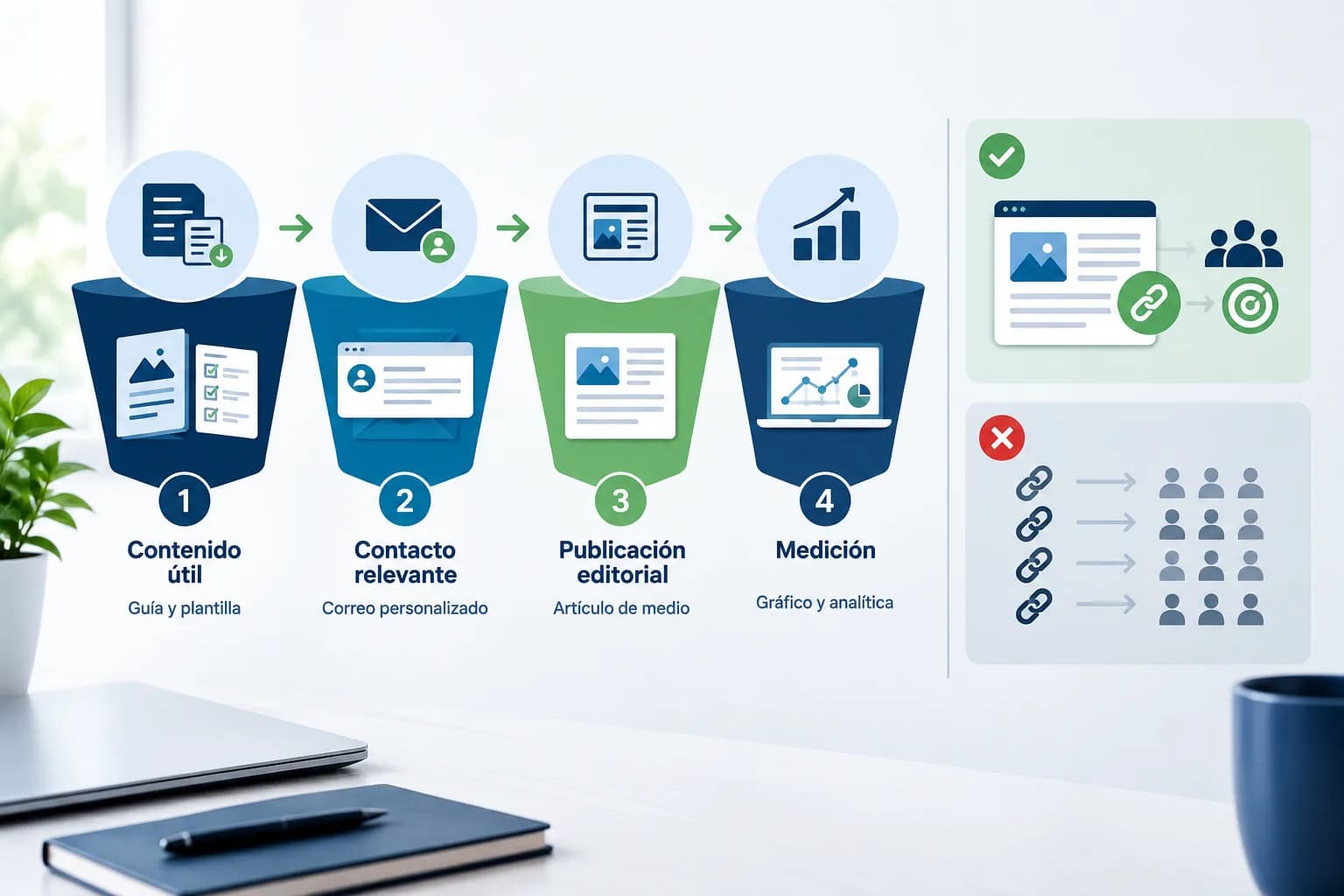
<p>Getting <strong>free backlinks</strong> is not about accumulating links in any directory, profile, or comment. The most sustainable path is to ensure other websites have a real reason to cite your content, your business, or a resource you have created.</p>
<p>A useful link usually appears in a context related to your activity, within a page that provides information to its audience. It can bring in visits, reinforce brand recognition, and help search engines understand the relationship between your site and a subject. There are no automatic results: quality, relevance, and usefulness weigh far more than volume.</p>
<h2>What are backlinks and what does getting them naturally mean?</h2>
<p>A backlink, also known as an inbound link, is a link from another website to a page on your site. This is not the same as a brand mention: if a media outlet names your company but does not include a URL, there is visibility, but no link for users to follow.</p>
<p>An editorial link is included because the publisher believes the destination completes, supports, or expands upon their content. That is the approach to pursue in a <strong>natural link building</strong> strategy: be a useful source, do not force a recommendation.</p>
<p>To evaluate a link, an isolated authority figure matters less than these questions:</p>
<ul>
<li>Does the source website deal with a subject related to mine?</li>
<li>Could its audience have a real interest in visiting my page?</li>
<li>Does the link appear within comprehensible and carefully curated content?</li>
<li>Does the page seem created to inform people, rather than to accumulate links?</li>
</ul>
<p>Just because a link is free does not mean it arrives on its own or that it should be obtained by any means. It requires an interesting asset, research, and respectful contact.</p>
<h2>Before looking for links: prepare a website worth linking to</h2>
<p>The best outreach cannot compensate for a poor, outdated, or difficult-to-use page. Before contacting media, blogs, or communities, review what a person will find when they click.</p>
<p>A linkable website conveys clarity: it explains who is behind the project, offers verifiable contact details, loads correctly, and solves a specific need. It should also have solid landing pages; it is of little use to direct someone to a generic homepage when a specific guide, product, or resource exists.</p>
<p>Content that attracts links does not have to be huge. It must be difficult to replace. For example:</p>
<ul>
<li>Practical guides that answer a frequent question with clear steps.</li>
<li>Templates, checklists, or simple calculators.</li>
<li>Local or sector-specific resources that are updated regularly.</li>
<li>Original data explained with methodology and clear limitations.</li>
<li>Glossaries, honest comparisons, or downloadable materials that facilitate a task.</li>
</ul>
<p>This type of content is often known as <em>link bait</em>, but the name can be misleading. It is not about baiting clicks: it consists of creating a piece that deserves to be recommended because it saves time, organises information, or provides an original perspective.</p>
<h2>7 ways to get free, high-quality backlinks</h2>
<h3>1. Create a resource that solves a specific need</h3>
<p>Generic guides compete with thousands of pages. A focused resource has more options to be cited. Instead of writing about “how to improve an ecommerce”, it can be more useful to create a product sheet control template, a shipping guide for a specific sector, or a task calendar for small businesses.</p>
<p>Think about the questions your team receives, the common mistakes of your customers, and the resources they usually ask for before making a decision. That is where possible linkable content lies.</p>
<h3>2. Publish a press release when there is a real update</h3>
<p>A press release can open up dissemination opportunities if it communicates a fact with news value: the launch of a project, a relevant initiative, a collaboration, a well-planned original study, or a verifiable milestone.</p>
<p>It is not a mechanism for placing links without context. Responsible editorial distribution helps to present information in an orderly way and makes it easier for journalists, blogs, or professionals to assess whether they find it relevant. Additional coverage and editorial links are not guaranteed.</p>
<h3>3. Contact specialised media and blogs</h3>
<p>Look for publications that already cover subjects close to yours and check what kind of content they produce. If your resource completes an existing article, you can propose it with a brief, personalised message.</p>
<p>The key is not to ask for “a backlink”, but to explain what value the resource provides to the audience. A local guide might fit into a local media outlet; a technical template, into a professional blog; an expert source, into a feature article in preparation.</p>
<h3>4. Provide resources to relevant associations and communities</h3>
<p>Some professional associations, sector entities, educational communities, or local organisations maintain resource pages for their members. If you have created something that really serves them, you can present it so they can assess its inclusion.</p>
<p>It is not advisable to send the same request to organisations unrelated to your activity. The thematic and geographic relevance must exist before making contact.</p>
<h3>5. Recover unlinked brand mentions</h3>
<p>If a website has already cited your business, a product, a report, or someone on your team, there is a reasonable opportunity to ask them to add the original source. Do so only when the link facilitates verification or expands information for the reader.</p>
<p>Locate those mentions through brand searches and review each case manually. A kind message might be enough: thank them for the citation, indicate the most useful URL, and make it clear that the decision is theirs.</p>
<h3>6. Participate in collaborations, interviews, and expert content</h3>
<p>An interview, a roundtable, a collaboration with another complementary company, or a signed article can generate natural mentions. The condition is to provide real knowledge, not to use the participation as a pretext to insert promotional links.</p>
<p>The <em>guest posting</em> can make sense when there is editorial discretion, audience affinity, and an original contribution. Publishing repeated texts on irrelevant sites just to link is a poor investment of time.</p>
<h3>7. Detect broken links and propose a useful alternative</h3>
<p>Some resource pages maintain links that stop working. If you locate one related to your sector and have a page that answers the same need, you can notify the person in charge and suggest your resource as a possible replacement.</p>
<p>The right approach starts with the warning: you point out a problem that affects their readers. The proposal of your URL should be secondary and honest; if it does not cover the same subject, do not force it.</p>
<h2>How to use a press release to generate link opportunities</h2>
<p>A press release works best when it stems from a novelty and is written so that someone can understand it and decide if it interests them. A concrete headline, an intro that answers the essential points, and verifiable data are more valuable than grandiloquent messages.</p>
<p>If you include a link, it must lead to a page that expands upon the information: the cited study, the project page, an activity sheet, or a related resource. Avoid repeating commercial terms or demanding an exact anchor text. A brand link or a clear URL often results in something more natural than an over-optimised sentence.</p>
<p>Before publishing, review the editorial focus, the subject matter of the media outlet, the transparency regarding the publication, and the context in which the content will appear. Publishing a note is not equivalent to obtaining additional journalistic coverage nor does it guarantee links from other sites. It can facilitate your information being available to anyone who wants to consult it.</p>
<p>In PublicaGratis you can consult help content on where to publish a press release and how to write it before preparing a distribution. The goal must be to inform with rigour and direct the reader to a useful source.</p>
<h2>How to ask for a backlink without spamming</h2>
<p>Effective <em>outreach</em> resembles an editorial proposal more than a bulk mailing. Research the website first, identify a specific page, and understand who it is addressed to. Afterwards, write little and with a clear reason.</p>
<ol>
<li>Choose sites whose audience has a real relationship with your proposal.</li>
<li>Locate a specific article, section, or resource where your content can fit.</li>
<li>Explain in one or two sentences what it contributes and why it can serve their readers.</li>
<li>Include a single relevant URL.</li>
<li>Follow up reasonably if you do not receive an answer and accept a no or silence.</li>
</ol>
<p>A simple model could be this:</p>
<p>“Hello, [nombre]. I read your guide on [tema] and found the part about [detalle] especially useful. We have prepared [recurso], which includes [aporte concreto]. In case you consider it could complement that section, I leave you the link: [URL]. Thank you for your time.”</p>
<p>There is no need to ask for a specific position, impose an <em>anchor text</em> or send email chains. If the resource does not fit, insisting only harms the relationship.</p>
<h2>How to evaluate if a link is worth it</h2>
<p>Not all <strong>free links</strong> have the same value. Before investing time in an opportunity, evaluate the whole and not a single metric provided by third-party tools.</p>
<ul>
<li><strong>Relevance:</strong> the topic, geographic area, and audience are related to your activity.</li>
<li><strong>Context:</strong> the link appears integrated into useful text, not isolated in a footer or a list without criteria.</li>
<li><strong>Site experience:</strong> there is identifiable content, reasonable navigation, information about those in charge, and an apparent audience.</li>
<li><strong>Visit potential:</strong> an interested person would have a logical reason to click.</li>
<li><strong>Naturalness:</strong> the anchor texts and destination pages are varied and coherent with the content.</li>
</ul>
<p>Beware of pages with posts on unrelated subjects, low-quality texts, huge blocks of outgoing links, or obvious signs that the site was created mainly to place links. Having a high metric does not compensate for a lack of context.</p>
<h3>Do nofollow links provide value?</h3>
<p>A link marked as <em>nofollow</em>, <em>sponsored</em> or <em>UGC</em> communicates a different type of relationship. It should not be treated as a conventional editorial link for SEO purposes, but it can provide discovery, referral traffic, notoriety, and a natural brand presence.</p>
<p>The priority remains context and usefulness to the user. Trying to make all links have the same attribute or the same anchor text does not reflect an organic strategy either.</p>
<h2>Practices to avoid</h2>
<p>The rush to increase the number of linking domains leads to tactics that rarely build a solid presence. Avoid, especially:</p>
<ul>
<li>Packages of hundreds or thousands of links offered in an automated way.</li>
<li>Link farms, networks of sites without a real audience, or posts created only to insert URLs.</li>
<li>Promotional comments on blogs, forums, or news that do not contribute to the conversation.</li>
<li>Repeated link exchanges without thematic relation.</li>
<li>Massive registrations in generic directories, empty profiles, or social bookmarking.</li>
<li>Commercial anchor texts repeated in an artificial way.</li>
</ul>
<p>Professional or local directories can be reasonable when they are specific, moderated, and help real users find services. They should not be the centre of your strategy nor justify indiscriminate registrations.</p>
<p>If you detect suspicious links to your web, do not assume from the start that you must act. Analyse if there is a worrying pattern and consult the current Google Search Central documentation before considering measures like the <em>disavow</em> file, which requires judgment and is not a routine task.</p>
<h2>How to measure a free backlink strategy</h2>
<p>Measure the process, not just the final number. Keep a tracking sheet with the opportunities found, the page contacted, the reason for the proposal, the date of sending, the response, and the URL obtained, if any.</p>
<p>Google Search Console can help you review links that Google shows associated with your site, although it should not be interpreted as a complete or immediate inventory. Complement observation with brand searches and referral traffic available in your analytics tools.</p>
<p>Pay attention to these signs:</p>
<ul>
<li>Visits that arrive from the pages that link to you.</li>
<li>Interaction time and conversions of that traffic, when you can measure them.</li>
<li>Impressions and evolution of the pages that receive links.</li>
<li>New brand mentions and collaboration opportunities.</li>
<li>Editorial quality and relevance of each link obtained.</li>
</ul>
<p>A small campaign that generates a sector collaboration, qualified visits, and a reliable mention can be more valuable than dozens of links without readers.</p>
<h2>30-day action plan to get started</h2>
<h3>Week 1: audit and linkable resource</h3>
<p>Review your most useful pages and detect a question that you can answer better than the competition. Create or improve a concrete resource, add authorship and contact information, and check that the destination URL works well on mobile.</p>
<h3>Week 2: selection of opportunities</h3>
<p>Prepare a short list of digital media, specialised blogs, associations, communities, and complementary businesses. Prioritise affinity over size. For each option, note a page or section where your resource could provide value.</p>
<h3>Week 3: publication and personalised contact</h3>
<p>If you have a legitimate update, prepare a press release with an informative focus. Afterwards, send personalised proposals to a manageable number of contacts. Adjust the message to each recipient and avoid automating generic texts.</p>
<h3>Week 4: follow-up and improvement</h3>
<p>Review responses, record links, and analyse which arguments have sparked more interest. Update the resource if you detect recurrent doubts and maintain the relationships created, even when there is no immediate link.</p>
<p>Getting quality backlinks without a budget is a work of constancy. The goal is not to deceive a search engine, but to publish resources that other people want to recommend and to build an editorial presence that makes sense for your audience.</p>