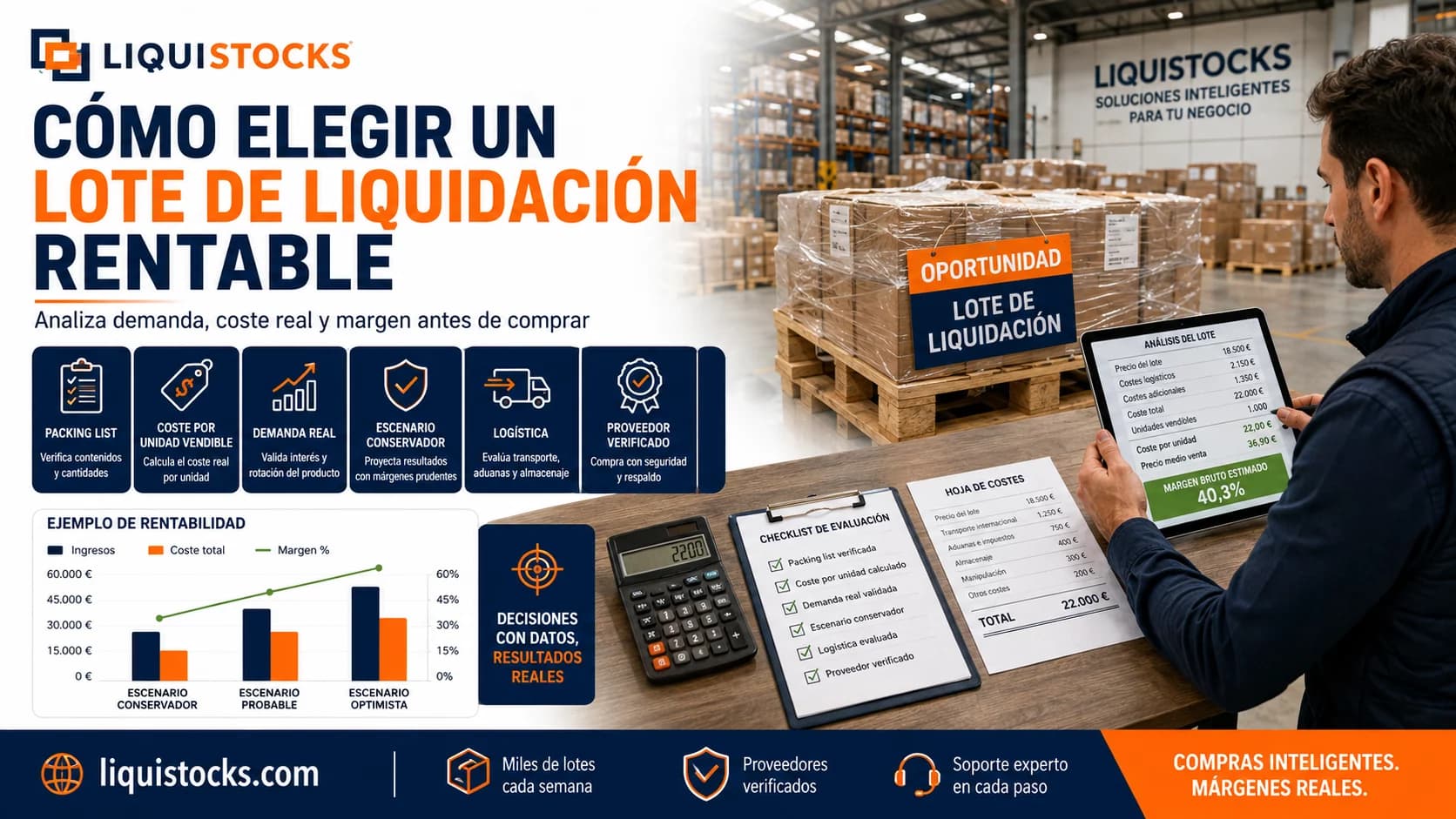
A liquidation offer can look attractive in a photograph and be difficult to make profitable once it arrives at the warehouse. Between these two situations, there is information that should be obtained before buying: what units the batch includes, which ones will be sellable, how much it will cost to prepare them, and how quickly they will find a buyer. For a business, the decision begins with its capacity to shift the stock.
LiquiStocks, which specialises in liquidations and wholesale operations, addresses these issues in its content for professional buyers. Evaluating a batch using a method allows different offers to be compared without making the discount percentage the only criterion. It also helps to identify operations that would require more resources than the business has available.
Start with the customer who will buy the merchandise
Before requesting prices, it is advisable to describe the product's destination. A local shop knows the sizes and categories its customers demand. An online seller also needs sufficient information to create listings and prepare individual shipments. A distributor supplying other businesses must assess what quantities it can place in each order.
This starting point avoids buying an assortment simply because it includes a few known references. If most of the batch belongs to categories the buyer does not deal with, the discount will have to compensate for a more complex commercial operation. Units that are difficult to sell also take up space and require attention.
Turn the offer into a verifiable list
The buyer needs to identify quantities, models, variants, and condition. Expressions such as "liquidation stock" or "returns" do not describe the condition of the items by themselves. It is useful to ask if they have been inspected, what accessories are included, and what differences exist between units of the same reference.
The documentation must correspond to the batch to be delivered. Current photographs and an agreed-upon inspection provide context, while the inventory allows the whole lot to be evaluated. A sample chosen only from the best products can provide an incomplete impression. When data is missing, that uncertainty must be incorporated into the decision.
Distribute the cost among the units that can be sold
The purchase price is only one part of the operation. One must consider transport, unloading, inspection work, and subsequent preparation. Some batches also require cleaning, replacement of packaging, or classification by condition. These tasks consume resources even if performed by the business itself.
As a hypothetical example, a batch costs 2.400 euros and requires another 600 euros to be received and prepared. If it contains 300 items, but it is estimated that 250 will be sellable, the initial cost per useful unit is 12 euros. Marketing expenses would still need to be deducted. The calculation changes when the truly usable units are considered.
Set a date for the sales plan
It is advisable to compare the projected price with current offers for the same product in an equivalent condition. The catalogue price from several years ago does not demonstrate what a customer will pay today. Nor is it enough to find one expensive advertisement: it is necessary to assess whether there is demand for the volume one wishes to acquire.
Afterwards, a prudent monthly exit can be estimated and one can review how much space will remain occupied during that period. An acceptable purchase should leave resources available to attend to the rest of the activity. If the business needs to sell the entire batch immediately to function, any delay will have a greater impact.
Document the agreement before closing
The composition, the described condition, the delivery, and the handling of discrepancies must be clear between the parties. It is also advisable to verify the identity of the seller and the existence of the merchandise. With these elements, it is simpler to decide whether it is worth negotiating, requesting more information, or discarding the offer.
The LiquiStocks guide to evaluating a liquidation batch develops this process. Its usefulness consists of converting an eye-catching offer into a decision supported by data, without attributing a guaranteed profit to any batch.