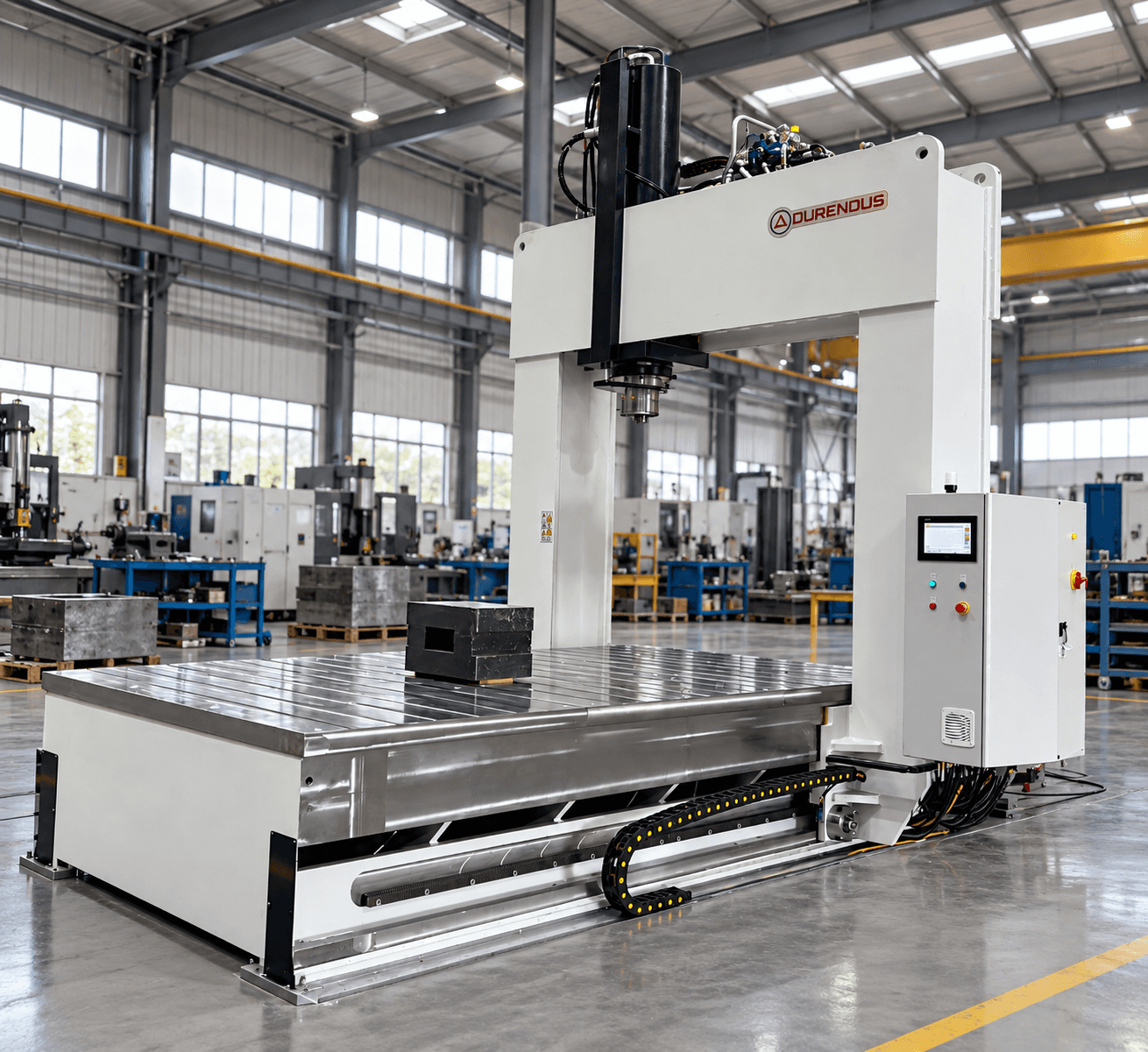
Choosing an industrial hydraulic press starts with the workpiece, the material and the operation to be performed. A company straightening metal components after cutting has different requirements from a manufacturer forming sheet metal in a deep drawing die. Understanding those requirements is the first step towards selecting a suitable machine.
Durendus offers hydraulic press solutions for industrial applications. Krollit is an authorised Durendus distributor for Italy and Europe, providing a point of contact for companies exploring the range and requesting a configuration for their production needs. The DPS and DHD series illustrate two distinct approaches to metalworking.
DPS: gantry presses for metal straightening
Metal components can require straightening after processes such as laser or plasma cutting. The dimensions and shape of the parts, access to the working area and the required pressing force all influence the choice of equipment.
The Durendus DPS series is designed for straightening steel and iron, including round and flat profiles. Its gantry arrangement offers access from three open sides, while movement on three or four axes supports positioning for the intended operation. The series is presented with pressing forces from 10 to 500 tonnes, with dimensions, capacity and equipment configurable to customer requirements.
For a fabrication workshop, the useful question is how the press will handle its actual components. Workpiece dimensions, loading arrangements and the space needed around the machine should therefore be considered alongside the nominal pressing force.
DHD: H-frame presses for deep drawing
Deep drawing requires a different assessment. The die, sheet material, forming depth and production cycle must be considered together when defining the press specification.
The Durendus DHD series is designed for sheet metal deep drawing and uses a welded steel H-frame structure. The product range includes adjustable pressing pressure and speed, a touchscreen HMI and a die cushion. These features should be assessed in relation to the tooling and forming process required by the customer.
The DHD series is presented with a force range from 10 to 2,000 tonnes. Final selection depends on the individual configuration: table dimensions, stroke, opening height, die cushion requirements and handling arrangements all form part of the technical discussion.
Define the application before comparing machines
A useful enquiry begins with a clear description of the intended operation. Companies should identify the material, its thickness or section, the size of the workpiece and the expected production volume. Drawings, photographs and tooling information can help explain the requirement.
Available floor space, access for installation, electrical supply and the movement of materials also need attention. A press must fit into the production workflow, including loading, unloading, operator access and maintenance activities. Planning these elements early makes comparisons between configurations more meaningful.
Consider support throughout the machine’s life
The purchase decision also includes installation, commissioning, operator training and ongoing maintenance. Durendus presents support services covering these stages, alongside spare parts and preventive maintenance. The scope of the proposed services should be discussed when requesting a quotation so that responsibilities and requirements are clear.
For companies evaluating a new press or expanding an existing workshop, the aim is to connect the machine specification with the work it will actually perform. Krollit, as an authorised distributor, provides a contact route for discussing Durendus solutions for Italy and Europe.
Describe your application and request a quotation
Explore the Durendus range at durendus.it. To discuss a specific project, describe your application and request a quotation, including the material, workpiece dimensions and operation you wish to carry out. These details provide a practical starting point for defining the press configuration.