Choosing workshop equipment requires an analysis of the work one intends to carry out. Before comparing prices or dimensions, it is advisable to define the materials, the most frequent operations and the size of the pieces. A joinery workshop dedicated to furniture making has different needs to a turning workshop. When working with both wood and metal, it is necessary to organise the two spaces coherently.
Krollit, an Italian company specialising in machine tools and equipment, provides a catalogue with solutions for wood, metal and sheet metal. For those preparing a workshop or renewing their equipment, the starting point should be a list of concrete tasks. This list allows for the comparison of machines according to their utility in the planned projects.
Preparing wood for each project
In joinery, the preparation of the pieces influences the subsequent stages. Cutting, planing, thicknessing and turning are distinct operations that require appropriate equipment. When selecting a machine, it is important to understand which of these operations will be carried out and what capacities are necessary for the usual work.
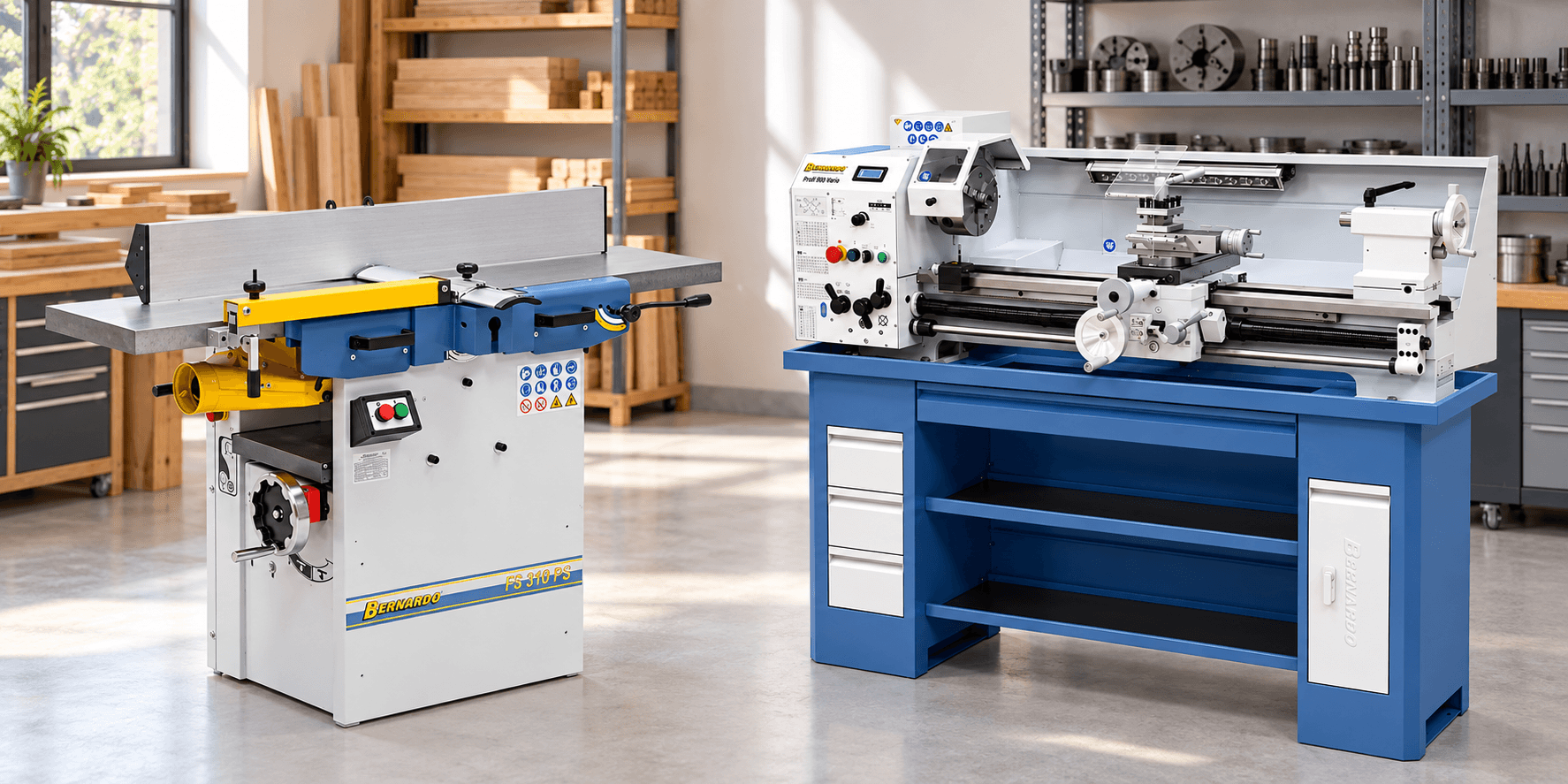
The Bernardo FS 310 PS is a surface and thickness planing machine for wood, featured in the Krollit catalogue. This type of equipment allows for the preparation of reference faces and for working on the thickness of pieces. Before choosing, the technical datasheet and manufacturer's instructions should be consulted, taking into account the dimensions of the wood, the power supply and installation requirements.
It is also advisable to provide space to support and move the pieces. A long board may require a circulation area significantly larger than the size of the machine itself. Planning this area before purchase helps to organise the work and avoid difficulties in the layout of equipment.
Choosing a lathe for metalworking
In metal turning, the choice begins with the type of piece and the intended operations. The material, diameter and length of the pieces must be compared with the capacities indicated by the manufacturer. Clamping systems, tools and available adjustments are also part of this evaluation.
The Bernardo Profi 900 Vario is a metal lathe from the Krollit catalogue and is included in the illustrative image for this article. When evaluating a lathe, it is useful to consult the documentation regarding speeds, work capacities and compatible accessories. This information helps to relate the equipment to the projects that one intends to execute.
A workshop may require other operations, such as cutting, drilling or milling. Therefore, the lathe must be considered as part of the overall work process, together with the remaining equipment and instruments required.
Organising space and installation
The layout of the workshop should reserve space for controls, for the movement of materials and for removing pieces. A simple drawing of the available area allows one to compare various arrangements and identify the most frequently used routes. The storage area should also be considered, especially when working with materials of different dimensions.
Electrical requirements and installation conditions should be verified for each model. In the area dedicated to wood, planning must include the extraction of dust and shavings. The manufacturer's instructions are the reference for preparing the installation and use of each piece of equipment.
Planning accessories and maintenance in the budget
The investment is not limited to the main machines. Cutting tools, clamping devices, measuring instruments and consumables may be necessary from the very first project. Including them in the budget allows for a more complete comparison of alternatives and better preparation for starting work.
Maintenance deserves the same attention. Knowing the recommended operations and the consumables used helps to plan daily use. Equipping the workshop in stages allows one to prioritise the most frequent tasks and add new capabilities as other projects arise.
The image accompanying this article was created from the photographs of the Bernardo FS 310 PS and the Bernardo Profi 900 Vario available in the Krollit catalogue. To see the machines and accessories, visit www.krollit.pt. Consult the equipment datasheets and compare their characteristics with the needs of your workshop.