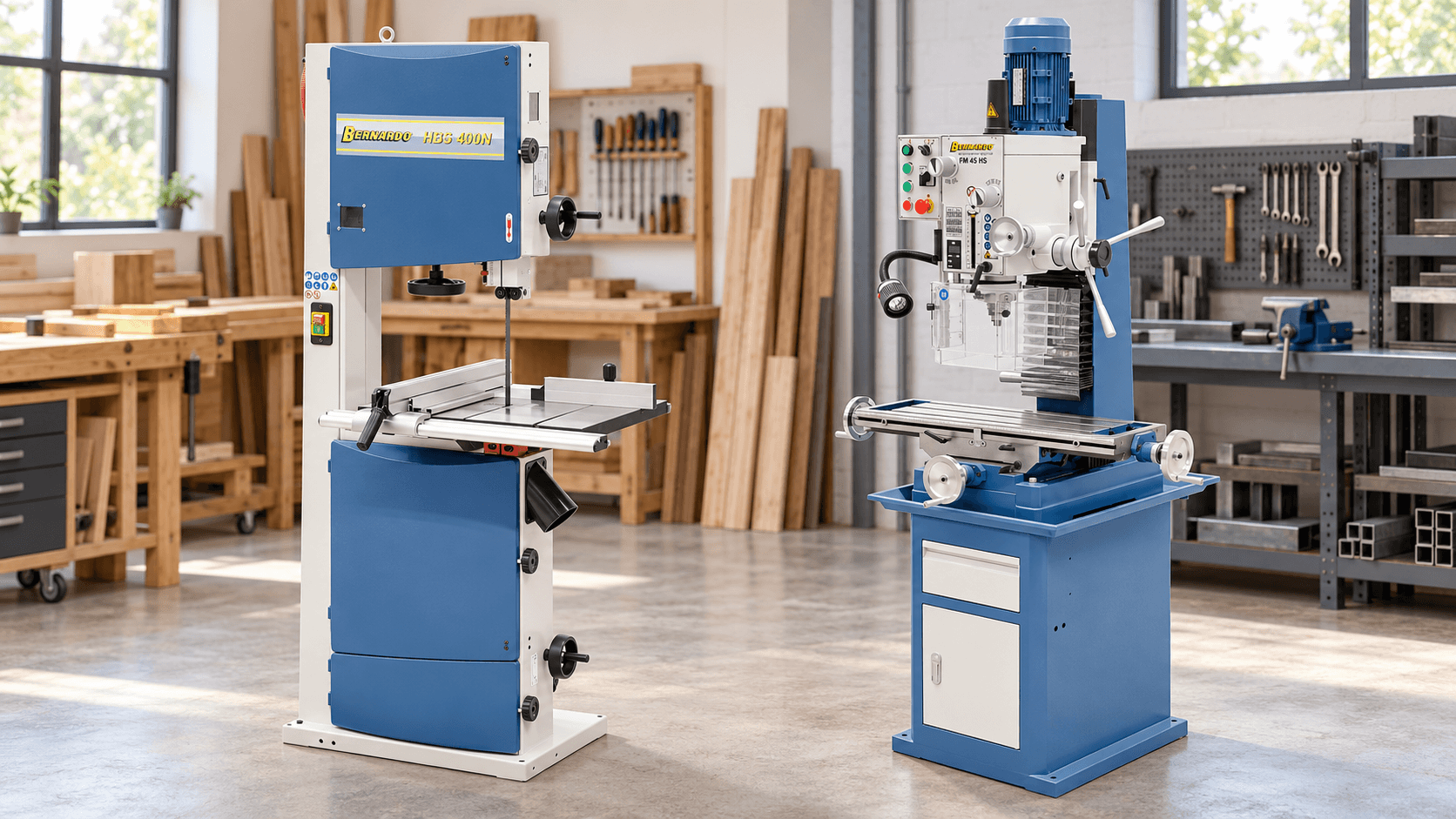
From your first machine to setting up a complete workshop, defining your requirements helps you choose equipment that suits your projects. Krollit presents guidelines for professionals and enthusiasts working with wood and metal.
Setting up a workshop begins with a simple question: what do you wish to create? A piece of furniture, a mechanical part or a series of components do not require the same equipment. Before comparing machines, it is therefore useful to specify the materials used, the dimensions of the parts and the anticipated frequency of work.
Krollit, an Italian company specialising in machine tools and workshop equipment, offers a catalogue dedicated in particular to the working of wood, metal and sheet metal. This diversity allows you to explore equipment corresponding to various projects, whether you are creating a first workspace or complementing an existing workshop.
Woodworking: start with the operations to be carried out
In a joinery workshop, each stage has its requirements. Cutting boards, preparing their surfaces, making joints and performing finishing work all demand different functions.
Depending on the projects, a bandsaw, a table saw, a planer-thicknesser or a wood lathe may be among the equipment to consider. The key is to link each purchase to a precise operation. To manufacture furniture, for example, wood preparation and cutting precision are important. For making turned objects, the criteria will be different.
The dimensions of the parts should also guide your selection. A machine suitable for small objects will not necessarily meet the needs of a user who regularly works with long panels or bulky elements.
Metalworking: examine the useful capacities
For metal, the choice depends in particular on the material, the shape of the parts and the desired result. Cutting profiles, drilling, turning or milling correspond to distinct operations.
Before selecting a machine, it is advisable to examine its working capacities, the available settings and its compatibility with the necessary tools. The needs of a workshop performing occasional work may differ from those of a repetitive activity.
Sheet metal work also requires specific consideration. Cutting, bending or forming operations must be related to the characteristics of the materials and the capacities indicated by the manufacturer.
Plan for the space around the machines
The footprint of a machine is not limited to its dimensions. You must account for movement, material handling and access to controls. Long parts may require additional space at the entry and exit of the work area.
The electrical power supply is another point to check before purchasing. The machine's specifications must match the available installation. In a wood workshop, the collection of dust and chippings also deserves to be integrated into the project preparation.
Think about accessories and maintenance
A machine is part of a whole. Blades, cutting tools, clamping devices and measuring instruments contribute to its daily use. Planning for these items from the start helps to establish a more complete budget.
The documentation, operating instructions and maintenance requirements must also be examined. A relevant choice is based as much on the possible operations as on the ability to use and maintain the equipment in good conditions.
Build a workshop that evolves with your projects
It is not always necessary to buy everything immediately. Identifying priority operations allows you to start with the most useful equipment, then gradually supplement the workshop.
To discover the machines and accessories intended for wood and metal work, visitKrollit Franceand compare the characteristics of the equipment according to your projects.