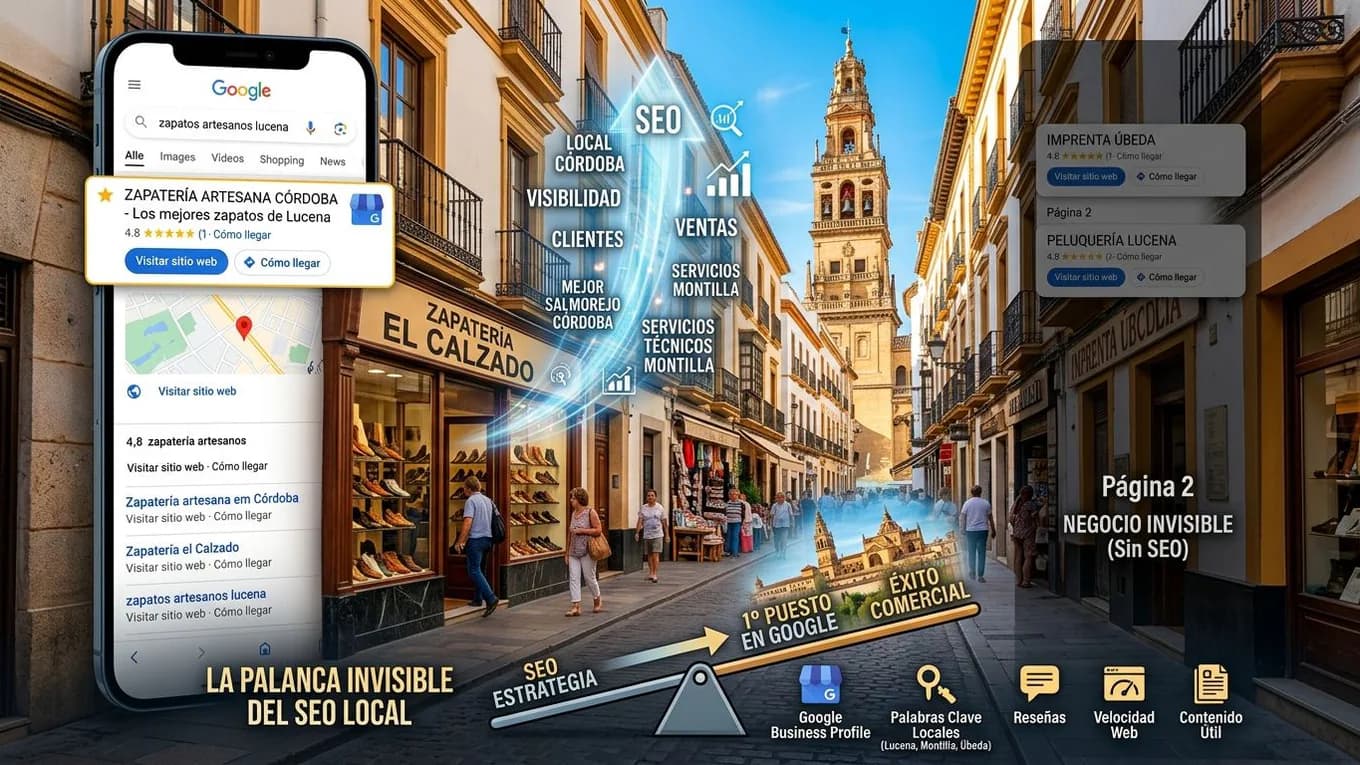
Every time a customer searches for "shoemaker in Lucena" or "technical service in Montilla", the search result is no accident: it is the product of a strategy that can make the difference between tripling turnover or disappearing after the first page.
Beyond the technical jargon: what SEO really is
A year ago, Mercedes Gómez, owner of a small print shop in the historic centre of Úbeda, told this columnist something that accurately illustrates the power of web positioning: "I used to make two calls a day. Now I receive between eight and ten". She did not change her commercial strategy. What changed is that her website appears when someone types "flyer printing in Úbeda" into Google. That, in technical terms, is called SEO.
SEO (Search Engine Optimization) brings together those adjustments—both in the website structure and its content—that make Google associate your business with the searches your customers are actually making. It is not about tricks, but a methodical process that, when executed correctly, turns any company's website—from a mechanical workshop in Bujalance to a law firm in Córdoba city—into a magnet for clients.
And in Córdoba, as in so many Spanish provinces, the geographical factor is not a decorative detail: it is the key. A 76% of searches that include the name of a town have local intent, according to Google data. That means when someone searches for "hairdresser in Lucena" or "appliance repair in Montilla", they are likely ready to decide which one to go to. And those are clients you do not pay to reach.
Local SEO: why Córdoba is not the same as Barcelona
If you have read any guide on web positioning, you will have seen that the recommendations sound generic to the point of seeming applicable anywhere. But SEO does not work like that. A business in Priego de Córdoba—with its focus on rural tourism and olive oil—follows a different logic to that which governs an appliance shop in Cabra. The competition, search intentions and, above all, customer behaviour vary.
In a recent study, Google analysed more than 2,3 million local searches in Spain and concluded that 82% of users visit the business they found in the first search results. In towns like Baena, famous for its oil, or in Luque, with its weekly market, local SEO does not just mean appearing on Google Maps, but building a digital presence that reflects the authenticity of the business.
This implies working on factors ranging from the consistency of reviews on Google Business Profile to the presence in local directories like La Voz de Córdoba or provincial newspapers. A restaurant in Bujalance that appears in the top 3 when someone searches for "best salmorejo near me" has conversion rates that exceed 40%, according to data from the platform itself.
The structural components of SEO
SEO is not a single discipline, but a set of interventions that must act in concert. Professionals usually divide it into three main blocks: technical, on-page and off-page. And, in the case of local businesses, a fourth block: local SEO itself.
Technical SEO ensures that Google can crawl and index your website without issues. This includes everything from loading speed—something critical on mobile devices, which account for 60% of local searches—to the internal link structure. A Screaming Frog study revealed that 47% of local business pages have technical errors that prevent correct indexing.
On-page SEO refers to the visible and optimised elements of the content: headings (H1, H2, H3), meta descriptions, keywords and, above all, the experience the page offers the user. An article about "the best tapas bars in Córdoba city" that includes reviews of bars in the Judería neighbourhood is more likely to rank than a generic one.
Off-page SEO is based on your website's authority, measured in part by the quantity and quality of external links pointing to it. A link from the Montilla City Council website to a local event has more value than a hundred paid ads.
Finally, local SEO integrates all the previous elements with specific strategies to appear in geolocated searches: complete Google Business Profile listings, review management, local posts and presence on maps. According to Moz, a well-optimised Google Business Profile listing can increase the chances of appearing in the local three-pack of results by 42%.
SEO and SEM: two sides of the same coin
People often talk about SEO and SEM as if they were alternatives. They are not. SEO generates organic traffic: without cost per click, but with an investment of time. SEM (Search Engine Marketing) generates immediate traffic through paid advertising.
For a business in Córdoba with a high season—as happens in many tourist towns like Écija or Baeza—combining both strategies can be decisive. While SEO builds a solid foundation that lasts for years, SEM responds to specific needs: a launch campaign in Villanueva de la Fuente, an event where a stand must be positioned in Puente Genil, or a summer promotion that demands immediate visibility.
The key is to understand that SEO is a medium-term investment—with results visible within 3 to 6 months—while SEM acts in a matter of hours.
Which businesses in Córdoba can start today
The question many entrepreneurs in the province ask themselves is simple: "Where do I start?". The answer is also simple:
- Audit your current website. Tools like Google Search Console reveal which queries already generate traffic and, more importantly, which ones fail.
- Optimise your Google Business Profile listing: updated photos, correct opening hours and managed reviews.
- Create authentic local content: it is not enough to mention "Córdoba" once in the text. You have to contextualise it. An article on "how to get to the cathedral from the centre of Córdoba" or a guide on "the best cafes to work in Lucena" generates not only visibility, but real engagement.
- Build a presence on local networks: collaborate with other businesses in the area, participate in town council events and share testimonies from real customers.
In"Belumoka", an agency based in Lucena specialising in local SEO, they have worked with more than 100 businesses in the province. Their approach combines automation—for data analysis and technical audits—with a deep knowledge of the Cordoban market.
"Every town has its dynamic", explains their founder. "In Cañete de las Torres, SEO for a restaurant involves positioning for 'wine route' and in La Carltona. In Lucena, the priority is the 'service sector'. You have to adapt."
Does your business in Córdoba still not appear when your customers search for you?
Request a free SEO diagnosis and discover how to position your company in Lucena, Montilla, Úbeda, Écija and the entire province.