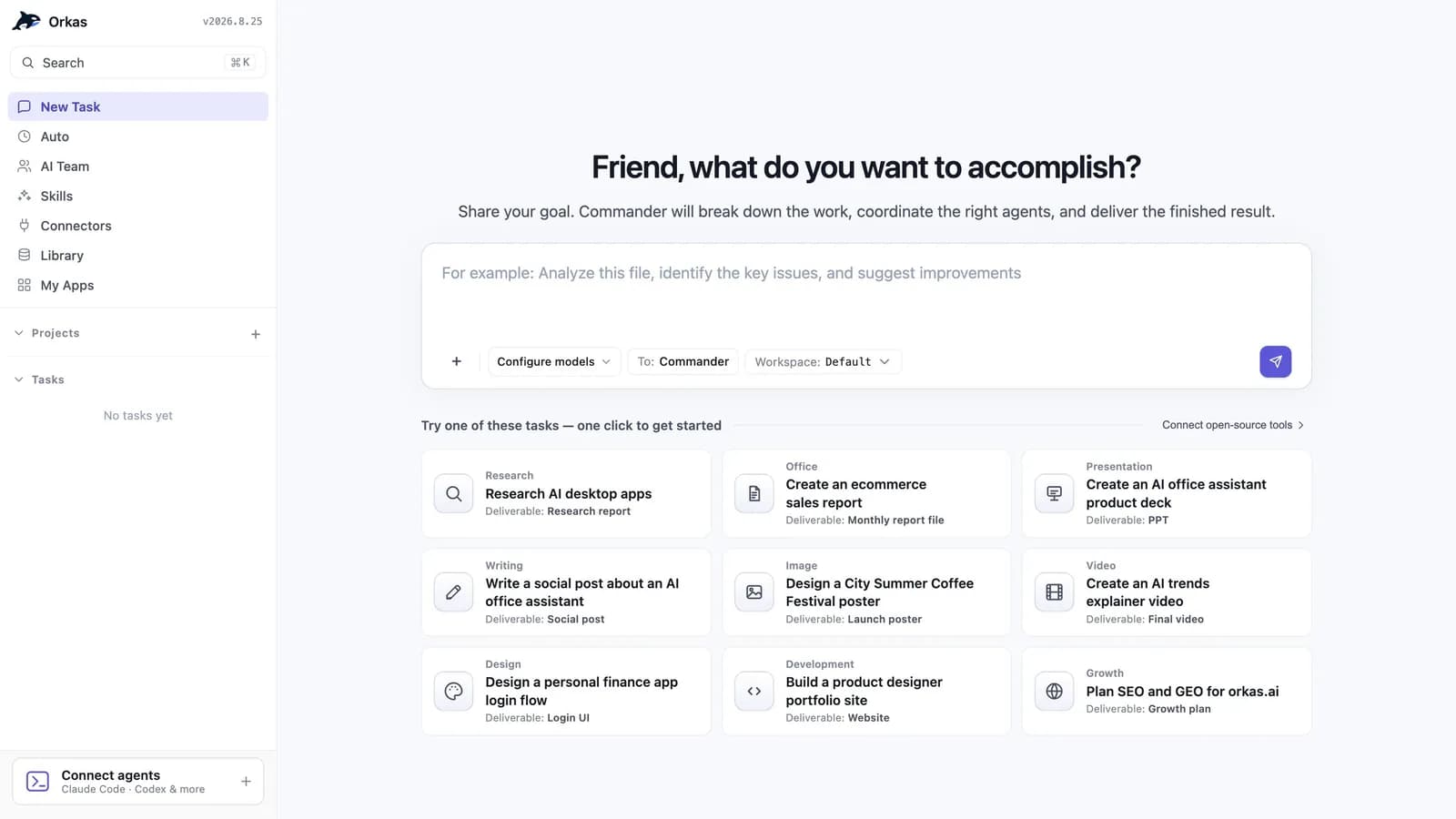
Preparing a project report often requires gathering documents, distinguishing facts from hypotheses, and converting scattered notes into understandable decisions. An AI conversation can help, but it loses utility if the result does not indicate where each statement comes from or if it forces you to reconstruct the context for every request. Orkas offers a desktop workspace to organise these materials and coordinate tasks with specialised agents.
Starting with a question and a set of sources
Before requesting a report, it is advisable to define the recipient and the decision it should facilitate. For example, a small team might need a weekly project summary: documented progress, pending obstacles, and next steps. Input files could be a tracking sheet, a requirements document, and meeting notes. This is an illustrative example, not the result of a test conducted with client data.
In an Orkas project, you can store instructions and reusable context. A useful instruction would be: "Prepare a report for Friday's meeting with the selected files. Separate confirmed progress, blockers, and open questions. Indicate the source for each conclusion and do not invent responsible parties or dates." Providing concrete documents and setting a time frame helps evaluate later whether the work meets the brief.
Coordinating work and keeping a reviewable result
Commander is the agent that interprets the objective, plans the work, and can coordinate specialists. OfficeWorker handles documents and spreadsheets; DeepResearcher can investigate a question using sources; PptMaker allows you to prepare a presentation when that format suits the recipient. The availability of each specialist and their tools depends on the configuration. It is not necessary to convert a simple report into a chain of agents: the goal is to obtain a deliverable that can be reviewed.
For the weekly example, a reasonable output structure would have four sections: executive summary, progress with references, blockers with missing information, and proposed next steps. An illustrative entry might say: "Blocker: need to confirm the deliverable acceptance criteria; source: questions section of the requirements document; proposed next step: request its validation." Thus, the proposal remains distinguished from an already approved commitment. If the documents do not allow the responsible party to be identified, the report must maintain that data as pending.
The value of an editable file is that the team can correct it before distributing it. When reviewing the result, it is advisable to check the figures against the original sheet, open the references, and verify that no proposal is presented as a decision. A subsequent presentation should inherit these same verified conclusions, rather than adding new statements just to complete slides. AI does not replace this review nor does it guarantee that all citations are correct.
What working with local files entails
Orkas is an open-source project with an MIT licence and a local approach: working files, history, and results remain on the device by default. This makes it easier to keep a project's context close to its materials. However, using a remote model provider or an external tool may send the content necessary for the task to them. Activating optional synchronisation or collaboration services also changes the scope of shared data.
The user can choose providers compatible with their own API keys or use the models managed by Orkas. Certain compatible connection points for local models are also supported, depending on their configuration and capacity. This does not mean that any model can perform all tasks, nor that all functions work offline. The basic application is free; model consumption and optional services may incur costs.
A first, limited request
To assess whether this method fits, it is practical to start with a few non-sensitive documents and a short report. Defining the format, sources, and review criteria in advance allows you to compare the deliverable with the objective. If the process proves useful, project instructions and reusable skills can preserve the method for subsequent requests. Documentation, download options, and public code are available at the official Orkas website.