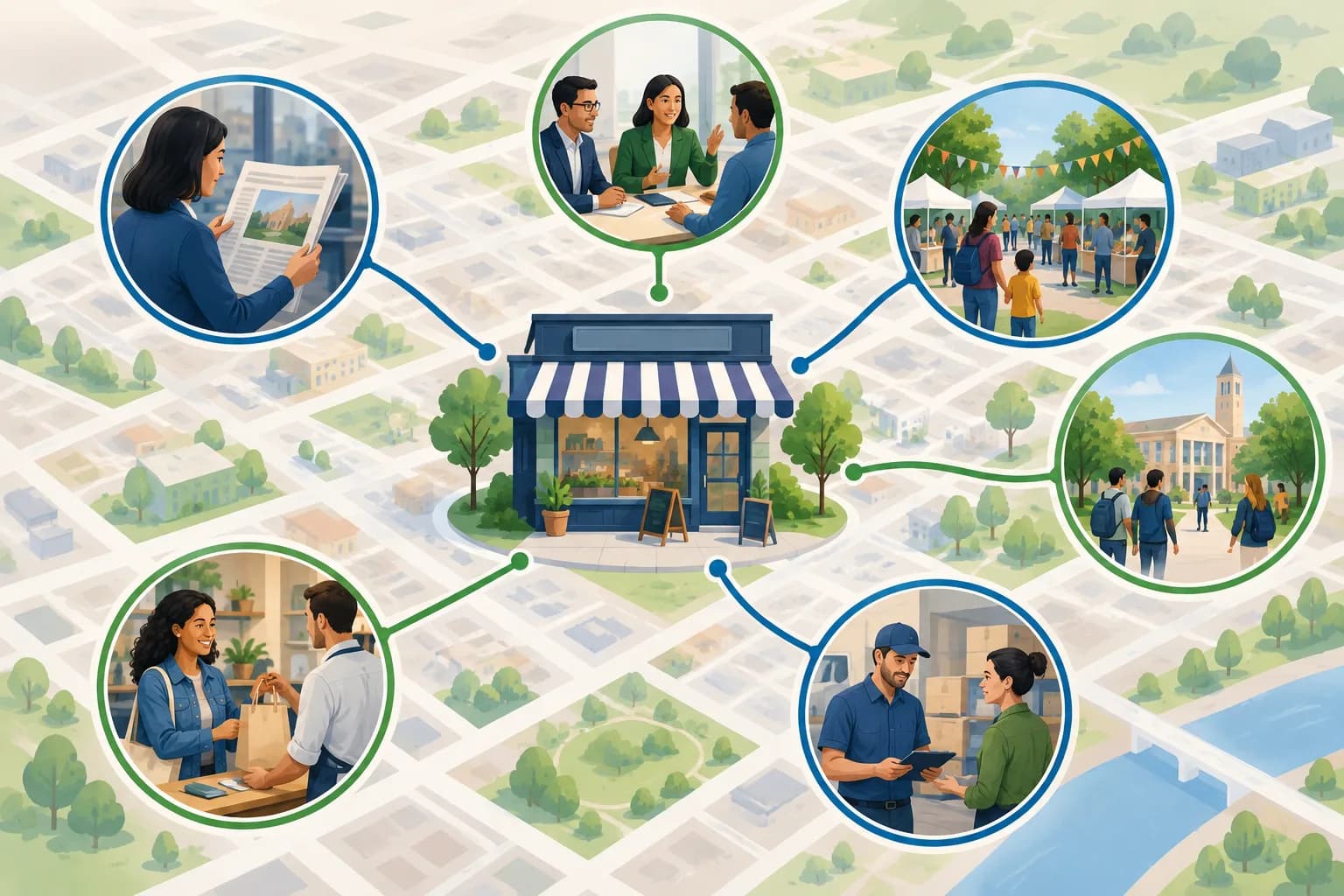
Backlinks for local businesses should not be viewed as a race to accumulate domains. For a company operating in a specific town, region, or neighbourhood, it is usually more sensible to aim to appear in places where a nearby audience already exists: local media, associations, educational entities, collaborators, event organisers, or sector-specific resources with real utility.A link does not replace a good service, a clear website, or a well-managed Google Business Profile. Neither does it guarantee visibility in Google Search. However, it can provide brand discovery, referral visits, and context signals when it comes from a page related to the activity or the territory. The key is simple: the mention must make sense to the person visiting the linking page.
Backlinks for local businesses: what counts as a relevant link
A backlink is a link from another website to yours. A
local mention, on the other hand, may be limited to citing the company name, its details, or its participation in an activity without including a hyperlink. And a local citation usually refers to the consistent presence of basic business data, such as name, address, and telephone number, on third-party sites.All three things can be useful for a digital presence, but they are not equivalent. An editorial link within a news story about a project you have participated in has a different context to an automatic listing in a generic directory. In the same way, a reference on a professional association's page can be valuable if the entity is linked to your sector or area, even if it is not a massive website.
When evaluating local SEO and links, prioritise these questions:
Does the website have a recognisable relationship with my activity, my audience, or my area?
- Does the content where the link would appear solve a need for the reader?
- Is the page well-maintained, active, and does it offer identifiable information?
- Does the collaboration exist in reality, even if the link is not published?
- A relevant link does not need to carry forced anchor text. In many cases, the brand name, the URL, or a natural phrase like “more information about the project” is sufficient. Repeatedly using commercial terms in anchors artificially is a poor foundation for a sustainable strategy.
__PG_TOKEN_0__. Turn local collaborations into editorial opportunities
The most accessible starting point usually lies in the relationships the business already maintains. Suppliers, distributors, professional clients, shared spaces, technology partners, or complementary companies may have project pages, use cases, collaborator directories, or resource sections.
The proposal should not be “put a link to my website”. It is more useful to propose a piece that improves the available information. For example:
A renovation company can document a solution applied to a work project with a supplier, explaining materials, process, and maintenance.
- A consultancy can collaborate with a business association on a basic guide for new self-employed people in the area.
- A specialist shop can participate in a product selection or recommendations prepared by a local partner.
- A B2B business can provide a technical explanation for a joint project page.
- Before contacting, check if the other party publishes their own content and what format they use. If they only have a minimal corporate page, perhaps there is no reasonable editorial opportunity. If they publish cases, news, or resources, propose a specific, verifiable contribution that is useful for their visitors.
How to make a proposal that does not seem like spam
Personalise the message and demonstrate that you understand the entity's activity. Summarise the idea in a few lines: what content you are proposing, why it may interest their audience, and what material you can provide. Only include data, images, or explanations if they are real and have authorisation when necessary. Do not send the same email to dozens of recipients changing only the name.
__PG_TOKEN_0__. Create resources that local entities want to recommend
Local content works best when it covers a specific need that other organisations also detect. You do not need to produce a large report for every campaign. Often, a well-defined resource has more chances of being shared than a generic guide about the sector.
Some ideas applicable to different businesses are:
A practical guide to preparing for a procedure, a visit, or a frequent hiring process in your city.
- A seasonal maintenance calendar adapted to the area's usual conditions, if you can base it on your professional experience without making non-verifiable claims.
- A downloadable checklist for clients, students, or small businesses.
- A thematic map or directory created with transparent criteria and verified data.
- An FAQ page for a recurring local problem.
- Chambers of commerce, professional associations, training centres, non-profit organisations, and collaborating companies can recommend resources if they fit their objectives. But the content must be able to stand on its own. Creating an empty page with the sole intention of inserting links rarely generates editorial interest.
If you work with data, explain its origin, period, and limitations. Do not turn internal observations into general conclusions, nor present estimates as facts. Trust is especially important when the resource can be cited by third parties.
__PG_TOKEN_0__. Participate in events, associations, and community projects
Sponsoring, collaborating in, or attending an event can lead to a web mention, but that should not be the only reason to get involved. Participation makes sense when it brings something real: knowledge, resources, logistics, space, materials, or transparent financial support.
Event organisers, sector associations, town councils, educational centres, and cultural entities often publish programmes, collaborator pages, or post-event summaries. If your participation is relevant, it is reasonable to ask for the information about the project to be accurate and for it to link to a useful page on your website where appropriate.
Instead of always linking to the homepage, prepare a coherent destination: a page about the workshop taught, a complementary resource, registration, a collaboration case, or an explanation of the related service. This way, the link offers continuity to the user.
Avoid agreements where the sponsorship only appears to be a link buying-and-selling scheme. Transparency, fit with the community, and content utility must come before any SEO expectations.
__PG_TOKEN_0__. Get mentions in local media through real news
Local media receive many promotional communications. To grab their attention, you need a novelty with interest for the audience, not just a commercial offer. It could be the opening of an activity with local impact, a community initiative, an educational collaboration, a change that affects the neighbourhood, or practical information linked to a current affair.
A useful press release answers the essentials quickly: what is happening, where, when, who it affects, and why it deserves attention. Add a contact person available to provide more information and verifiable materials. If there is a spokesperson, they must be able to explain the matter clearly, not just repeat advertising messages.
The link, if published, depends on the media's editorial criteria. It is not advisable to demand it or treat coverage as a guaranteed service. You can facilitate a reference page that expands on the news: event information, authorised images, project details, or a resource for readers.
News stories that tend to have more reach than a promotion
Joint projects with local entities.
- Open activities with a clear utility for residents, professionals, or students.
- Resources that solve a practical need linked to the territory.
- Own and verifiable information that helps to understand a local topic.
- Advertising can be legitimate, but it must not be disguised as news. Separating both levels protects the relationship with local journalists and avoids unbelievable campaigns.
__PG_TOKEN_0__. Use guest posting and collaborations with criteria
Publishing as a guest can bring visibility if the host website has a real audience and a clear thematic interest. It is not a formula to place links in series. A valid editorial collaboration starts with a useful question for the host site's readers.
A clinic, for example, could provide prevention recommendations to a local health publication; a logistics company could explain how to prepare shipments for local commerce campaigns; an energy professional could clarify frequent doubts for a neighbourhood association. The article must be informative even if the reader does not visit the author's website.
Be wary of sites that publish texts from unconnected sectors, barely have editorial identity, or seem designed exclusively to accept paid collaborations. Demands to use exact anchors, the accumulation of commercial links in each article, or a lack of transparency about who manages the publication are also warning signs.
__PG_TOKEN_0__. Recover brand mentions and missed opportunities
Before looking for new contacts, review where your business has already appeared. There may be mentions on event pages, articles, galleries, calls, collaborations, or profiles of entities you have worked with. Some do not include a link; others point to an old URL or contain incorrect data.
The easiest request to accept is one that improves the existing page. If an entity mentions an activity you carried out, you can thank them for the publication and point out, with respect, that a specific page would expand the information for their visitors. If there is an error in name, schedule, or address, request the correction without turning the message into a complaint.
It is also advisable to review broken links that point to old pages on your own site. Recovering a relevant URL through an appropriate redirect or updating the destination avoids losing utility for users and references already obtained.
How to evaluate a local backlink before seeking it
Not every opportunity is worth the time. A simple filter avoids falling into link spam or dedicating resources to websites with no relation to your business.
Relevance:
- the website and the page have a thematic, geographic, or community connection to your activity.Context:
- the link appears within understandable content, not isolated among dozens of links.Activity:
- the site maintains identifiable information and a recognisable editorial or institutional activity.Utility:
- the person who clicks finds a page that expands on what they were reading.Transparency:
- the collaboration, sponsorship, or commercial relationship can be explained without ambiguity.Discard mass publication proposals, systematic exchanges, link packages, duplicate texts, or websites that promise positioning results. More quantity does not equal a better local link building strategy. A damaged relationship with an organisation in your environment can cost more than any link obtained.
Plan for __PG_TOKEN_0__ days to start without depending on directories
Week 30:
- create an inventory of suppliers, professional clients, associations, events, media, and projects with which a relationship already exists. Also note found mentions and broken links.Week __PG_TOKEN_0__:
- choose a single useful asset: a local resource, a project page, or a verifiable news story. Review it before disseminating it and make sure it responds to a specific need.Week __PG_TOKEN_0__:
- select a short list of qualified contacts. For each one, define why the content might interest their audience and which page would be the most logical destination.Week __PG_TOKEN_0__:
- contact them in a personalised way, record responses, and carry out prudent follow-up. Update the list with links, mentions, future collaborations, and lessons learned.This process is deliberately small. It allows you to check which relationships and content generate a response before expanding efforts. Consistency and the quality of the contact are usually more useful than a very broad and impersonal campaign.
What to measure and what not to expect
Measure results in several layers. Count the relevant links and mentions obtained, but also observe referral traffic, queries coming from those pages, event participation, and commercial opportunities in which local visibility has played a part.
It is advisable to record the URL that mentions the business, the linked page, the type of relationship, the date of publication, and subsequent actions. That history helps to detect which kind of collaborations bring quality visits or contacts.
Do not expect immediate positions or attribute any visibility change to a single link. Organic performance depends on numerous elements, among them the technical quality of the site, content, competition, and search intent. Local links are one piece of a broader digital presence, not a shortcut.
Conclusion: local relevance before quantity
The best backlink strategy for local businesses is less like an automatic acquisition campaign and more like a work of relationships and useful communication. Participate in real projects, create resources that deserve to be recommended, provide reliable information to media and collaborators, and look after existing mentions.
When the link is a consequence of providing value, it fits better on the web that publishes it and also in the experience of the person who follows it. That is a much more solid foundation than pursuing massive lists or promises of quick results.
__PG_TOKEN_0__