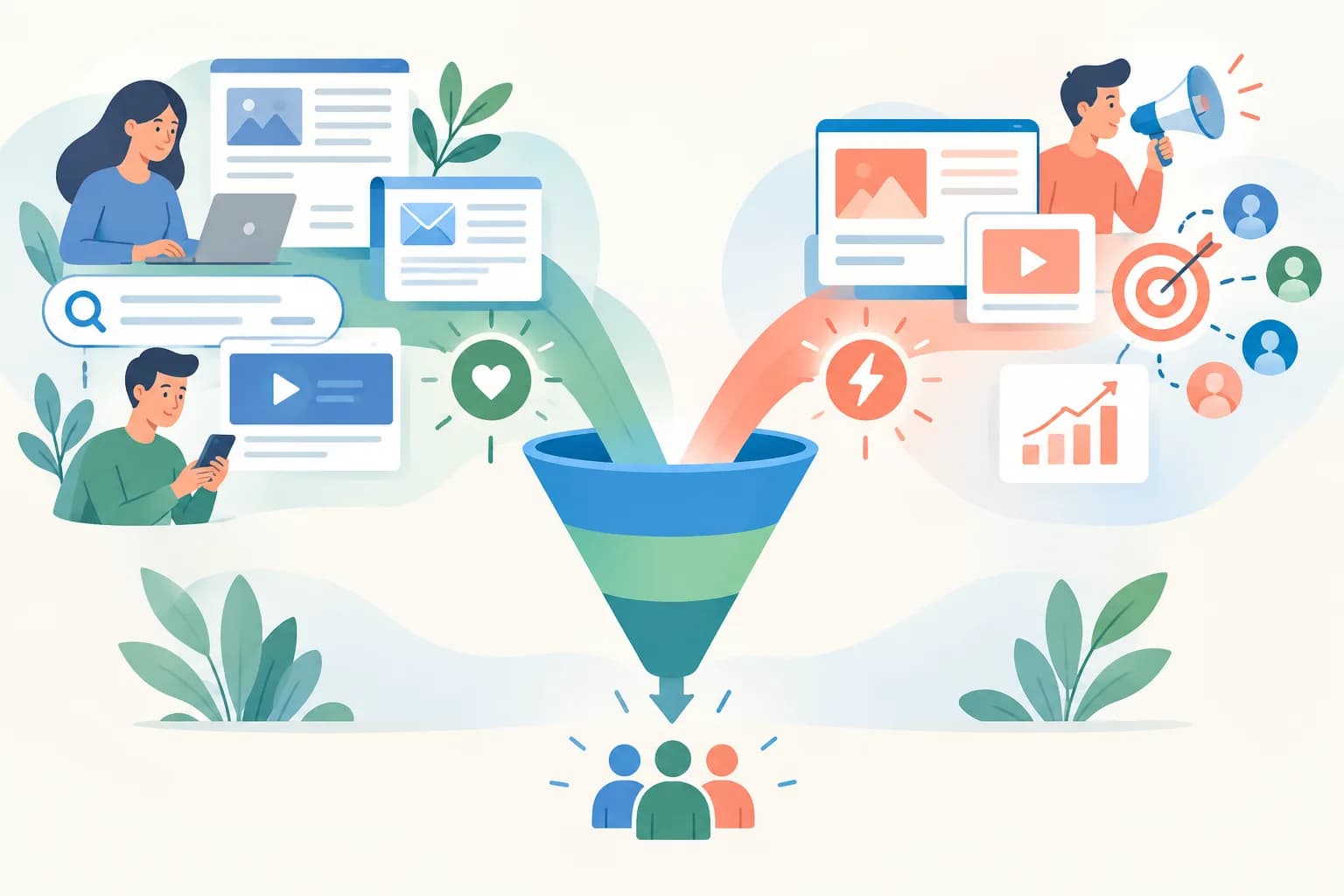
Choosing between content marketing and advertising should not be seen as a rivalry. Both can help a business gain online visibility and capture opportunities, but they do so in different ways: content builds an owned presence and advertising buys reach for a specific period.
For an SME, the decision depends on four questions: what objective it is pursuing, how urgently it needs results, what budget it can sustain and how much time it can dedicate to creating and improving its digital assets. The answer is rarely “only one thing”. The most useful approach is usually to assign a clear function to each tool.
Content marketing vs advertising: they do not compete for the same thing
The content marketing consists of creating and distributing materials that solve questions, explain a need or help to make a decision. A corporate blog post, a guide, a newsletter, an explanatory video or a useful post on social media can form part of a content strategy.
The digital advertising uses paid ads to show a message to a specific audience. It can appear in search engines like Google Search, on social media or in other advertising spaces. Its purpose is usually to accelerate the reach of an offer, a landing page or content.
The main difference lies in what is being built. Well-worked content can continue to be useful and attract visits or enquiries after its publication. An ad depends on active investment: when paused, the traffic it generates usually decreases as well.
Neither of the two paths guarantees sales, organic positions or profitability on its own. A campaign needs a clear offer and a coherent conversion journey. Content needs to answer real questions, be distributed and be reviewed with good judgement.
What content marketing contributes
Owned content is especially valuable when the client needs information before buying. Not all decisions are resolved with a brief ad. In professional services, complex products or purchases that require comparison, explaining the problem and the solution well can make the difference.
- Trust and authority: responding clearly to frequent questions demonstrates knowledge and reduces uncertainty.
- Organic visibility: useful pieces can support SEO by covering searches related to the audience's real needs.
- Reusable assets: an article can become posts for social media, a newsletter sequence, a commercial resource or a basis for a service page.
- Accompanying the buyer's journey: not everyone is prepared to make contact on the first visit. Content can maintain interest until a concrete need exists.
- Better commercial conversation: a person who has already understood the problem and the company's approach usually arrives with more precise questions.
This does not mean publishing non-stop. A content strategy is not measured by the number of blog entries, but by their usefulness. A small business can advance more with a few well-chosen pieces than with an intense calendar of generic topics.
It is worth starting with questions that appear in calls, quotes, emails and meetings: what the service includes, how to choose a solution, what errors to avoid, what requirements exist or what differentiates one alternative from another. That is where the material closest to the audience's intent is usually found.
What digital advertising contributes
Online advertising allows a message to be placed in front of an audience without waiting for the content to gain reach on its own. It is useful when there is a need to make a launch known, promote a specific offer, check if there is interest in a service or boost online acquisition in a specific area.
With platforms like Google Ads or Meta Ads, a company can define segmentation criteria and test messages, creatives and calls to action. That testing capability is one of its great advantages: it allows you to obtain signals about which proposal attracts attention and which does not.
- Distribution speed: it can generate visibility from the start of a campaign, although the result will depend on the configuration, the message and existing demand.
- Focus control: it helps to direct an action to a location, an audience profile or a specific need.
- Validation: it serves to test whether an offer, a landing page or a call to action arouses interest.
- Remarketing: it can help to recover the attention of people who already visited a page or interacted with a brand.
But paying for clicks or impressions does not correct an unclear proposal. Before investing, the landing page must be reviewed: it must explain what is offered, who it is for, what action is expected and what happens after completing a form or making contact.
Key differences between content and advertising
The following comparison helps to decide what role each strategy can assume in the marketing budget.
- Timeframe: advertising can accelerate reach; content usually needs more time to consolidate visibility and trust.
- Cost: ads require direct investment and tracking. Content may not require the purchase of media, but requires research, production, editing, distribution and maintenance.
- Control: in advertising, there is greater control over who you try to reach and for how long. Organic reach depends on less predictable factors.
- Duration: a campaign works as long as it maintains budget and suitable conditions. Relevant content can continue to provide value, although it must be reviewed when it becomes outdated.
- Intent: content usually educates, resolves questions and accompanies. The ad seeks to drive a specific action: visit a landing page, request information, download a resource or buy.
- Measurement: in ads, you observe data such as clicks, cost per result and conversions. In content, positioned queries, subscriptions, interaction and assisted conversions also matter.
Which strategy is suitable according to the objective
To build authority and owned presence
Prioritise content if the business needs to explain its speciality well, works with considered purchase decisions or frequently receives the same questions. A corporate blog, complete service pages, explanatory cases without confidential data and a newsletter can create a solid foundation.
To validate an offer or generate short-term demand
Advertising may be suitable if there is a concrete proposal and a measurable action. For example, a company launching a new service can test several messages with a limited budget before dedicating months to developing a content campaign around an unclear idea.
For a new brand
A gradual combination is usually more sensible. First, it is advisable to have a clear website, a functional landing page, basic information about services and some pieces that answer essential questions. Afterwards, a targeted campaign can lead traffic towards those assets and provide learning.
For a launch
Ads can provide initial reach, while content expands the explanation. A post that details the problem, a frequently asked questions page or a downloadable resource can resolve objections that a brief advertising format does not manage to cover.
For a local company
It is useful to combine content focused on local needs or the type of client with geolocated campaigns. Content helps to demonstrate closeness and experience; advertising allows for concentrating the dissemination where the company actually provides service.
For a business with a low budget
The priority is to avoid dispersion. It is preferable to create a small but useful base —service pages, frequently asked questions and a central piece of content— and reserve ads for specific tests. You do not need to be present in all channels to start learning.
How to combine content and advertising without wasting resources
A simple integration can follow these steps:
- Define an audience and a need. Instead of addressing “everyone”, specify who you want to help and what problem you want to solve.
- Choose an offer and a main action. It could be requesting a quote, booking a consultation, requesting information or downloading a useful resource.
- Create a base piece. Develop a landing page or content that responds in depth to that need and connects with the offer.
- Distribute first in owned channels. Share it in newsletters, social media, commercial conversations and other spaces where there is already an audience.
- Use advertising selectively. Promote the piece or the offer to a coherent audience, with an investment limit and a clear hypothesis to test.
- Reuse what works. An article can lead to brief posts, an email, a commercial presentation or new frequently asked questions sections.
- Review and adjust. Maintain actions that generate learning or business results and discard those that only add activity.
Advertising does not always have to lead to a direct sale. In some cases, it makes sense to send traffic to useful content for audiences who are still researching. Later on, remarketing or the newsletter can support a next stage of the sales funnel.
Metrics to know if the strategy works
Measuring only visits or clicks can provide an incomplete picture. Each channel must be evaluated according to its function within the buyer's journey.
- In content: review impressions and queries in Search Console, qualified visits, interaction, subscriptions, contacts and conversions in which the content has participated.
- In advertising: observe reach, clicks, cost per result, conversion rate, quality of leads and subsequent behaviour on the web.
- In business: connect the activity with commercial opportunities, sales, acquisition cost and value that clients provide over time.
Tools like Google Analytics can help to understand the users' journey, but it is advisable to interpret the data with caution. A conversion can be influenced by several contacts: a search, an ad, a visit to the blog and a recommendation. Attributing all the credit to a single channel usually leads to poor decisions.
Frequent errors when choosing between content and advertising
- Expecting recently published content to attract business immediately.
- Investing in ads without a defined offer or a landing page prepared to convert.
- Confusing high traffic volume with quality potential clients.
- Publishing generic topics without listening to the target audience's questions and objections.
- Interrupting a campaign or content strategy before gathering enough learning.
- Valuing an action only by reach metrics and not by its relationship with commercial objectives.
- Seeking guarantees of rankings, sales or return on investment in environments that depend on multiple variables.
Conclusion: what to prioritise in an SME
An SME starting out should first build a minimum base of owned presence: a clear proposal, useful pages, a simple way of making contact and content that answers the most relevant questions. That base improves both organic positioning and the effectiveness of future campaigns.
Online advertising comes into play when there is a need to accelerate an action, reach a specific audience or validate a proposal. Its best use is not to replace SEO or owned content, but to complement a visibility strategy with defined objectives.
Start with a concrete need, a controlled budget and a metric that matters to the business. Afterwards, review which combination of organic content and paid ads generates better conversations, opportunities and learning. The right strategy is not fixed: it changes with the maturity of the business, the demand and the available resources.