When a company has news to communicate, the initial question is usually simple: is it enough to publish a free press release, or is it worth paying for distribution? The answer depends less on the chosen format than on three factors: the relevance of the news, the target audience, and the resources available to promote the announcement.
Both paths can form part of a useful strategy. Free publication allows for online visibility of news and creates a public reference point. Paid distribution can provide planning, segmentation, or operational support, depending on the provider and the service contracted. Neither, on its own, replaces well-focused news.
Free press release or paid distribution: what are you actually comparing?
Before deciding, it is worth separating three concepts that are often confused:
- Publication:hosting the press release on a platform, newsroom, or corporate page so that it can be consulted online.
- Distribution:delivering the press release to a database of contacts, media outlets, journalists, or defined audiences.
- Editorial coverage:successfully ensuring an independent media outlet considers the news relevant and decides to cover or publish it.
Publishing a release does not imply active distribution. Distributing it is not equivalent to achieving journalistic coverage. And paying for a distribution service does not guarantee that a media outlet will publish the content, nor that it will include links back to the company.
In a free publication, the company usually distributes its release via an open channel and subsequently shares that page from its own media. In paid distribution, the benefits can vary: some services offer submission management, segmentation options, additional formats, or reports. That is why it is important to review exactly what each proposal includes before comparing prices.
Free publication: advantages and limits
Publishing a free press release is a reasonable option for SMEs, freelancers, and entrepreneurs who need to start communicating without expanding their communication budget. It also serves to maintain an organised archive of corporate announcements, launches, collaborations, events, or company milestones.
What it provides
- Low entry barrier:allows for communicating news without cost being the primary obstacle.
- Message control:the company prepares the text, chooses when to make it public, and retains an accessible reference for clients, partners, or professional contacts.
- Support for owned channels:the publication can be shared via social media, a newsletter, the corporate website, or through direct contact with interested parties.
- Practical learning:helps to identify which topics generate queries, visits, or responses, and which need a clearer approach.
On platforms like PublicaGratis.es, a publication can function as a communication asset: a specific page to which you can refer when announcing news. Its utility increases if the content is well-written, responds to genuine news, and is accompanied by your own distribution efforts.
What not to automatically expect
Visibility within a platform is not equivalent to appearing in general or specialised media outlets. There is no automatic SEO improvement from publishing a release, nor an implicit promise of traffic, links, or external mentions.
A release with a generic title, lacking verifiable data, or focused solely on self-promotion will struggle to generate interest, whether free or paid. Journalistic writing remains decisive: you must explain what happened, why it matters, and who is affected.
Paid distribution: what it can offer
Paid distribution makes sense when the company needs to expand its distribution capacity or is working on a campaign requiring greater coordination. It does not buy editorial interest, but it can save time and facilitate the release reaching selected recipients, always depending on the conditions of the chosen service.
Possible contributions include better organisation of the submission, options for segmentation by topic or region, support in managing distribution, and access to complementary formats or channels. These features are not universal: they must be verified in each case.
It can be especially useful if the team lacks a communication department, has little time to prepare contacts, or needs to coordinate news with a specific date, such as an event, a launch, or a corporate milestone. Even so, budget does not correct a poor proposal. If the message lacks interest for the audience, wider distribution may yield few results.
The right question is not “does paying guarantee publications?”, because the answer is no. It is more useful to ask: what distribution work does this service resolve and what audience does it help reach?
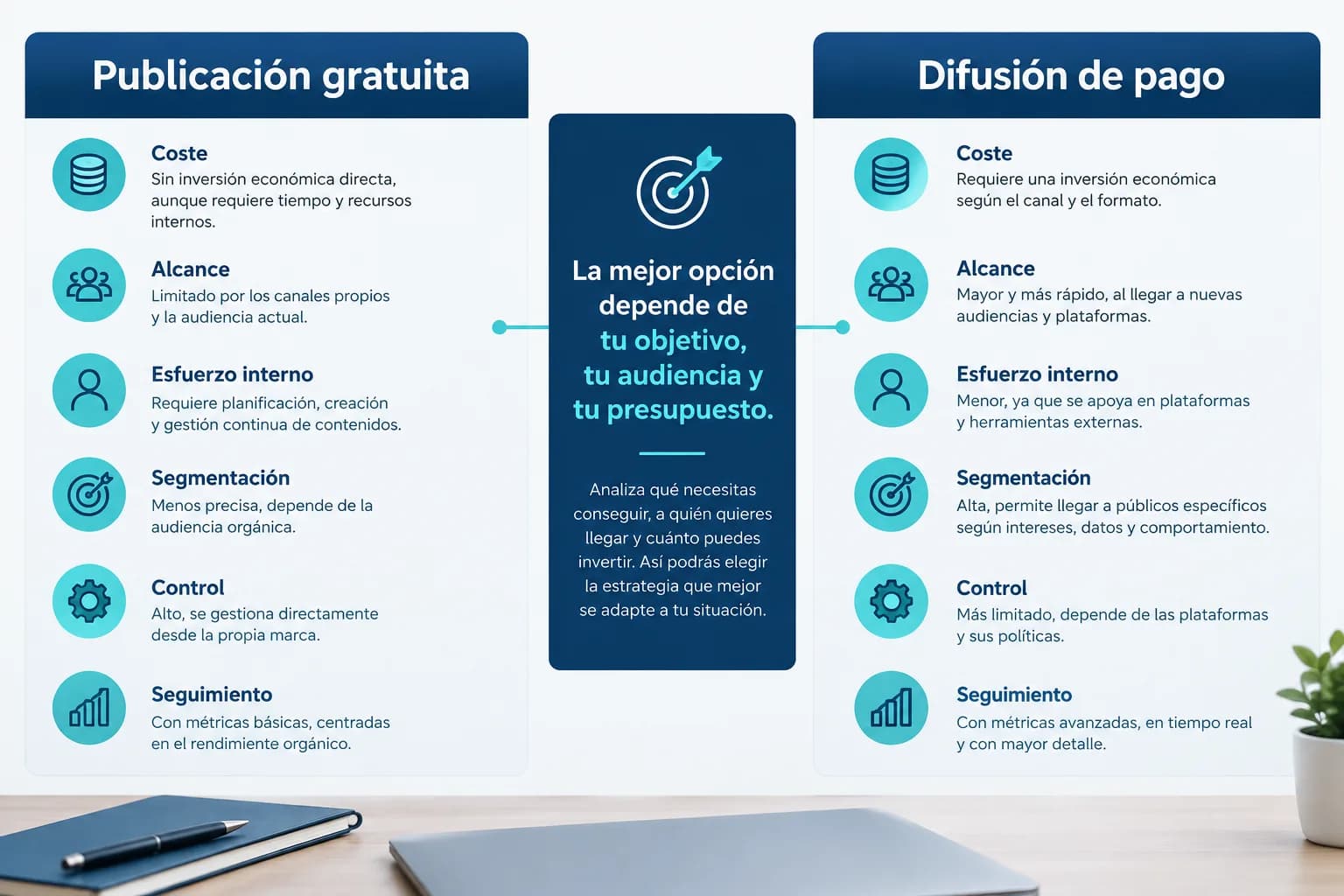
Comparison: free versus paid
| Criterion | Free publication | Paid distribution |
|---|---|---|
| Direct cost | Reduces or eliminates the cost of publishing, depending on the channel. | Requires budget and conditions defined by the provider. |
| Internal effort | The company usually handles more subsequent distribution. | May reduce distribution tasks, depending on the service. |
| Content control | High over the text and the time of publication. | Can also be high, although it depends on the contracted process. |
| Reach | Depends on the platform and the owned channels used. | Can be planned with more orientation, without promising editorial results. |
| Segmentation | Normally more limited or manual. | May exist if the service includes audiences, sectors, or regions. |
| Tracking | Requires internal review of reactions and queries. | May include tracking information; it is worth confirming what metrics are offered. |
| Expectation risk | Confusing publication with media coverage. | Confusing payment for distribution with a guaranteed editorial publication. |
Credibility does not depend solely on whether or not you pay. It is built by the accuracy of the release, the quality of the sources, the utility of the information, and the consistency between what is announced and what the company can demonstrate.
When to choose a free publication
The free option fits well when the main goal is to make news public and have a stable page to share it. For example, it may be sufficient to report on a new line of services, a local opening, participation in an initiative, a relevant change for clients, or your own invitation.
It is also a good entry point for businesses still building their content strategy. It allows you to test approaches, organise communications, and verify if there is internal capacity to maintain a routine of distribution.
To improve your options, it is advisable not to leave the release isolated. Share it with your own audience, incorporate it into the company's newsroom if one exists, and make direct, selective contacts when there are media or professionals for whom the topic is truly relevant. Manual distribution does not have to be massive: it is usually more useful to select a few relevant recipients than to send the same text indiscriminately.
When to consider paid distribution
It may be worth considering paid distribution when the news is linked to a specific opportunity and the cost is justified by the potential value of reaching a defined audience. This can happen with a launch that needs visibility in a sector, an event with an upcoming date, corporate expansion, or a campaign involving multiple channels.
It is also an alternative to consider when the main constraint is not the quality of the news, but the team's time. If no one can organise contacts, adapt the message, or follow up, outsourcing part of the distribution can free up internal resources.
Before contracting, ask for clarity on practical aspects: intended recipients, segmentation possibilities, submission format, handling of images or materials, available metrics, timelines, and conditions. Avoid basing the decision on ambiguous phrases about “great reach” if how the distribution is handled is not explained.
Can both strategies be combined?
Yes. In fact, for many small businesses, a gradual combination is more sensible than choosing just one path permanently. An online publication can serve as a public reference, while distribution is concentrated on the contacts and channels where the news is most likely to be relevant.
The key is to adapt the approach. A client may be interested in the practical effect of the news; a specialised media outlet, in the sector trend; a local entity, in the impact on its environment. It is not about copying the same text everywhere, but about maintaining the facts and adjusting the angle.
After each action, review basic signals: queries received, requests for information, mentions, event attendance, or reactions from your own audience. Not all releases pursue the same result, so it is advisable to evaluate each one with criteria consistent with its initial objective.
How to decide: checklist before investing
- Define a priority objective: inform, gain online visibility, support a campaign, attract attendees, or facilitate contacts.
- Describe with precision who you want to reach and why that audience might be interested in the news.
- Evaluate if there is a verifiable, current, and concrete fact behind the release.
- Calculate the available budget and the time you can dedicate to distribution and follow-up.
- Review what each service includes: publication, distribution, segmentation, additional materials, and metrics.
- Do not interpret distribution as a guarantee of editorial coverage, links, or commercial results.
- Choose the alternative that resolves your real need, not just the one that seems cheapest or broadest.
Conclusion: the best option depends on the news and the objective
In the comparison between a free press release and paid distribution, there is no universal answer. Free publication may be sufficient to start, provide context to news, and reinforce owned channels. Paid distribution can provide organisational capacity and a more planned reach when a specific audience and an opportunity exist that justify it.
The decisive factor is to avoid two mistakes: thinking that publishing is equivalent to appearing in the media, and believing that paying transforms any communication into news. First prepare a clear, relevant, and demonstrable message; then, choose the channel that fits your resources. If you have already decided that you need an open publication, you can publish a free press release on PublicaGratis.es as a starting point to make your release visible and share it as part of your communication strategy.