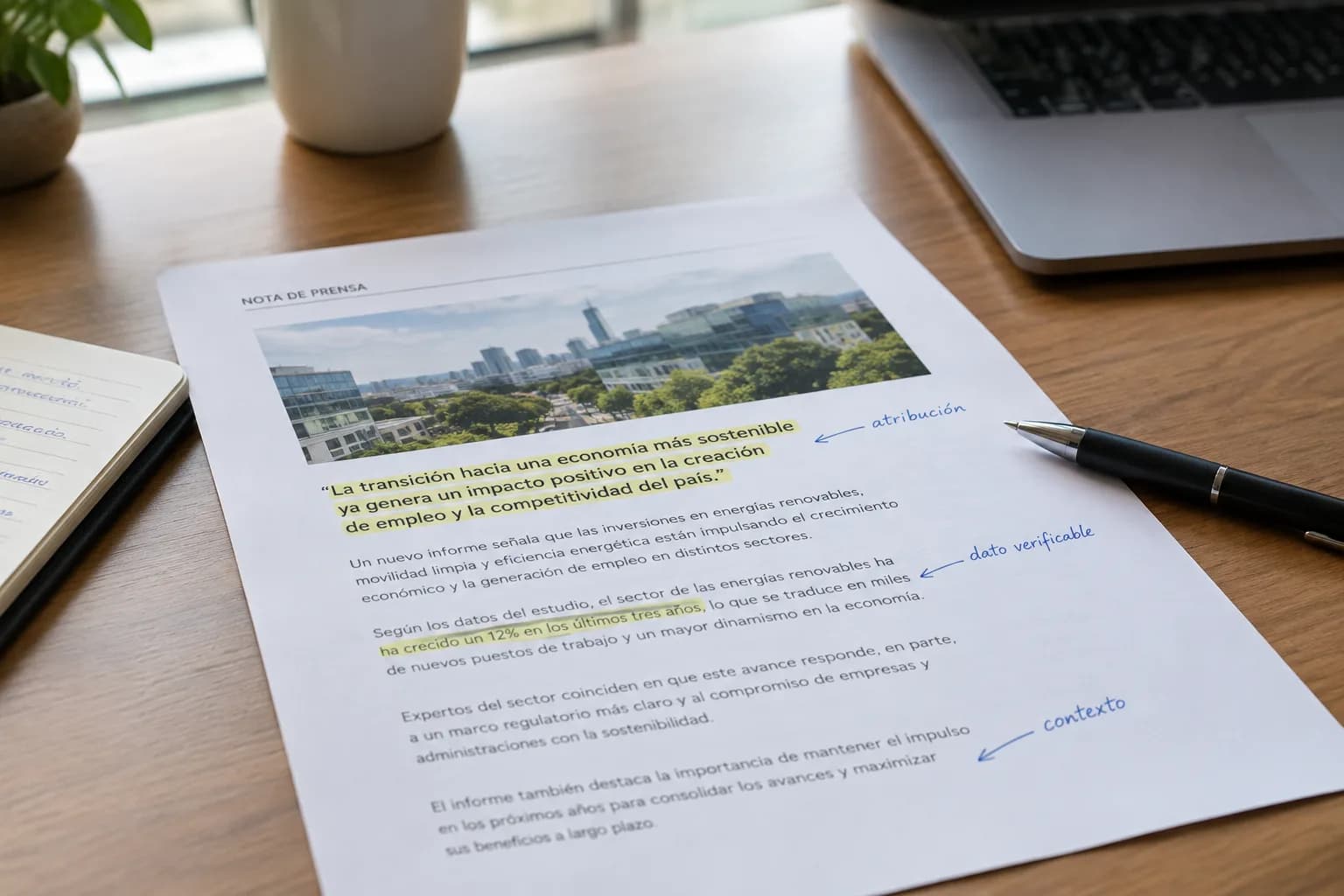
A spokesperson quote can add depth to a press release or turn it into an advertising message that is hard to use. The difference does not lie in sounding solemn or accumulating praise for the company. It lies in adding a concrete explanation: what a decision implies, what context helps to understand data, or what consequences a piece of reported news might have.
In corporate communication, a statement works best when it treats the journalist and their audience as readers who need information, not as recipients of a campaign. It must be clearly attributable, hold up if verification is requested, and make sense even if a media outlet decides to publish only a fragment.
What a spokesperson quote brings to a news story
A direct quote is a statement attributed to an identifiable person, usually a company spokesperson, a manager, or someone responsible for the area related to the news. It does not replace the essential facts of the release: it interprets or completes them.
A good corporate statement can serve several functions:
- Explain the reason for an announced decision.
- Clarify how a development affects clients, teams, suppliers, or the sector.
- Provide context for data already documented in the body of the release.
- Specify the scope of an initiative without presenting expectations as achieved results.
- Express an assessment clearly identified as the spokesperson’s opinion.
For example, if the headline reports the opening of a new service line, the quote does not need to repeat that the company has opened it. It can explain what identified need motivated the decision, what will change in operations, or what the limits of the project are in its initial phase.
Not all press releases require a quote. A brief statement on an administrative fact, a highly technical update, or information that relies entirely on documentation may be clearer without statements. Including an empty phrase just to follow a formula detracts from space and credibility.
The main rule: the quote must say something new
Before approving a quote, compare it with the headline and the lead. If it says the same thing with different adjectives, it is probably unnecessary. The headline answers what happened; the lead summarises the essential data; the statement must take a step forward and answer, for example, why it matters, what decision lies behind it, or what is expected to happen next.
It is advisable to carefully separate facts from opinions. Verifiable data must be supported by a source, a document, a reviewable internal record, or an explanation that the company can provide if a media outlet asks. A spokesperson's assessment can also be valid, provided it is not disguised as a fact.
Instead of claiming that a measure is “a success” or “the best solution on the market”, an informative quote can describe the criteria used to adopt it. Instead of assuring that a development will “transform the sector”, it can indicate what specific problem it intends to address. Prudence does not weaken the message: it avoids promises that the available information does not support.
How to build a spokesperson quote step by step
1. Define the question it must answer
Start with a real question that a journalist might ask: why is this decision being taken now?, what has changed from the previous situation?, who is affected?, what evidence supports this priority? The answer guides the statement toward information and avoids it becoming a slogan.
2. Choose a main idea
A quote must have a recognisable core. If you try to explain the origin of the project, its advantages, its schedule, the commercial strategy, and the vision for the future, it will be lengthy and difficult to edit. It is preferable to distribute these ideas throughout the body of the release and, if really necessary, use two separate quotes.
3. Add specific context
Context can be operational, temporal, or related to an identified need. It must be concrete without revealing confidential information or incorporating impossible-to-verify data. If a figure, date, collaboration, or result is mentioned, check that it is documented and that the person quoted has the authority to confirm it.
4. Explain the relevance
Journalistic utility usually appears here. The spokesperson can explain what practical consequence the announced fact will have or what limited objective the organisation is pursuing. Avoid turning this conclusion into a commercial invitation. A press release informs; the call to action, if necessary, has other spaces.
Recommended structure and length
There is no mandatory length, but a brief and focused statement usually facilitates reading and journalistic editing. As an editorial reference, one or two sentences with a single main idea are more manageable than a long paragraph loaded with corporate messages.
A simple structure can be this:
- Fact or context: situate the subject the spokesperson is referring to.
- Interpretation: explain the reason, priority, or concrete implication.
- Prudent scope: indicate the next step or the expected effect without presenting it as a confirmed result.
Attribution also matters. After the quote, or before it, identify the name, job title, and company when that information is relevant: “notes [nombre], [cargo] of [empresa]”. Check that the job title is current and that the person can speak on the matter. Attribution allows the reader to evaluate from what position the statement is formulated.
Examples: from promotional phrase to informative statement
These examples are drafting models, not real statements or claims about specific companies.
Empty praise
Not very useful: “We are very proud to present a revolutionary solution that confirms our commitment to excellence”.
The phrase does not explain what has been presented, what problem it solves, or what information can be verified. It could appear in almost any press release.
More informative: “We have designed this service based on recurring queries from our clients regarding [necesidad concreta]. The first phase will focus on [alcance definido], while we collect information to adjust its development”.
This version explains the origin of the decision and defines its scope. The elements in brackets should be replaced only by confirmed information.
Business decision
Not very useful: “This step consolidates us as leaders in innovation”.
More informative: “The decision responds to the need to coordinate tasks for [area or process] within the same team. We seek to reduce internal duplications and evaluate performance with indicators that we can review during implementation”.
The second formulation does not proclaim leadership. It sets out the reasoning and avoids presenting a future result as already achieved.
Context for data
If the release includes documented data, the quote can help interpret it: “The data reflects the evolution of [periodo o ámbito], but it does not alone allow us to anticipate the behaviour of the coming months. That is why we will maintain the evaluation on [criterio verificable]”.
Thus, the spokesperson provides insight and caution. They do not use the figure as automatic proof of a broader conclusion.
Common errors in company statements
- Using superlatives without proof: “unique”, “leader”, “incomparable” or “revolutionary” require solid evidence and, even then, rarely add information to a news story.
- Promising results: presenting an expectation as an achievement reduces reliability. Distinguish between what has already happened and what the company expects or intends to do.
- Repeating the brand message: a quote is not the place to reproduce a slogan or a commercial description of the product.
- Accumulating internal language: acronyms, names of processes, and technical jargon may be necessary, but they must be explained when they are relevant to a general audience.
- Mixing too many ideas: the more extensive and scattered the statement, the more likely a media outlet is to cut it or discard it.
- Attributing without backing: the spokesperson should not state figures, comparisons, collaborations, or impacts that the company cannot confirm.
How to review a quote before publishing the press release
The final review does not only consist of correcting style. It serves to check that the statement can withstand questions and fits the journalistic treatment of the release.
- Does it provide information different from what is already in the headline and the lead?
- Is it understood by someone outside the company and the project?
- Can every concrete piece of data be verified and explained if a media outlet requests it?
- Is it clear which part is a fact and which part is the spokesperson’s assessment?
- Does the person quoted have the appropriate job title and authority to make that statement?
- Does the tone avoid praise, absolutes, and unproven promises?
- Does the quote make sense if published outside the full context of the release?
A quote from a client, collaborating entity, or external specialist can also be included if there is authorisation to use it and the attribution is precise. In that case, it is advisable to clarify the relationship with the company when relevant and not present a self-interested opinion as an independent validation.
Spokesperson quote, lead, and body of the release: how to avoid repetitions
A press release gains clarity when each element performs a task. The headline communicates the news fact. The lead summarises who, what, when, and where, along with the essential data. The body develops background, details, and elements that allow the information to be verified. The spokesperson quote provides interpretation, context, or an attributed explanation.
That is why it is more effective to write the facts of the release first and prepare the statement afterwards. By knowing what information is already covered, it is easier to detect what the spokesperson’s voice can add. A final edit should remove everything that repeats previous text or only attempts to reinforce a corporate image.
A clear statement does not guarantee publication or media coverage, but it does improve the utility of the material for those who have to evaluate, edit, or check it. That is the most solid criterion for corporate communication: say something relevant, attribute it well, and be able to support it.