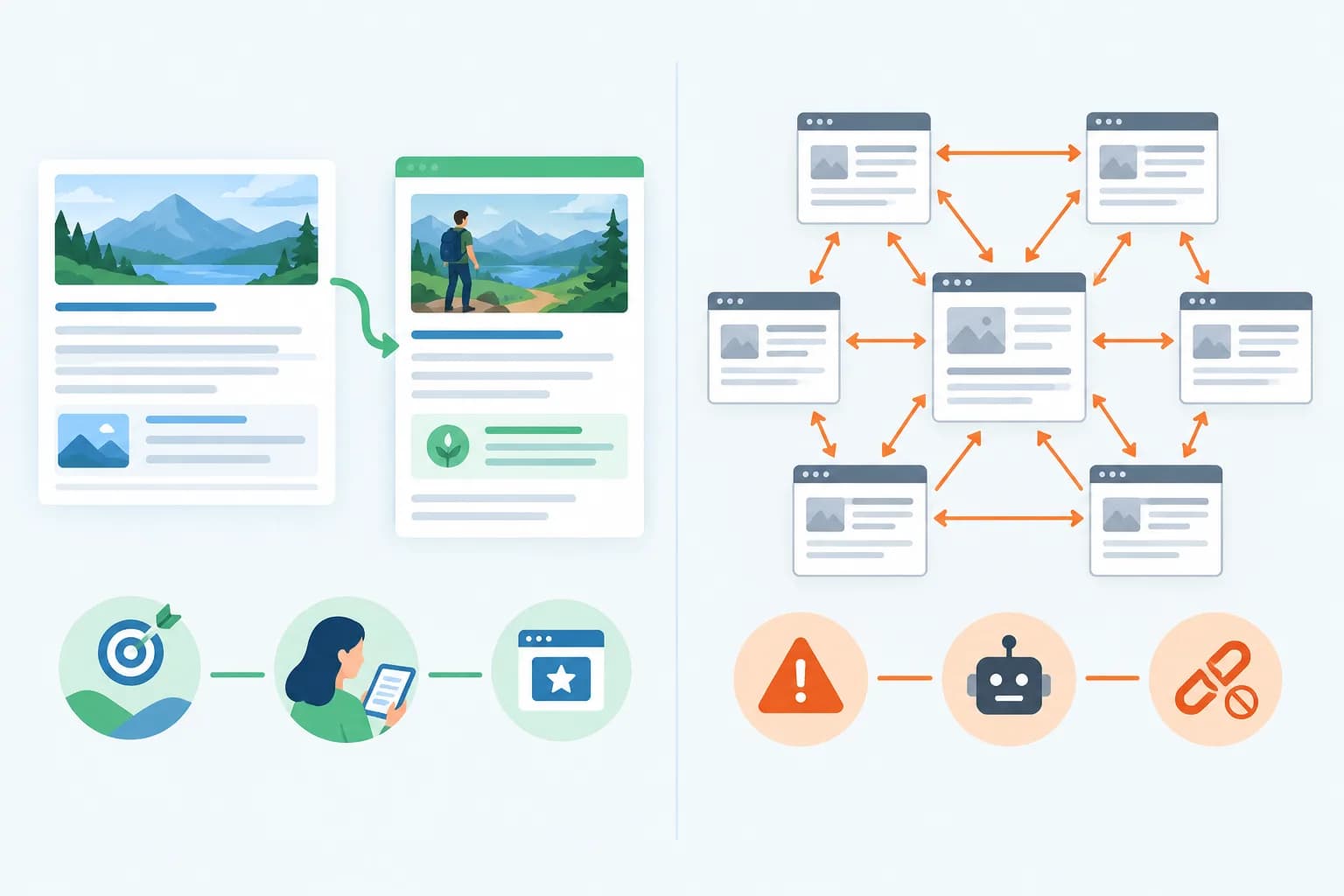
An external link is not valuable just because it points to a website. In off-page SEO, the motive for its publication, the context in which it appears, the relationship between the two pages and the utility it provides to the reader are what matter.
For this reason, it is useful to distinguish between natural backlinks and artificial links. The difference does not depend solely on whether payment was made for an action, whether the link is dofollow or nofollow, or the format used. A guest post, a press release or a collaboration may be reasonable if they respond to a genuine editorial interest. In contrast, a link network with no thematic relationship can prove problematic even if no money has changed hands.
Natural backlinks vs. artificial links: what is the difference?
A natural backlink is a link that a website decides to include because it considers it useful to cite, recommend, expand upon or reference other content. It may point to a guide, a tool, a specialised source, a relevant product or a page that helps to complete information.
An artificial link is created primarily to try and influence search rankings. It usually responds to patterns of forced placement, scale, repetition or a lack of editorial relevance. The problem is not that a company works on its visibility: making useful content known is part of a legitimate strategy. The risk appears when the link becomes the sole purpose and an attempt is made to simulate a recommendation that does not exist.
The most useful question is not "was this link free?", but rather this: "would it make sense to the reader if search engines did not exist?" If the answer is yes, there is a much more solid basis for considering it a reasonable editorial mention.
What characterises a natural backlink
Natural links do not follow a fixed formula. Even so, they usually share several signals:
- They provide context. The link appears within content that explains why that page may be useful.
- They have a thematic relationship. A publication in the same sector, on a complementary subject or of interest to a similar audience offers a more logical connection than a page unrelated to the subject matter.
- They are integrated editorially. They do not look like last-minute additions in a generic paragraph, nor are they accumulated next to dozens of indiscriminate links.
- They use a natural anchor text. It may be a brand name, a URL, the title of a resource or a clear description. It does not always need to repeat an exact commercial phrase.
- They can generate value beyond SEO. Referral traffic, brand recognition, professional contacts or the discovery of a resource are possible consequences of a well-placed link.
Domain authority can be a signal to review, but it does not replace analysis. A small, specialised website can offer a very pertinent reference. Similarly, an apparently large site does not automatically make a link published out of context useful.
What are artificial links and what practices do they include
Artificial links seek to alter the perception of a page's popularity or relevance through mechanisms that do not respond to a genuine editorial recommendation. Google Search Essentials contains guidelines on practices that may be considered link spam.
Situations that deserve special caution include the following:
- Buying or selling links to influence rankings. An advertising collaboration should be treated as such and use the appropriate attributes where applicable.
- Mass or reciprocal exchanges. An occasional reference between two related projects is not the same as an organised pattern of "I'll link to you if you link to me".
- Link farms and site networks. These are pages created or used mainly to place links, often with poor, repetitive content or no identifiable audience.
- Insertions without editorial sense. For example, a commercial link introduced into a text that has no relation to the destination.
- Over-optimised anchor texts. The systematic repetition of the same business phrase can reveal a campaign more concerned with manipulation than with informing.
- Automated or sitewide links. Links replicated in footers, sidebars, templates or comments can create unnatural patterns, especially if used on a large scale.
Not every irrelevant link causes a negative consequence. The internet accumulates imperfect, old or low-value links. The problem increases when there is a clear, persistent pattern oriented towards manipulating results.
Quick comparison: natural and artificial
| Aspect | Natural backlink | Artificial link |
|---|---|---|
| Origin | Editorial decision or useful recommendation | Placement created primarily to alter rankings |
| Topic | Related to the content or audience | Irrelevant, generic or forced |
| Context | Integrated into a text that explains its utility | Added without justification or among mass links |
| Anchor text | Descriptive and varied | Repetitive, commercial or systematic exact match |
| Scale | Grows consistently with the content's visibility | Replicated quickly through patterns or automation |
| Value for the reader | Helps to expand, verify or resolve a need | Little or none |
| SEO risk | Generally low if editorial and pertinent | Higher if it reveals manipulative intent |
This comparison serves to guide a review, not to automatically label a link. A single isolated indicator is rarely enough to diagnose a problem.
Does a guest post or a press release always generate an artificial link?
No. The format alone does not determine the quality or the intent of a link.
A guest post can provide a specialised perspective to another medium's audience, provided the content is original, relevant and published using editorial criteria. If it is used repetitively, with interchangeable articles and a single linking objective, the approach changes.
A press release can also be useful when it communicates real news: the launch of a project, verifiable original data, a relevant initiative or an informative milestone. Distributing promotional texts without journalistic interest to obtain links, however, hardly builds a sustainable editorial presence.
When there is a commercial, promotional or sponsorship relationship, it is advisable to review the current Google Search Central documentation on link attributes. The values rel="sponsored", rel="nofollow" and rel="ugc" help describe the nature of certain links. They are not a formula for improving positions: they serve to communicate the context of the relationship.
Risks of artificial links
The main consequence of an artificial strategy is not always an immediate penalty. Frequently, the first problem is more practical: time and budget are invested in links that do not attract readers, do not reinforce reputation and do not build a usable editorial base.
Furthermore, a link profile with manipulative patterns can complicate organic visibility. Depending on the case, search systems may ignore low-value signals, re-evaluate the utility of certain links or detect non-compliance with their policies. When applicable guidelines are breached, manual actions may also occur.
A manual action should not be confused with any drop in traffic or positions. Changes in visibility can be due to many causes: competition, technical problems, outdated content, changes in demand or search system adjustments. If in doubt, Google Search Console is the starting point for reviewing communicated messages and manual actions.
How to evaluate whether a backlink appears natural or high-risk
Reviewing a link profile requires looking at the whole picture. This process helps to prioritise:
- Check the source page. Read its content, identify its topic and assess whether it appears to be a website maintained for a real audience.
- Review the paragraph surrounding the link. Ask yourself if the destination expands on the information or if it has been inserted in a forced manner.
- Analyse the thematic relevance. It is not necessary for both websites to be identical, but there should be an understandable connection.
- Observe the anchor texts as a whole. A natural mix of brands, titles, URLs and descriptions is usually more reasonable than a constant repetition of commercial terms.
- Detect patterns of scale. Many similar links, published in a short time, on low-quality sites or from templates may require review.
- Distinguish metrics from evidence. SEO tools can help discover domains, anchors and linked pages, but no authority metric replaces editorial judgement.
Google Search Console allows you to check links that Google has identified for a property. Other tools can expand the sample and facilitate comparisons. Use them to investigate, not as an automatic verdict on the quality of a website.
How to get natural backlinks sustainably
A safe link-building strategy starts before contacting anyone: it starts by creating pages that deserve to be linked.
Publish resources that resolve a specific need
Practical guides, honest comparisons, templates, tools, technical documentation, glossaries and clear answers to frequently asked questions can become references. The content must provide something of its own: better structure, verifiable experience, updates, more useful explanation or data that can be cross-checked.
Work on dissemination with editorial criteria
Sharing a resource with digital media, associations, communities and relevant professionals is not spam if there is a clear motive for doing so. Personalise the contact, explain why it might interest that audience and accept that many proposals will not receive a response.
Build relationships, not mechanical exchanges
Participating in sector conversations, collaborating on valuable content and providing knowledge can generate brand mentions over time. The best editorial relationship is not the one that guarantees a link, but the one that makes sense for both audiences.
Take care of the pages that receive links
A good link loses utility if it leads to a slow, superficial, outdated or purely promotional page. The landing page must meet the expectation created by the anchor text and offer a clear experience.
What to do if artificial or low-quality links already exist
Before taking action, it is advisable to avoid impulsive decisions. A link profile may contain irrelevant mentions without that implying a serious problem.
- Document the domains and pages that generate doubts, along with the reason for the review.
- Stop campaigns, automations or suppliers that are creating links without quality criteria.
- When feasible, request the removal of clearly manipulative links that you control or that proceed from previous collaborations.
- Check Google Search Console to see if there are warnings or manual actions.
- Consult the official documentation before using the disavowal tool. It is a measure that requires judgement and should not be used as a routine response to every low-quality link.
At the same time, reinforce your own assets: improve strategic content, correct weak pages and seek legitimate editorial opportunities. Cleaning up a high-risk pattern is more useful when accompanied by a positive strategy of quality and relevance.
Final checklist for a secure link strategy
- Does the link genuinely help the person reading?
- Is the source website relevant to the topic, the sector or the audience?
- Is the link integrated into an understandable editorial context?
- Does the anchor text describe the destination without repeating commercial formulas in a forced way?
- Would the action still make sense even if it did not generate an SEO signal?
- Are there patterns of scale, automation, systematic exchanges or pages created only to link?
- Does the destination page deserve the recommendation and meet the user's expectation?
- Is the commercial, promotional or user-generated relationship correctly identified when applicable?
Natural backlinks are not obtained with an instant formula. They are the consequence of useful content, well-crafted visibility and pertinent editorial relationships. Faced with the temptation to accumulate SEO links, it is safer to pursue references that a real person would have a motive to follow.