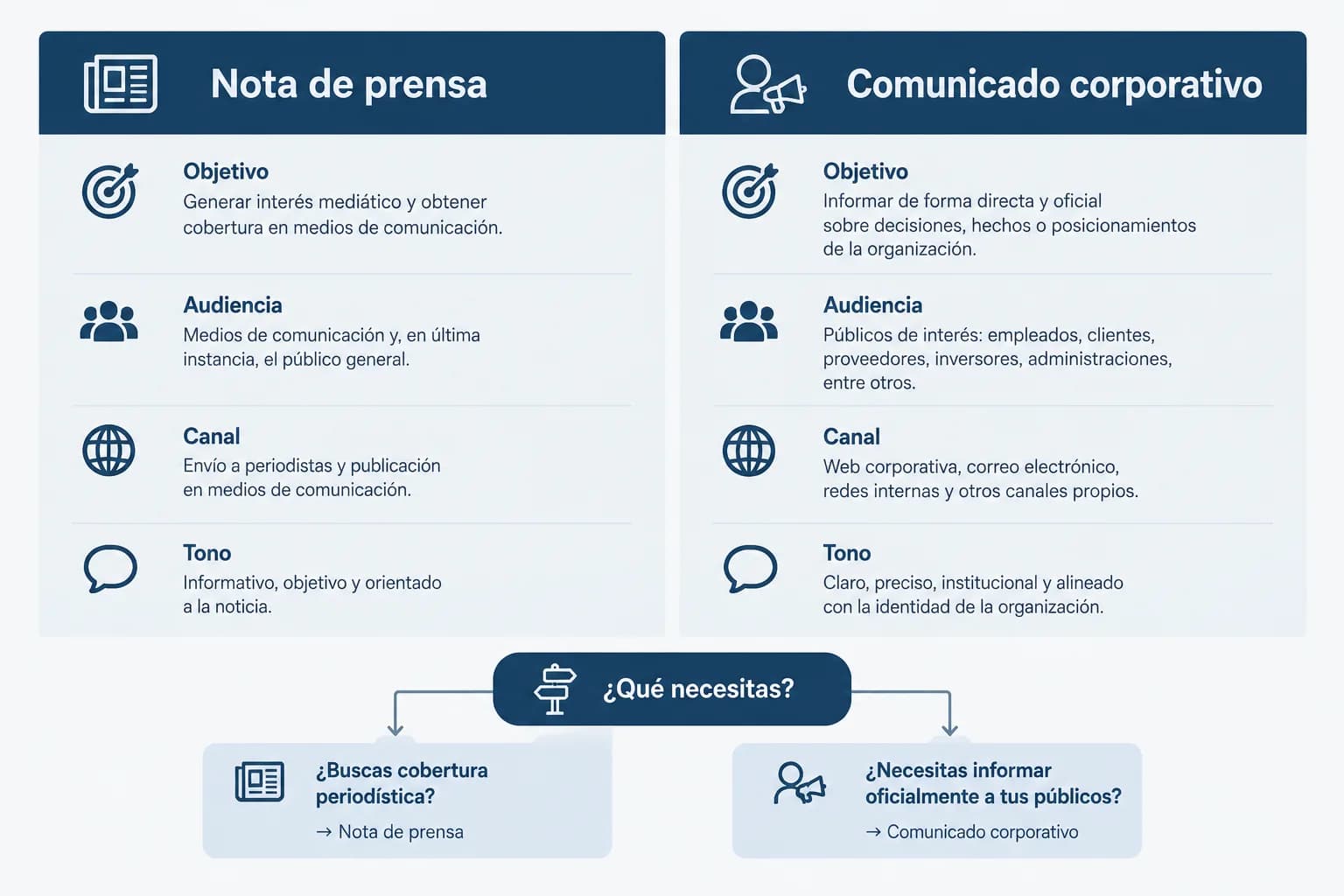
A press release and a corporate statement may arise from the same event, but they do not pursue exactly the same goal. The former is designed for journalists and media outlets to assess whether there is a story worth covering. The latter serves to convey information, a decision or an official position of the company to its stakeholders.
The distinction matters because it dictates the approach, tone, data included and the distribution channel. Publishing a text on a corporate website does not, by itself, turn it into a news story. Similarly, sending journalists an institutional message without context or newsworthiness will hardly facilitate their work.
Press release vs statement: the essential difference
The main difference lies in the communicative function. A press release presents a potentially newsworthy event in a clear, verifiable and useful way for a newsroom. Its reasonable objective is to make it easy for a media outlet to evaluate the information, verify it and, if it considers it relevant, cover it according to its own criteria.
A corporate statement, on the other hand, is an official declaration or information issued by an organisation. It can be addressed to customers, employees, investors, suppliers, the media or the general public. It does not need to rely on a journalistic publication: it is usually disseminated via owned channels, such as the corporate website, the press room, email or corporate profiles.
The terms are not always used the same way in every company. Therefore, rather than focusing only on the label, it is worth asking: “Do I need the media to assess an informative event, or should I communicate an official position to a specific audience?”
What is a press release
A press release is a document aimed primarily at journalists. It summarises a development, an announcement, a milestone or data that may have news value for a specific audience. It must allow one to quickly understand what has happened, who it affects, why it matters and where the information comes from.
The treatment must be journalistic, not promotional. This implies prioritising verifiable facts, attributing statements and providing sufficient context. Expressions such as “undisputed leader”, “revolutionary” or “the best solution” do not replace data or help to assess the relevance of the news.
Common structure of a press release
- Informative headline: anticipates the main fact without exaggeration.
- Lead paragraph: concentrates the essential data: what is happening, who is involved, where or when it occurs and why it might be relevant.
- Body: explains background, scope, operation or known impact of the announcement.
- Attributed statements: provide interpretation, commitment or context from an identifiable spokesperson.
- Supporting information: figures, documents, images or background that can be verified.
- Press contact: indicates a real channel for expanding on data or answering questions.
The release does not guarantee coverage. Media outlets decide independently what they publish, what approach they take and what sources they consult. The role of the company is to provide rigorous information and respond with agility if they receive queries.
What is a corporate statement
The corporate statement expresses official information from the organisation. It can announce a decision, clarify an incident, explain an organisational change, update a situation or set out a corporate position. Its priority is not for a journalist to construct a news story from the text, but for the recipients to understand the message and know where to look for further information.
It is especially useful when the company needs to place a position on record or inform several audiences directly. For example, regarding a change in service, an internal reorganisation, an operational interruption or a clarification regarding previously disseminated information.
What a statement should include
- A clear subject or headline that identifies the matter at hand.
- The explanation of the situation with the facts available and confirmed.
- The company's position or the decision taken.
- Measures, deadlines or next steps, where appropriate.
- A contact channel or reference for subsequent queries.
In sensitive matters, clarity is preferable to rhetoric. If there is information that cannot yet be confirmed, it is better not to present it as a fact. A precise statement can explain what is known, what is being reviewed and when an update is expected, without speculating.
Key differences between both formats
| Aspect | Press release | Corporate statement |
|---|---|---|
| Main objective | To facilitate journalistic assessment of a newsworthy event. | To inform, clarify or set an official position. |
| Priority audience | Journalists and media outlets. | Customers, employees, partners, investors, suppliers or other audiences. |
| Tone | Informative, contextualised and fact-oriented. | Institutional, direct and adapted to the recipient. |
| Common channel | Media contact, press lists or press room. | Corporate website, email, intranet, social media and other owned channels. |
| Utility criterion | That a media outlet can understand, verify and assess the information. | That the official message is clear, accessible and traceable. |
Both formats can share factual information, but they do not have to reproduce the same text. Effective corporate communication adapts the level of detail, structure and channel to each audience.
When to use a press release and when a statement
The choice stems from the objective and the recipient, not the desire to obtain visibility. These cases help to decide:
- Launch of a new development: may justify a press release if there is a verifiable and relevant fact beyond commercial promotion. In owned channels, a statement can explain conditions, availability or practical information for customers.
- Organisational change: if it primarily affects employees or collaborators, the statement is usually the main format. If the change has significant public implications, it may also require a press release.
- Incident or reputational crisis: the statement allows for an official position to be offered and affected audiences to be updated. If there is journalistic interest, the relationship with the media requires consistent information, a defined spokesperson and verifiable answers.
- Results or progress: a press release may be suitable when verifiable data and context for interpretation are available. If it is follow-up information for specific stakeholders, a statement may suffice.
- Partnership or event: it is worth assessing what novelty it brings, who benefits from knowing about it and whether there are verifiable elements that transcend the announcement between the parties.
The same event may require both documents. A company that communicates an incident may publish a statement for customers with clear instructions and prepare a press release with the available context to attend to the media. It is not duplicating for the sake of it: it is responding to different needs.
How to draft and distribute each document
Before writing, it is advisable to gather the elements that can be verified: names, roles, dates, scope, available figures, background and internal sources responsible for validating the text. Review is part of corporate writing, not a final formality.
In a press release, the headline and the first few paragraphs must contain the essential information. A journalist must be able to identify the event without going through a commercial introduction. Statements must be attributed and provide something that the data alone does not explain.
In a statement, the order can be more functional: situation, position, measures and next steps. If it is aimed at customers or employees, it is worth anticipating practical questions: what changes, since when, who it affects and where to resolve doubts.
Distribution also changes. The press release is aimed at media and contacts whose audience may have a relationship with the matter. The statement is published or sent via the channels where its recipients actually are. In both cases, an organised press room and an updated corporate page help to maintain an accessible record of the official message.
Common errors when confusing them
- Presenting advertising as news: a catalogue of commercial benefits does not acquire journalistic interest because it is in press release format.
- Sending an internal statement to a newsroom without adaptation: it may lack the context, data or focus for an external audience.
- Using unproven claims: superlatives and vague promises reduce clarity and credibility.
- Hiding relevant information: in sensitive situations, an evasive message can generate more doubts than a limited but precise explanation.
- Distributing the same text to everyone: each audience needs different language, detail and a call to action.
- Confusing dissemination with coverage: publishing or sending a document increases its availability, but does not equate to editorial validation by a media outlet.
Quick table for choosing the format
| If you need to... | Priority format | Control question |
|---|---|---|
| Present a fact with news value to journalists | Press release | Is there data and context for a media outlet to evaluate it? |
| Inform staff, customers or partners of a decision | Corporate statement | What do the recipients need to know and do? |
| Explain an incident from an official position | Corporate statement | What facts are confirmed and when will there be an update? |
| Address an issue that affects internal audiences and attracts external attention | Both, adapted | What version does each audience require without altering the facts? |
| Announce an event or a partnership | Depends on newsworthiness | Does the information provide interest beyond self-promotion? |
Conclusion: choosing the format improves the message
The press release does not replace the corporate statement, nor does the statement replace the work of media relations. The former facilitates possible journalistic coverage; the latter allows for official communication with specific audiences.
Before drafting, define the event, confirm what information you can sustain, identify who you need to reach and choose the right channel. From there, a clear headline, sufficient context and rigorous review will do more for the quality of the message than any promotional formula. Drafting and review guides for press releases can serve as support to turn that planning into a precise and useful piece.