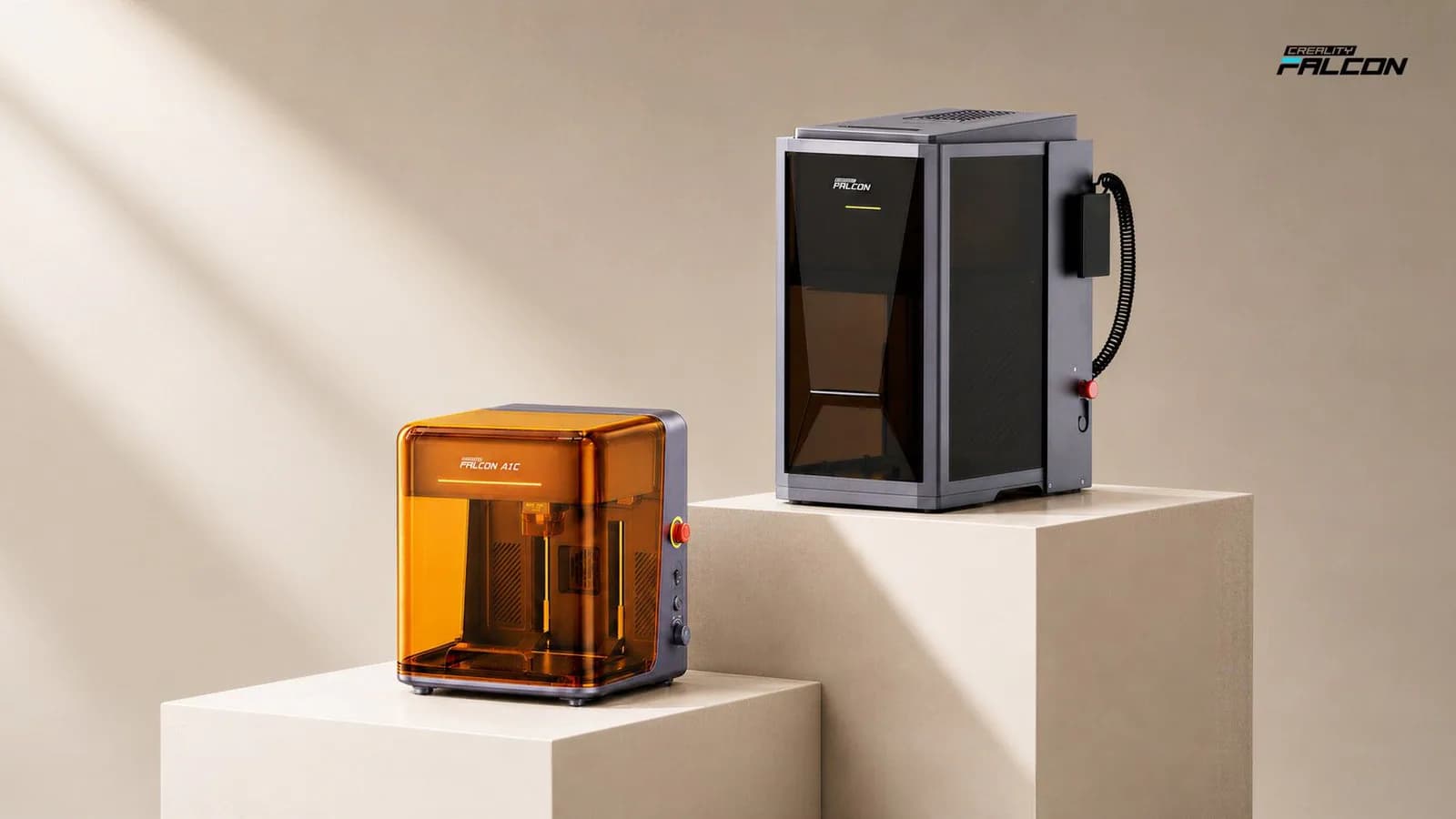
Recently, the global digital manufacturing brand Creality announced the launch in Argentina of two new laser engraving products from its line Falcon, aimed at makers, schools, customisation workshops and small local manufacturing businesses, with solutions ranging from entry-level to professional.
The new Falcon T1, which the brand defines as the first laser engraving station expandable to five light sources, allows the laser module to be changed in about 15 seconds, without the need to purchase several dedicated machines. Available modules include a 20W and 40W diode laser, a 20W fibre laser, a 60W MOPA fibre laser and a 5W UV laser, covering materials such as wood, acrylic, leather, coated metals, stainless steel, aluminium, titanium, precious metals, plastics, ceramics and glass. The equipment also incorporates capabilities unusual in desktop equipment, such as deep engraving, engraving on curved surfaces and internal engraving on crystal, with processing precision of up to 0,01 mm and up to 0,001 mm in UV mode, and speeds of up to 10.000 mm/s. Its Class 1 safety enclosure incorporates automatic module recognition and is compatible with the Falcon Design Space and LightBurn software.
For its part, the Falcon A1C, conceived under the philosophy that any creator can use it with ease, is the ideal option for those starting out in laser engraving. Its Class 1 safety enclosure, together with auto-focus, AI camera and vision-assisted positioning, greatly simplifies job preparation: the user can preview the design directly on the material before engraving, and the smart layout function helps to make better use of the material. It is compatible with 5W and 10W diode laser modules, and with an optional 1.2W infrared module; it offers a workspace of 150 × 150 mm, speeds of up to 15.000 mm/min, Wi-Fi and Bluetooth connectivity, and a compact desktop format.
At the software level, the Creality ecosystem integrates AI into the entire engraving workflow: tools such as intelligent contour extraction, one-click cropping and filling, AI filters, high-definition restoration, mask cropping and breakpoint joining support the user from material preparation and design to production. The mobile app also supports one-tap engraving of AI-processed photos and remote monitoring of the process.
Likewise, the Creality ecosystem is supported by cloud storage and an extensive image library, and connects with content platforms such as MakerMuse, CraftSeek and FanForge, continuously exploring cutting-edge technologies such as vector generation from text, conversion of images into 3D and interconnection between devices. In this way, it links content, software, hardware and production in a creation chain that goes from idea to final object, helping users move from custom creation to mass production.
For the Argentine market, the arrival of these two pieces of equipment could not be more timely: from local scenarios such as engraving wooden or leather mates and personalising souvenirs, to maker education in schools and the marking needs of small businesses, the Falcon line offers an option for every profile. Furthermore, the "change the module instead of the machine" model can help workshops significantly reduce equipment investment and required space.
Currently, the Falcon A1C and T1 can already be purchased in Argentina through local suppliers officially authorised by Creality. Configurations, optional modules and prices are reported through the official channels.
Local purchasing channel in Argentina:
Falcon A1C:https://www.detintas.com.ar/productos/grabadora-laser-falcon-a1-c-diode-5w/
Falcon T1:https://www.impfot.com.ar/product-page/creality-falcon-t1-40w