The start date, recurrence rule and shared time limits make the number of scheduled visits traceable.
Oldenburg, 8 October 2026. For regular cleaning work, the exact scheduling rule influences the agreed scope. 'Every four weeks' means an interval of 28 days. 'Once a calendar month' describes a different rule. Anyone equating both specifications may therefore compare tenders or service volumes on an inappropriate basis.
The publicly available Jonas workbook on cleaning planning expressly points out this distinction in the 'Glass Recording' sheet. The following calendar scenarios are my own, freely chosen calculation examples. They describe neither a customer order nor actual Jonas service dates and do not take into account public holidays, access, or rescheduling rules.
One shared calendar year, two appointment lists
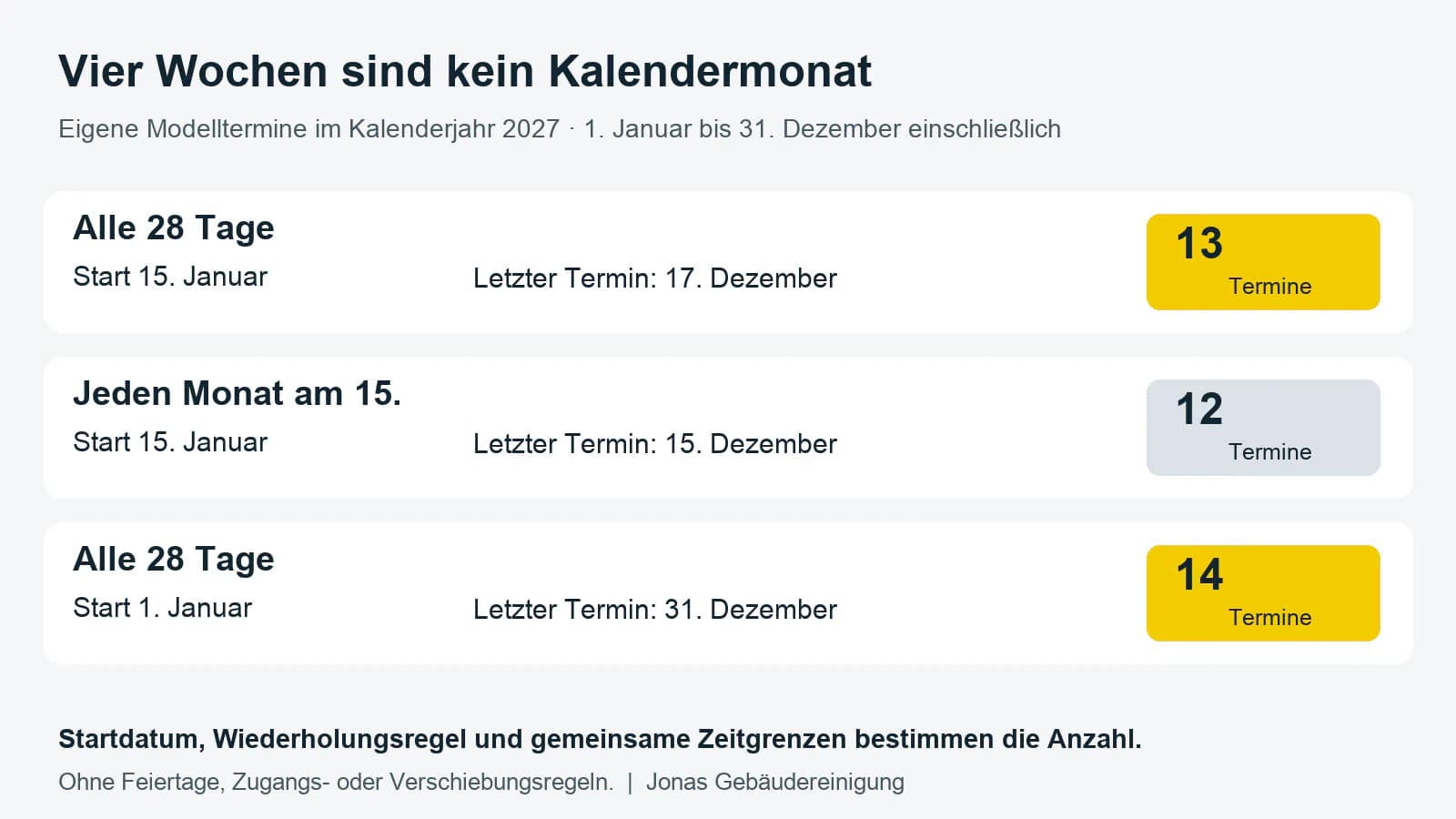
The comparison period used here is 1 January to 31 December 2027, inclusive of both. The first assumed service takes place on 15 January. With a fixed interval of 28 days, the following dates arise: 15 January, 12 February, 12 March, 9 April, 7 May, 4 June, 2 July, 30 July, 27 August, 24 September, 22 October, 19 November and 17 December. That is 13 appointments within the defined period.
For the other assumed rule, cleaning takes place on the 15 of the calendar month: from 15 January to 15 December, a total of twelve appointments. As early as February, the dates differ: 12 February versus 15 February. In this example, the fixed four-week interval also leads to two visits in July. The appointment count alone does not prove the equivalence of the work performed; for that, the areas and activities must match.
The starting point also changes the number
The abbreviation 'four-weekly always results in 13 appointments per year' would be incorrect. If the assumed four-week cycle starts on 1 January 2027, its 14 appointment falls on 31 December. Both dates are counted in this example. Between them lie 13 intervals of 28 days each, totalling 364 days. A different starting point or a different contract period changes the list.
In practice, a fixed sequence of days can be checked by adding 28 days from the first appointment. Only dates within the agreed limits are counted. A cycle that is already running before the observation period must be continued with its original sequence of appointments; its starting point is not arbitrarily reset for comparison.
Define before checking quantities and prices
A traceable plan specifies the first appointment, the recurrence rule, the period under consideration, and the treatment of its boundary days. For a monthly cycle, it must also be clear which day is meant. Public holidays, closed properties, or appointment rescheduling require a separate agreement. The actual number then results from this concrete appointment list.
Make appointment changes visible separately
If an individual scheduled appointment is moved, the original recurrence rule should remain recognisable. The decisive factor is then whether the change only affects this one service or also changes the starting point of subsequent appointments. These two cases create different lists and must not be silently equated. For a comparison, the intended dates are documented first, followed by the expressly agreed changes. The model calendar calculated here contains no such changes; its figures can therefore be checked directly from the start date, day interval, and time limits.
The existing Jonas template provides a static planning note for this purpose. The data lists shown were calculated for this technical article; an automatic calendar function of the workbook is not derived from this. The article does not set any general minimum intervals for cleaning or hygiene.
Source reference for the work aid: Public Jonas work aid
About the sender
Jonas Gebäudereinigung is a cleaning company based in Oldenburg with a public service offering for commercial clients.
Contact
Jonas Gebäudereinigung
Alexanderstraße 101 B, 26121 Oldenburg, Germany
Telephone: 0441 24923021
Email: info@jonas-gebäudereinigung.de
Editorial note: This technical article was created with AI support based on the aforementioned public Jonas work aid and the explicitly described explanation.