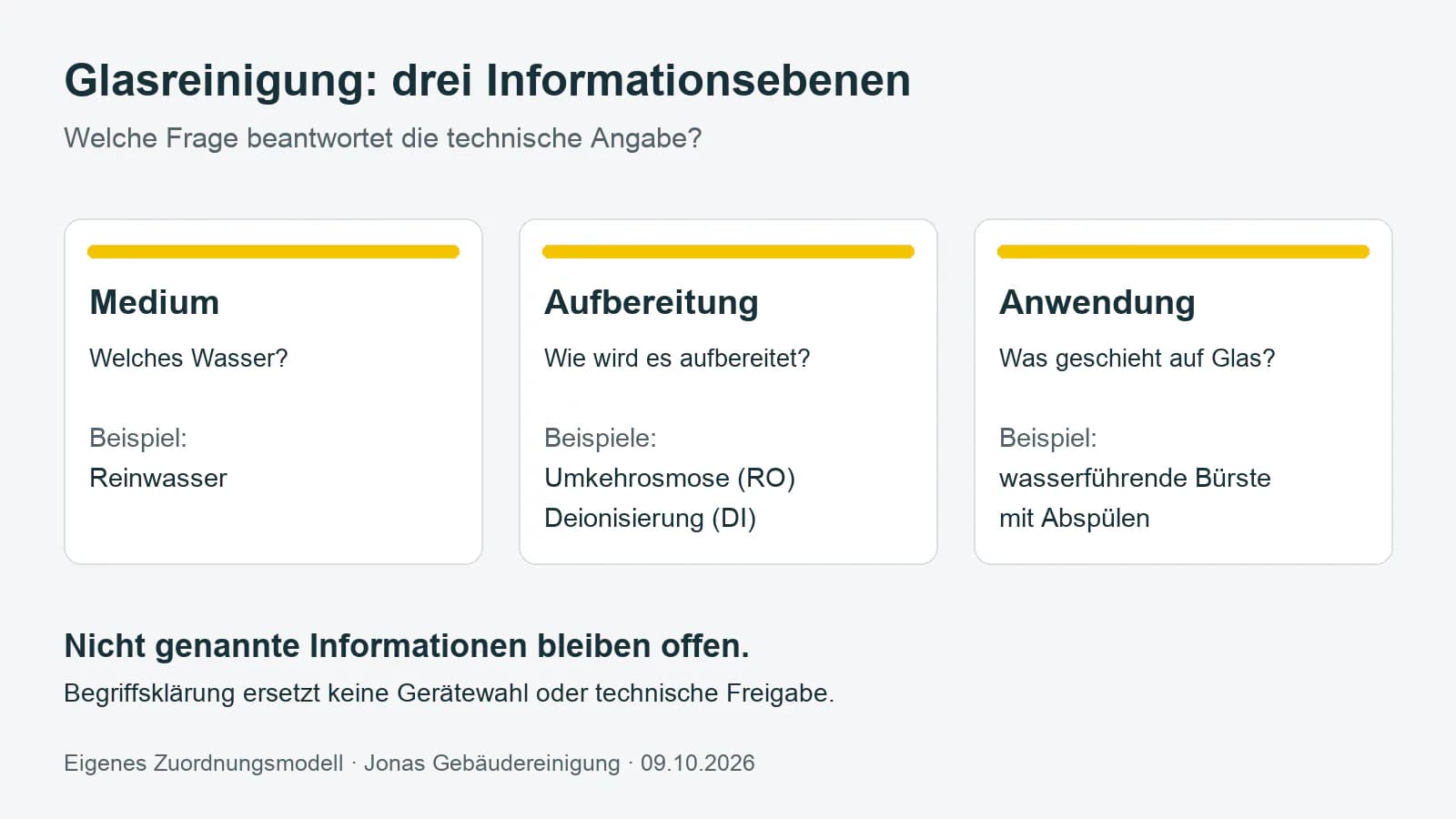
Oldenburg, 9. October 2026. What does a brief technical statement actually say about glass cleaning? Commercial clients can classify terms more easily if they distinguish between the water used, its preparation, and the cleaning process. The following specialist article by Jonas Gebäudereinigung explains these three levels using freely constructed brief descriptions. It does not describe actual offers or customer orders.
Three levels instead of one collective term
In the context considered here, pure water refers to processed, demineralised water. The term thus denotes a medium. It does not by itself state how this water was generated or which work steps are intended for a specific glass surface.
Reverse osmosis, abbreviated as RO, and deionisation, abbreviated as DI, refer to water treatment processes. The manufacturer UNGER lists both as methods for generating pure water for glass cleaning. The processes are different methods of preparation; therefore, one cannot unambiguously infer RO from the word pure water. Also, a statement about preparation does not replace a description of the application.
The application includes the activities actually described on the surface. A water-fed brush followed by rinsing denotes such steps. However, the wording taken by itself explains neither the preparation of the water nor all components of a cleaning order. Medium, preparation, and application each answer a different question.
Three freely chosen brief statements in comparison
The first example statement is: “Pure water for exterior glass cleaning”. It names the medium and a rough area of application. The water treatment process remains open. Likewise, it is not yet described which activities take place on the glass surface. The appropriate follow-up question is: How is the water prepared and which application steps are planned? A specific system or a brush procedure are not yet verified.
The second example statement is: “Reverse osmosis water treatment”. It names a process at the preparation level. This does not result in a complete activity description for glass cleaning. The appropriate follow-up question is: Which work steps on the glass surface are planned? Whether a brush is used or subsequent rinsing occurs must emerge from the description of the application.
The third example statement is: “Water-fed brush with rinsing”. It describes parts of the application. Whether the water used is processed and how this processing takes place remains unnamed in this short sentence. The appropriate follow-up question is: Which water is used and is it processed? If yes, how? The open statement proves neither a specific filter technology nor the use of ordinary tap water.
Using the classification practically
For a brief evaluation, three fields can be created: medium, preparation, and application. Only the explicitly mentioned information is transferred into each field. An unverified field receives the note “not specified”. This makes assumptions visible before they are passed on as supposed technical properties.
Another freely constructed composite example is: “Pure water treated with reverse osmosis; treatment of exterior glass surfaces with water-fed brush and subsequent rinsing”. Here, the medium, the named preparation process, and the described application steps can be assigned. The more detailed statement provides more information than any of the three individual examples. Nevertheless, it is not a complete technical approval for a specific object.
Limits of term clarification
The classification does not decide on the suitability for a specific glass, coating, or soiling. It also does not define purity limit values, equipment selection, safety measures, or guaranteed cleaning results. For this, the respective conditions must be checked separately. The benefit of the example lies in reading a description more precisely and specifically clarifying open information.
Sources and technical context
UNGER, explanation of filter methods: https://www.ungerglobal.com/de/anwendungen/glasreinigung/reinwasser-reinigung
Jonas, technical context for glass cleaning: https://xn--jonas-gebudereinigung-e2b.de/osmose-oder-klassische-glasreinigung/
About the sender
Jonas Gebäudereinigung is a cleaning company based in Oldenburg with a public range of services for commercial clients.
Contact
Jonas Gebäudereinigung
Alexanderstraße 101 B, 26121 Oldenburg, Germany
Phone: 0441 24923021
E-Mail: info@jonas-gebäudereinigung.de
Note: Corporate specialist article, created with AI support. The examples are freely constructed and are not documented practical cases.