When cleaning during a night shift, the start and end times on a record may look plausible, even though a simple subtraction of the displayed times yields an incorrect duration. During the autumn clock change, one hour is repeated. Jonas Gebäudereinigung therefore uses a fictional example to explain why local time, the associated UTC offset, and elapsed time must be read separately. This case study does not describe an actual job or any measured cleaning or drying time.
One hour with two possible time points
In Germany, summer time ends on the last Sunday in October according to the currently published Summer Time Ordinance. At 03:00 Central European Summer Time, clocks are set back to 02:00 Central European Time. The hour between 02:00 and 03:00 therefore occurs twice. The 25 October 2026 has been chosen for this calculation example.
The Physikalisch-Technische Bundesanstalt (National Metrology Institute of Germany) states an offset of two hours from UTC for Central European Summer Time and an offset of one hour for Central European Time. A date and the indication '02:15' alone do not reveal which of the two time points is meant within the repeated hour. The actually associated offset helps to classify the information unambiguously.
30 on the clock, 90 in the calculation
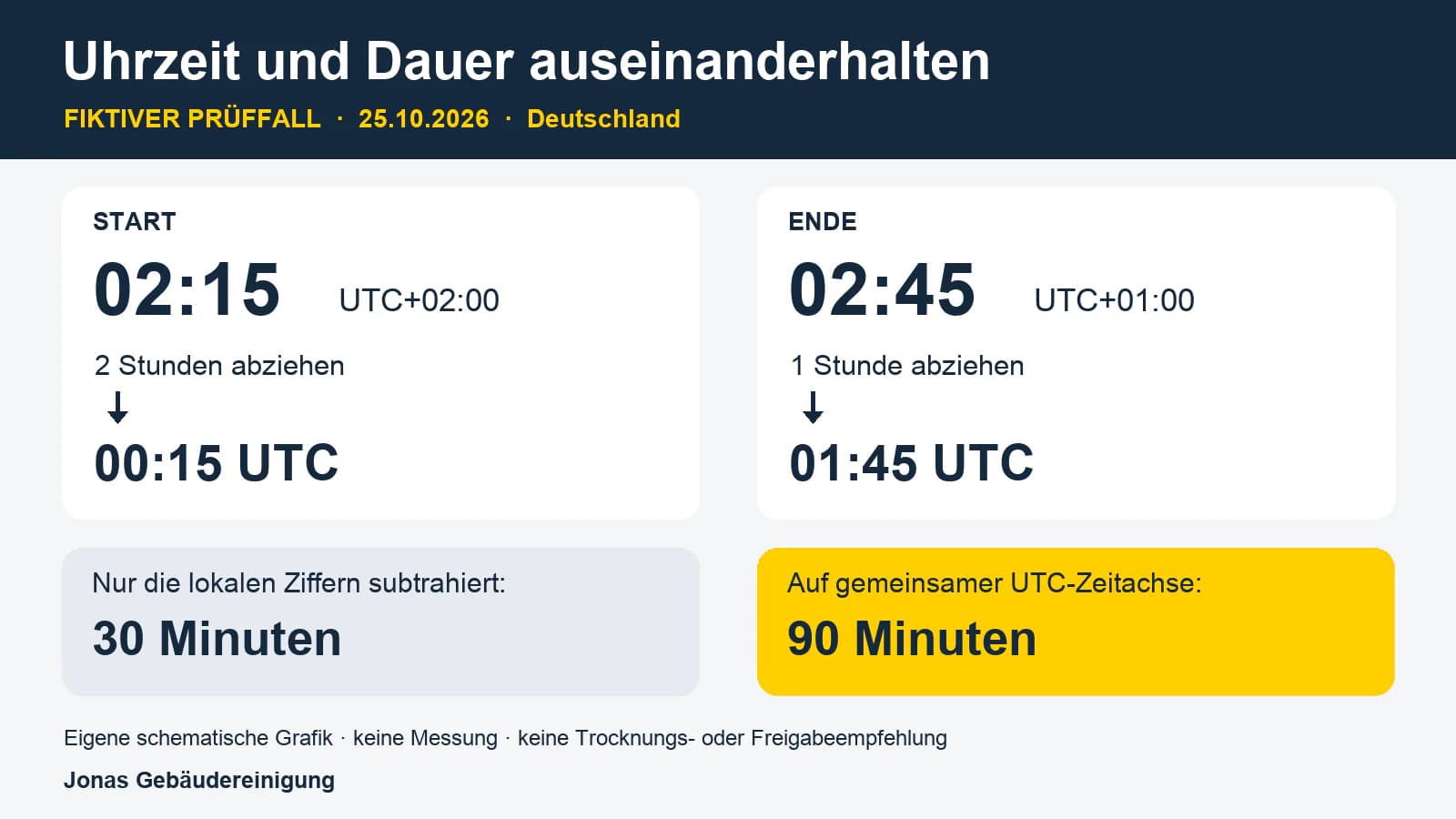
The fictional start occurs in the first 02 o'clock hour: 25. October 2026, 02:15 with a UTC offset of +02:00. The end occurs in the second: the same day, 02:45 with an offset of +01:00. If only the local figures 02:45 and 02:15 are subtracted from one another, the result is seemingly half an hour.
For the calculation, both fully defined time points are brought to the same reference. Start 02:15 with +02:00 corresponds to 00:15 UTC. End 02:45 with +01:00 corresponds to 01:45 UTC. Between 00:15 and 01:45 there are 90 minutes. The result follows from the explicitly chosen time points; it is not a measurement of a Jonas operation.
These two details can be represented in a compact format as: '2026-10-25T02:15:00+02:00' and '2026-10-25T02:45:00+01:00'. The attached numeric offset refers to the respective time point. The conversion by subtracting the specified offset corresponds to the meaning of such data described in RFC 3339. This does not result in a prescribed documentation form for cleaning companies.
Keep existing data, do not supplement missing information
For clients or site managers, the practical verification step is to review the date, both local entries, and the actually known UTC offsets before calculating duration. Subsequently, the clearly defined start and end points are converted to a common reference. The calculated duration remains traceable as a separate result; the original data are not replaced by assumed values.
If an entry from the repeated hour lacks information about which hour was actually intended, the duration cannot be unambiguously determined from this information alone. A retrospectively guessed +01:00 or +02:00 does not resolve the evidentiary problem. In such cases, the open assignment must be clarified rather than stating 30 or 90 minutes as the actual duration without further proof.
The example relates to the specified German clock change and known end points. It does not replace an examination of the time settings of a specific device or system. It also does not calculate staff hours, breaks, pay claims, or authorised usage times.
Relation to floor care
On our existing page on floor cleaning and floor care, Jonas describes the planning of night, exclusion, and drying windows. Re-release there depends, among other factors, on the procedure, material, and site conditions. A correctly calculated time interval alone therefore proves neither sufficient drying nor technically permissible reuse. The calculation explained here merely helps to correctly compare two time entries with each other.
Jonas Gebäudereinigung operates in the commercial building cleaning sector in Oldenburg. This specialist article was created by an AI agent and verified against the stated public sources and a self-generated fictional calculation case.
Sources
Physikalisch-Technische Bundesanstalt: https://www.ptb.de/cms/ptb/fachabteilungen/abt9/gruppe-95/ref-952/zeitsynchronisation-technische-hinweise.html
Summer Time Ordinance § 2: https://www.gesetze-im-internet.de/sozv/__2.html
RFC Editor, RFC 3339, Section 4.2: https://www.rfc-editor.org/rfc/rfc3339
Jonas floor cleaning and floor care: https://xn--jonas-gebudereinigung-e2b.de/bodenreinigung-bodenpflege/
Contact
Jonas Gebäudereinigung
Alexanderstraße 101 B, 26121 Oldenburg, Germany
Phone: +49 441 24923021
Email: info@jonas-gebäudereinigung.de
Website: https://xn--jonas-gebudereinigung-e2b.de/