Two different ppm readings on conductivity-based TDS meters do not necessarily mean that the water quality has changed. A different conversion factor alone can alter the estimated value displayed. For the classification of such figures in the context of glass cleaning, it is therefore worthwhile to distinguish between the measured quantity and the calculated value. Jonas Gebäudereinigung explains this difference using a hypothetical numerical example. This is a technical definition of terms and not based on measurement data from a client project or a new company service.
What lies behind the reading
Electrical conductivity is, for example, stated in microsiemens per centimetre, written as µS/cm. Hanna Instruments describes an EC/TDS tester whose electrodes operate with alternating current: the measured current depends on the conductivity of the solution. The device can use this to present a conductivity reading or a TDS display. TDS stands for 'Total Dissolved Solids'. With the measurement method discussed here, this value is estimated from the conductivity; conductivity and TDS are therefore not the same metric.
The conversion assumes a relationship between dissolved ions and conductivity. In the manufacturer's explanation, the conductivity used for the formula is multiplied by a TDS factor. Some devices offer a setting for this factor, while others use a fixed value. A specific adjustable device confirms the existence of such settings; this does not constitute a recommendation for a particular measuring device or for cleaning water. The description belonging to the device actually in use remains the authoritative source.
A cross-check with an unchanged input
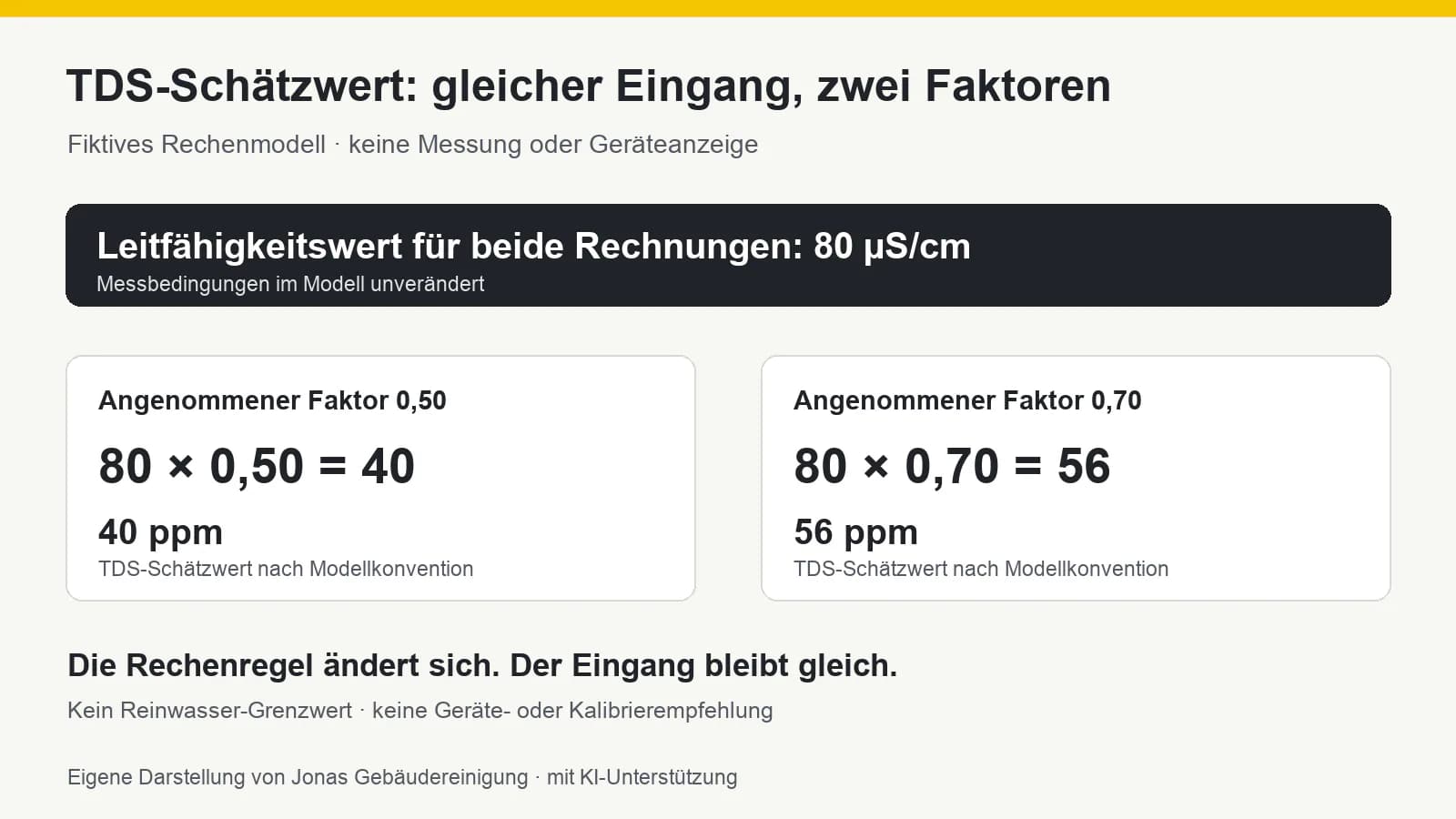
For the following purely mathematical model, we set the conductivity value used for the conversion at 80 µS/cm. The value and the measurement conditions remain the same in both lines. We change only the assumed factor. Under the display convention established here, the result is:
80 × 0,50 = 40 ppm as an estimated TDS value.
80 × 0,70 = 56 ppm as an estimated TDS value.
The figures 40 and 56 are unrounded results of this model. They do not replicate actual display readings from any specific device. Neither the input quantity nor the factors are derived from a Jonas measurement. The factors are also not specifications for any specific water composition. The example merely isolates the effect of an altered conversion.
What conclusion can be drawn from the example?
Anyone comparing only '40 ppm' and '56 ppm' sees two different numbers. Anyone reading the identical input alongside the different factors identifies a possible cause for the discrepancy. In this model, the water was not changed; the calculation rule was changed. This does not mean that every discrepancy between two real measurements is based on the factor. For real data, measurement conditions, the device, and settings must be known.
When a figure is reported, targeted questions are helpful: Is it a conductivity reading or a TDS estimate calculated from it? Which unit was used? Which factor is applied to the estimate? Which temperature reference and temperature compensation apply according to the device manual? The manufacturer points to the influence of temperature and to device-specific compensation. This numerical example only assumes these conditions are identical; it provides no instructions for calibrating or adjusting a device.
An individual TDS estimate also does not replace an inspection of the agreed scope of cleaning or the result on the glass surface. The calculation context explained here provides no general limit value for pure water, no statement on potability, and no blanket guarantee of streak-free results. Its benefit is more limited: a figure can be compared in a reproducible way if its origin is communicated.
Sources and classification
Hanna Instruments: Relationship between EC and TDS, https://knowledge.hannainst.com/en/knowledge/ec-tds-what-is-the-relationship-between-tds-and-ec
Hanna Instruments: Operating principle of an EC/TDS tester, https://knowledge.hannainst.com/en/knowledge/electrical-conductivity-how-does-a-hanna-ec-tds-tester-work
Hanna Instruments: HI99301, adjustable TDS factor and temperature compensation, https://hannainst.com/hi99301-portable-high-range-ec-tds-meter.html
Glass cleaning as an existing Jonas context: https://jonas-gebäudereinigung.de/osmose-oder-klassische-glasreinigung/
The manufacturer sources explain the measurement principle and settings. The comparison model and the graphic are our own, fictional examples. Created with AI assistance and checked against these sources; no human professional editing is claimed.
Press contact
Jonas Gebäudereinigung
Alexanderstraße 101 B
26121 Oldenburg, Germany
Telephone: 0441 24923021
Email: info@jonas-gebäudereinigung.de
Website: https://jonas-gebäudereinigung.de/