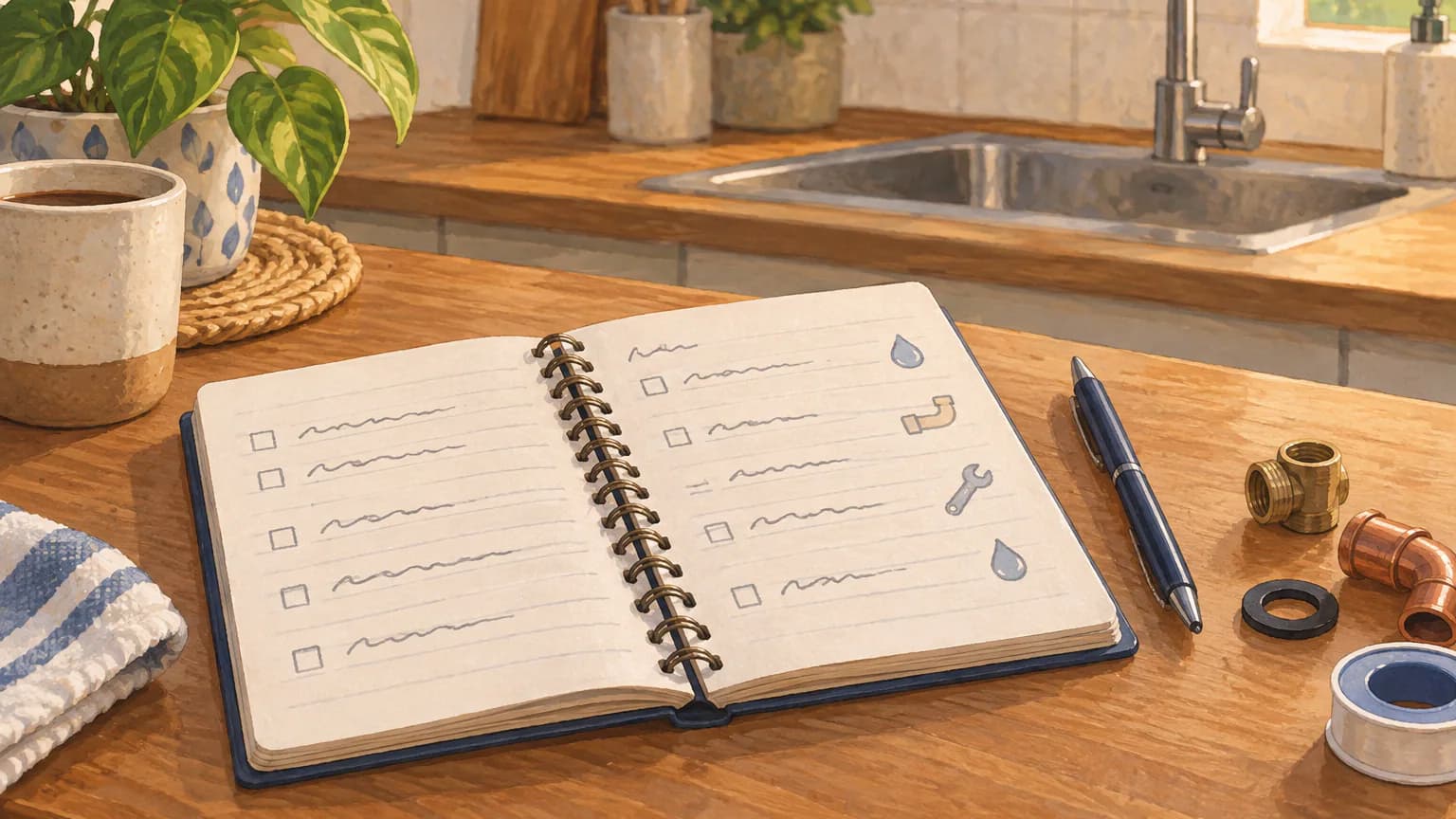
This guide from Fontaneros Bizkaia is aimed at those who need to organise plumbing incidents in a property in Bizkaia. A small note can prove more useful than trying to remember weeks later when a leak started. An incident log gathers observations, photographs and actions in one place. It helps to explain what happened to the professional and to keep track of a repair. It does not replace an inspection or turn a suspicion into a diagnosis.
Choose a simple format
A notebook, a spreadsheet or a digital folder will do. The important thing is that you can find the information and update it without complications. Dedicate an entry to each incident and use a specific title, such as "dripping observed under the sink". Avoid calling it a "broken pipe" if it has not yet been verified what is happening.
If several people live in the house, agree on where the log is kept. This way, there won't be photographs scattered across different conversations. Note the town in Bizkaia and an internal property reference when necessary, but do not publish the file or include other people's data without reason.
Note down what you can observe
Record the date and, if you remember it, the time of the first observation. Indicate the room and the nearby fixture: washbasin, sink, shower or wall. Describe what is visible in simple terms. A stain, a noise or a water leak are observations; their origin may require a professional assessment.
Add what was happening at that moment, provided you know. For example, if the drip was observed while a tap was being used or if the dampness seemed to have increased compared to the previous day. When data is missing, write "not verified" instead of completing it by intuition. You can also note who observed the change, without making that person responsible for the fault.
Save photographs that allow for comparison
A general image of the area and another of the relevant element can help explain the incident. Save the files along with their date and avoid ambiguous names like "new photo". If you take another photograph later, keep both to maintain the sequence.
Do not force access to an installation or dismantle elements to obtain an image. Avoid photographing documents, faces or belongings that do not provide information. Before sharing the log, check which files are necessary and keep a copy of the original set for your tracking.
Separate observations and actions
After a visit, add the date, what was checked and what action was documented. Distinguish between what was carried out and what was proposed for later. Keep the reports, invoices or instructions you receive, associated with the corresponding incident.
If the professional explains a cause to you, note it as received assessment, without retroactively modifying the initial observations. This separation allows you to understand the evolution: first what was seen, then what was checked and finally what was done. Do not attribute a technical conclusion to a photograph or an incomplete conversation.
Update without deleting the history
When you detect a change, add a new note. If the incident seems resolved, record from when it has not been observed and any pending inspection. Do not delete previous entries: they can facilitate a subsequent consultation if another sign appears in the same area.
To avoid confusion, keep the same date format and distinguish each incident with a brief reference. If you correct a note, make it clear what data has been clarified and when. An organised folder allows you to retrieve information without relying on memory.
Do not wait to complete the log to ask for help if the situation needs attention. Fontaneros Bizkaia provides plumbing support 24 hours a day. The log serves to organise information; it is not a condition for requesting assistance.