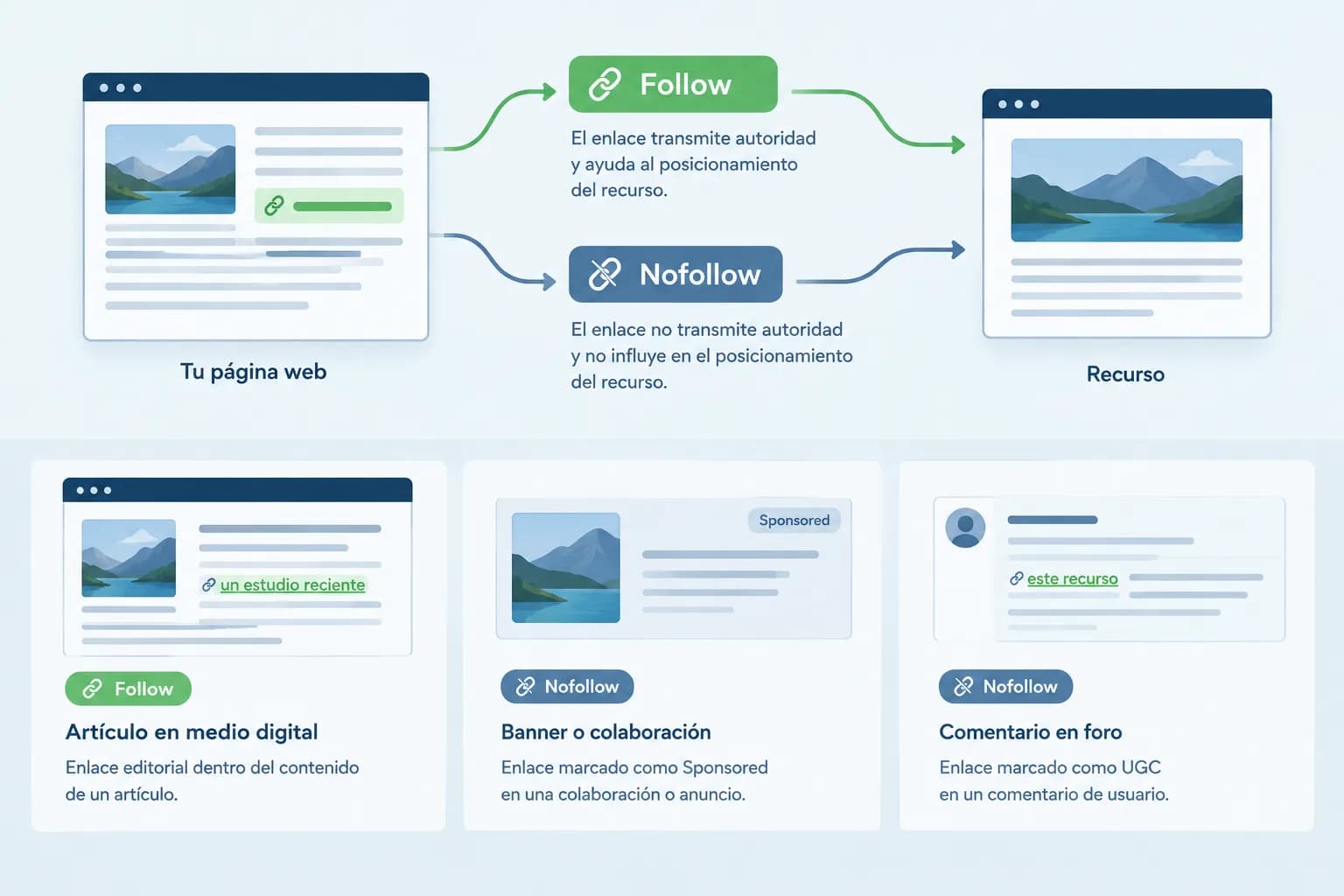
The difference between follow vs nofollow does not consist of one being good and the other useless. Both can form part of a healthy digital presence. What changes is the signal the linking site communicates via the rel attribute and, above all, the context in which the link appears.
An editorial link to a useful guide, a mention in a digital medium, an affiliate link, or a URL published in a comment do not represent the same relationship. Labelling them correctly helps to maintain transparency and avoids turning link building into a race to accumulate follow links without criteria.
Follow vs nofollow: the difference in one sentence
A follow link is usually a standard link, without a rel attribute that limits or qualifies that relationship; a nofollow link includes rel="nofollow" to indicate that the linking site does not want to treat it as a conventional editorial recommendation.
That does not guarantee that a follow link will improve rankings, nor does it imply that a nofollow link lacks value. Search engines value multiple signals, and specific behaviour can vary. Furthermore, crawling, indexing, referral traffic, and value as a link signal are distinct concepts.
What is a follow link
In practice, a follow link is called a standard HTML link, for example:
<a href="https://ejemplo.com/recurso">See resource</a>
It does not carry rel="nofollow", rel="sponsored", or rel="ugc". That is why it is usually interpreted as the type of link an editor places naturally when citing a source, expanding on an idea, or recommending relevant content.
However, follow does not automatically equate to quality. A link can be technically follow and have little interest if it comes from a page unrelated to the topic, is inserted without context, or uses a forced anchor text. Conversely, a contextual link from a specialised publication can be useful because it helps the reader and connects related content.
When assessing follow links, it is worth checking the thematic relevance, the editorial quality of the originating page, the link placement, the anchor text, and the real utility of the destination URL. It is not enough to just look at a tag.
What is a nofollow link
A nofollow link incorporates the rel="nofollow" attribute:
<a href="https://ejemplo.com/recurso" rel="nofollow">See resource</a>
With this attribute, the linking site expresses that it does not wish to associate the link in the same way as a standard editorial recommendation. It can be used, for example, in certain commercial mentions, links included in spaces open to users, or references that the editor does not want to endorse directly.
Reducing nofollow links to the question of whether they “pass authority” is a simplification. A nofollow mention in a relevant medium can generate qualified visits, strengthen brand visibility, make it easier for new people to discover a resource, or lead to future editorial references. None of these effects is guaranteed, but all can have business value.
It is also important not to confuse nofollow with an absolute block. The attribute does not in itself prevent a URL from being crawled or indexed. The indexing of a page depends on many other factors and the decisions of the search engine.
Comparative table: follow and nofollow
| Aspect | Follow link | Nofollow link |
|---|---|---|
| Standard attribute | Link without a restrictive or qualifying rel | rel="nofollow" |
| Frequent use | Editorial reference, source, contextual recommendation | Links that you do not want to endorse editorially in a conventional way |
| Relationship with SEO signals | Can be considered within link signals | Indicates a different relationship; does not allow a fixed effect to be concluded |
| Potential value | Context, discovery, traffic, and editorial reference | Traffic, awareness, discovery, and link profile diversification |
| Common mistake | Assuming any follow is valuable | Discarding it without assessing audience, context, and brand |
Nofollow, sponsored, and ugc: when to use each attribute
The rel attribute allows for better description of the nature of the link. nofollow, sponsored, and ugc are related but not identical.
- Nofollow: useful when you do not want to transmit a conventional editorial recommendation or when the context requires it.
- Sponsored: indicates that the link is part of an advertising, sponsored, or affiliate relationship. It is the appropriate tag when there is compensation or a commercial agreement linked to the link.
- Ugc: stands for user-generated content. It can be applied to links published by participants in comments, forums, or other open spaces.
A link can combine values if the situation justifies it. For example, an affiliate link may carry rel="sponsored nofollow". The decision must respond to the actual relationship between the parties, not an attempt to manipulate signals.
Does a nofollow link work for SEO?
It can be useful within an SEO strategy understood broadly, although no direct or automatic result in rankings should be promised. Off-page SEO is not reduced to an authority figure or chasing a single type of backlink.
Imagine an e-commerce site appearing cited in an article in a sector medium. Even if the link is nofollow, the publication can bring the brand closer to an interested audience, attract visits, and make a category or resource visible that deserves to be known. That impact can be valuable even if it cannot be translated into a concrete improvement in positions.
The useful question is not just “is it follow?”, but: “does this mention reach the right audience, appear in a coherent environment, and provide something to the reader?”
When it makes sense to use a follow or nofollow link
Editorial references and own content
When a medium, a blog, or a company links to a source because it expands the content and considers it relevant, the link can be follow. The central criterion is editorial: there must be a real reason to direct the reader to that page.
Collaborations and guest posting
A guest article can be useful if it provides knowledge to a related audience. Before proposing the link, it is advisable to prioritise the quality of the content, transparency, and the rules of the medium. Publishing irrelevant collaborations just to obtain a backlink creates an unnatural footprint and offers little value.
Advertising, sponsorships, and affiliation
In commercial actions, sponsorships, and affiliate programmes, it is appropriate to use rel="sponsored". The fact that a collaboration is legitimate does not eliminate the need to identify it correctly.
Comments, forums, and open spaces
For links added by users, rel="ugc" often makes sense, and in some cases, nofollow as well. It is a way of managing links that the site editor has not reviewed or recommended one by one.
Internal links
Internal links serve a different function: they connect pages on the same site and help build a logical navigation. Applying nofollow indiscriminately to internal links does not usually solve architectural, crawling, or indexing problems. It is better to work on a clear structure, accessible content, and useful links for the user.
How to check the attribute of a link
The basic check can be done with browser tools:
- Right-click on the link and open the option to inspect the element.
- Search for the <a> tag in the HTML.
- Check if a rel attribute appears and what values it contains: nofollow, sponsored, or ugc.
- Also analyse the page, the context surrounding the link, the anchor text, the destination URL, and thematic affinity.
Extensions and analysis platforms can speed up a review, but they should not replace editorial judgement. A third-party metric does not by itself explain whether a mention is relevant, credible, or useful for a specific audience.
Frequent mistakes when working with backlinks
- Buying follow links massively: prioritises volume over relevance and can generate artificial patterns.
- Demanding that all links be follow: a natural strategy includes different contexts and attributes.
- Forcing commercial anchors: repeating exact terms mechanically reduces naturalness and can harm the reading experience.
- Hiding a commercial relationship: sponsored or affiliate links must be identified with the appropriate attribute.
- Ignoring the destination: getting a mention does not compensate if the linked page is poor, irrelevant, or does not meet the expectation created.
- Measuring only authority: referral traffic, thematic affinity, and content quality matter as much or more than an isolated figure.
How both types fit into a natural strategy
A sustainable strategy does not start with asking for links, but by creating reasons for them to exist: own studies with verifiable data, practical guides, useful tools, resources for customers, relevant news, or content that explains a complex topic well.
Digital PR, relationships with digital media, and editorial collaborations can extend that visibility when approached with informational interest. Sometimes the consequence will be a follow link; other times, a nofollow mention or even a citation without a link. All can contribute to a brand becoming better known to the right audience.
The reasonable objective is to build a coherent presence: relevant editorial links, transparent attribution in commercial actions, content that deserves to be recommended, and a website that welcomes those arriving from those references.
Conclusion: it is not about always choosing follow
Follow and nofollow links perform different functions. A follow can be a valuable editorial signal when it stems from a relevant context; a nofollow can bring audience, awareness, and visibility even if it should not be interpreted as an SEO guarantee.
The correct decision depends on the nature of the link: editorial reference, sponsorship, affiliation, or user-generated content. Instead of seeking follow links at any price, it is advisable to prioritise relevance, transparency, utility, and sustainable editorial relationships. That approach protects the quality of the content and fits better with a long-term brand strategy.