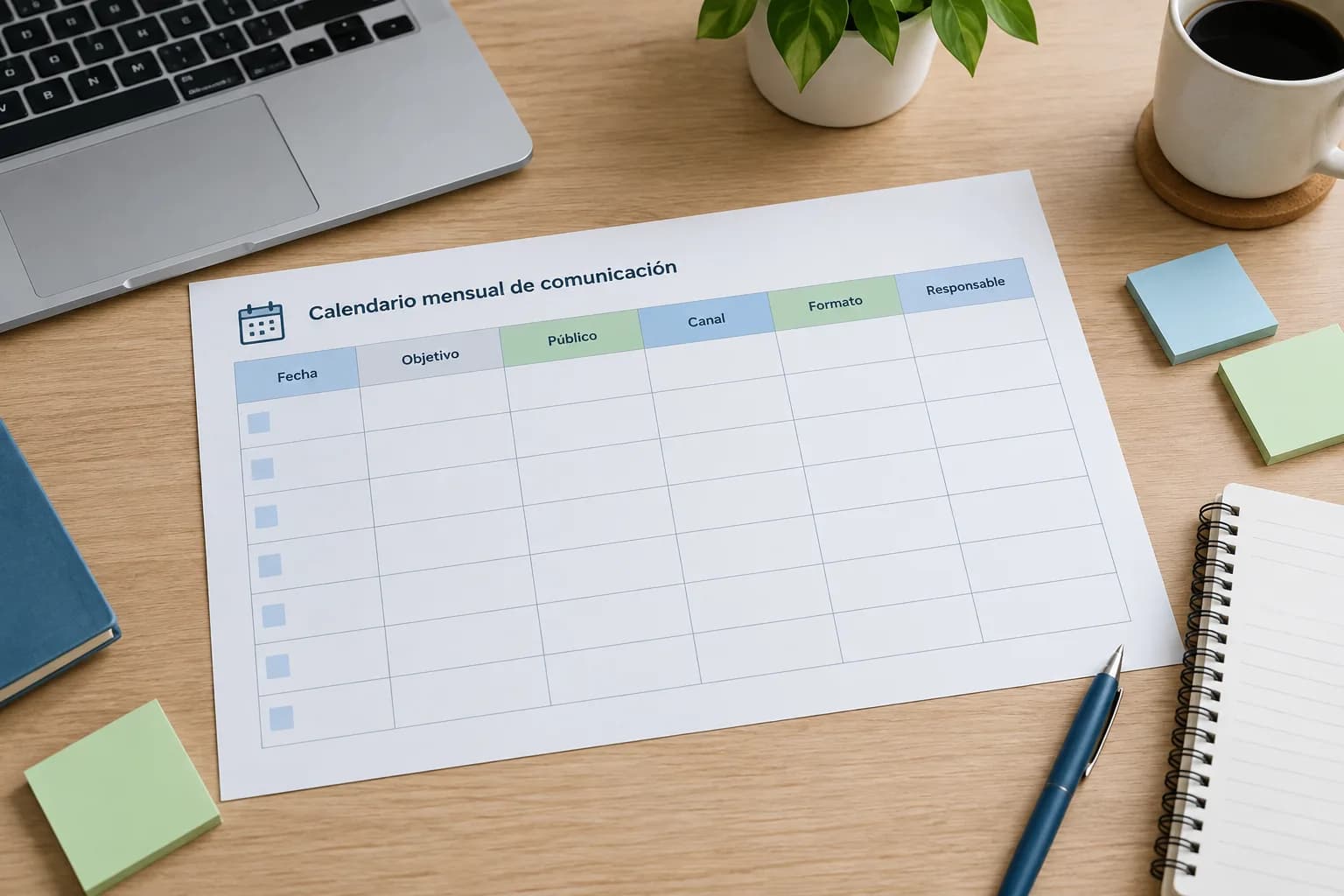
A small business does not need to be present everywhere or publish incessantly. It needs to decide what is worth communicating, to whom, via which channel, and with what resources. A communication calendar turns these decisions into a visible work plan: it prevents posts from depending on the day's urgency and helps maintain a coherent line between internal content, social media, and external dissemination actions.
The key is for it to be sustainable. An ambitious calendar that no one can execute lasts little time; a simple one, reviewed regularly, allows for learning and adjustment. This guide proposes a method designed for SMEs, startups, and teams without a large communication department.
What a communication calendar is and why it helps a small business
A communication calendar is the temporal planning of the messages and actions through which an organisation relates to its audiences. It may include posts on the corporate blog, content for social media, email communications, participation in events, proposals for guest articles, press releases, and other corporate materials.
It is not the same as a communication plan. The plan defines the framework: objectives, priority audiences, messages, positioning, and criteria for action. The calendar brings that framework into practice: it determines what will be done, when, who is in charge, and what is missing to publish it.
The editorial calendar is part of that system, but it usually focuses on internal content, such as articles, videos, newsletters, or social posts. The communication calendar is broader because it also incorporates relations with external media, relevant corporate announcements, and opportunities that do not originate on the blog.
Used well, it provides three practical advantages:
- It gives continuity to communication without the need to improvise every week.
- It avoids repeating messages or concentrating all news at the same time.
- It allows tasks to be distributed, approvals to be foreseen, and the lack of information or resources to be detected in time.
It should not, however, become a rigid list of posts. If relevant news, a recurring customer question, or a suitable editorial opportunity arises, the team must be able to reorganise priorities.
Before creating the calendar: objectives, audiences, and messages
Starting with dates usually leads to filling gaps with useless topics. Beforehand, it is advisable to answer three questions: what objective is pursued, who do you want to inform, and what can the company support with verifiable information.
Choose one or two priority objectives
For an initial period of 30 days, one or two concrete objectives are sufficient. For example: better explaining a complex service, increasing awareness of a new line of activity among current clients, ordering corporate communications, or giving visibility to the team's specialised knowledge.
An objective is not “publishing more”. Publishing is an action. The objective must guide the selection of topics and allow for assessing whether the effort makes sense.
Define priority audiences
An SME can address potential clients, current clients, suppliers, professionals in a sector, candidates, or the media. Not everyone needs the same information or uses the same channels.
Describe what doubts, needs, or decisions each audience has. Then, relate those needs to topics that the company can address with rigour. If there is insufficient data, authorisation, or evidence to support a claim, it is preferable to reformulate the message or discard it.
Establish messages and boundaries
Key messages are ideas that should be maintained consistently: what problem the company helps solve, what experience it can explain, or what relevant changes it can communicate. It is also advisable to agree on boundaries: who validates corporate statements, what data is confidential, and what type of announcement requires additional verification.
This step reduces errors and prevents each channel from presenting a different version of the company.
What a communication calendar should include
A useful template does not need to be complex. It can start in a shared spreadsheet and grow only if the work requires it. Each row represents an action or a piece of content.
These are the minimum recommended columns:
- Date: day of publication, sending, or planned contact.
- Objective: purpose of the action.
- Audience: priority recipient.
- Topic and main message: subject to be covered and the central idea.
- Channel and format: blog, social network, email, press release, guest article, or presentation, among others.
- Responsible: person who prepares, reviews, or publishes.
- Status: idea, in preparation, pending approval, scheduled, or published.
- Necessary resources: data, images, statements, internal documents, or approval.
- Result: metric or lesson to be noted later.
When an action has a call to action, add it as well. It could be reading a guide, requesting information, answering a query, or registering for an activity. Not all posts need a commercial call: some should limit themselves to informing with clarity.
How to choose channels and a sustainable frequency
Communication for SMEs improves when dispersion is reduced. Before opening or feeding a channel, ask yourself if the priority audience uses it, what type of content fits there, and who will be able to maintain it.
A corporate blog can serve to explain issues in detail and create a proprietary base of content. Social networks help to distribute ideas, converse, and adapt messages to short formats. Email can be useful to communicate with contacts who have agreed to receive information. External media and guest articles require, in addition, that the subject fits the audience and the editorial line of the medium or website.
There is no universal correct frequency. A company can start with one well-crafted piece of internal content per month and several short adaptations, or with a different rhythm if it has more resources. The important thing is that the frequency does not compromise quality, review, or attention to other essential tasks.
Reserve unassigned spaces. They serve to respond to business changes, sector news, audience questions, or unforeseen events. A completely closed calendar usually breaks in the first week.
Example of a monthly calendar for an SME
This example is not intended to set a mandatory pattern. It shows how to connect a main idea with several actions without repeating exactly the same text.
- Week 1: publish on the blog a guide that answers a frequent customer question. Prepare two social posts that highlight different angles of that guide.
- Week 2: share a corporate update that is relevant and verifiable, such as the incorporation of a capability, a process change, or confirmed participation in a professional activity. If the information has real news interest, consider a press release.
- Week 3: publish a short piece with a practical explanation, a frequent question, or a sector observation based on information that the company can verify. Propose a guest article only if the topic adds value to the chosen medium's audience.
- Week 4: recover the content with the best response, update it if necessary, and review results. Note down questions received and pending matters for the idea bank.
Alternation prevents all communication from being promotional. It also helps to separate educational content, corporate communications, and messages linked to products or services.
How to coordinate blog, social media, press releases, and guest articles
One idea can have several lives. An extensive article can become a short post, an answer to a common question, a script for an intervention, or a collaboration proposal. Reusing does not mean copy and paste: each format must provide an approach appropriate to its context.
A press release should not be the automatic destination for every commercial novelty. It is a tool to communicate specific facts with possible news interest: relevant changes, initiatives with context, own data that can be documented, or events that affect a broader audience. The medium decides independently whether to publish, transform, or ignore the information sent.
Guest articles require a similar criterion. Before proposing them, check if the medium or publication addresses the topic, if its audience can benefit from the content, and if the contribution will be informative, not a covert promotion. Relevance and thematic suitability matter more than accumulating external publications.
Tools and work process to keep it updated
Google Sheets, Trello, Notion, or an equivalent tool can serve to organise the calendar. The choice should depend on what the team can already use comfortably, not on having the most sophisticated system.
It is advisable to establish a simple flow:
- Collect ideas from sales, customer service, management, product, and technical team.
- Check what information supports each proposal and if it requires approval.
- Prioritise the actions that respond to the defined objectives and audiences.
- Assign responsibles and realistic dates for drafting, review, and publication.
- Review the coming week in a short meeting or through shared tracking.
The idea bank is especially useful when time is short. It can include customer doubts, confirmed internal changes, process explanations, common sector errors, materials already published that allow for updates, and topics proposed by company professionals. Not every idea must be published; the bank allows deciding with more criteria when the time comes.
Metrics and frequent errors
Metrics must respond to the objective. For an informative piece, it may be of interest to check if it generates relevant visits, reading time, queries, or follow-up questions. In social media, qualitative interactions, clicks, or received messages can be observed. In external dissemination, it is advisable to register responses, mentions, and obtained publications, without confusing sending a press release with press coverage.
In addition to the results, measure the compliance of the process itself: how many actions were completed, which ones were delayed, and why. If the calendar is not met every month, perhaps the problem is the frequency, the distribution of tasks, or the approval circuit.
The most common errors are covering too many channels, publishing out of obligation, turning every message into a sale, not differentiating audiences, and not leaving room for unforeseen events. Another common flaw is not reviewing what was published: content planning only improves if lessons are registered and applied in the next cycle.
Basic communication calendar template
To start, create a table with these columns:
- Date
- Objective
- Priority audience
- Topic
- Main message
- Channel
- Format
- Responsible
- Status
- Resources and approvals
- Call to action, if applicable
- Result or lesson
Plan the next 30 days, not a whole year. Include first the dates and matters already confirmed, then the content that supports your objectives, and, finally, several flexible gaps. At the end of the month, keep what has worked, eliminate what adds work without providing utility, and adjust the following calendar.
The template does not replace a communication strategy, but it helps to execute it. For a small business, that difference is decisive: less dispersed activity and more prepared, verifiable, and useful messages for the people it is aimed at.