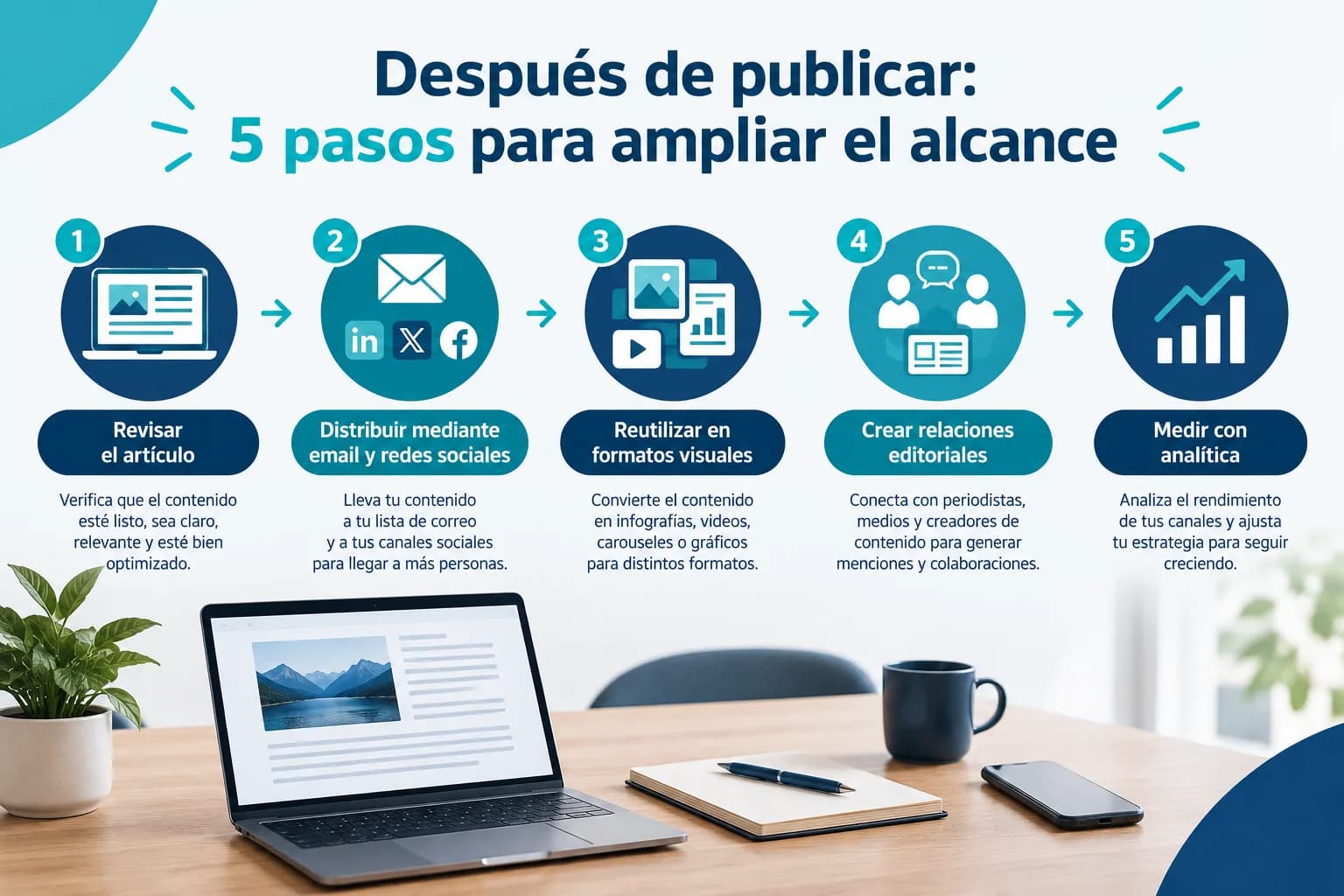
Publishing an article does not mark the end of the work: it opens its life cycle. If an SME or professional expects only to receive visits from search engines, they may be leaving a significant part of the content's value untapped. Content dissemination consists of bringing each piece to the right people through owned channels, relevant communities, adapted formats, and performance tracking.
It is not about pasting the same link everywhere or promising search engine rankings. It is about providing context, solving a specific need, and repeating actions that generate qualified visits, conversations, subscriptions, or leads.
What to do after publishing an article: dissemination begins when you click publish
A good article may take time to consolidate organic visibility. Meanwhile, content promotion allows you to activate your available audience: subscribers, customers, followers, professional contacts, or readers of other pieces on the site.
It is worth distinguishing between two horizons. On one hand, there is immediate visibility, which comes from a newsletter, a LinkedIn post, or a recommendation in a community. On the other, organic reach, which can develop gradually if the content responds well to a search, is well linked within the site, and proves useful to those who arrive at it.
Distribution does not replace the quality of the article. It amplifies it. Before promoting, ensure the piece answers a real question, has a clear structure, and offers a reasonable next step for the reader.
Checklist for the first few hours
Before sharing the URL, dedicate a few minutes to reviewing the reading experience. Correcting a detail now avoids sending traffic to an incomplete or confusing page.
- Check the title, introduction, and subheadings: they must clearly explain what the reader will get.
- Check the mobile reading experience, images, links, and any forms or calls to action.
- Add internal links to related content and, where appropriate, include links from old articles to the new publication.
- Confirm that the page can be crawled and indexed according to your site's usual configuration. Google Search Console can help detect coverage or crawling issues.
- Include the article in a category, resource page, or related content block if you have them.
- Prepare several approaches to communicate it: a question, a useful conclusion, a common mistake, or a recommendation extracted from the text.
That last point makes a practical difference. A link accompanied by "new article" offers few reasons to click. Conversely, a message that previews a concrete idea allows each person to decide if the content is relevant to them.
Distribute the article on your owned channels
Owned channels are usually the priority for small teams because they do not depend on third-party approval. You do not need to be on all of them: it is more useful to look after the spaces where an audience related to the topic already exists.
Send a newsletter with a reason to read
Email marketing works best when the email is not limited to announcing a publication. Summarise the problem, share an actionable conclusion, and explain what the reader will find when they open the article. If your list gathers different profiles, segment whenever possible: not everyone needs to receive the same content or the same approach.
An article can also be integrated into a welcome sequence, a periodic digest of resources, or a follow-up message for people interested in a specific service. The key is that the link makes sense within the conversation.
Activate corporate and personal profiles with judgement
Share the piece from the company's profiles on the social networks where your audience participates. The team's personal profiles can extend the reach if there is a genuine relationship with the subject and each person contributes their own perspective.
Adapt the format. On LinkedIn, a brief professional reflection might work; on Instagram, it might be more appropriate to turn an idea into a visual sequence; on Facebook or X, it is advisable to prioritise context and conversation over an isolated link. You do not need to use all platforms: choose those you can maintain with utility and consistency.
Promote content on social networks and communities without spamming
Online communities, professional groups, industry forums, and public conversations can generate quality referral traffic. But they only work when the article answers a question that is already present in that space.
Before sharing, review the rules of participation. Some communities do not allow promotional links; others accept them if they are accompanied by a useful explanation. In both cases, the best practice is to contribute first: answer the question, point out a practical step, and link to the article only if it truly expands the answer.
- Look for recurring questions that the article solves specifically.
- Explain part of the solution within your post; do not force a click to get the essentials.
- Participate consistently, not just when you have something to promote.
- Avoid automating messages, tagging people without reason, or repeating the link in other people's conversations.
Promoting articles is not interrupting an audience. It is putting a useful resource before those who may need it at that moment.
Repurpose an article to extend its reach
A long article often contains several smaller pieces. Content repurposing allows you to work the same research into formats suitable for other consumption habits, without copying and pasting the text or fragmenting it without criteria.
Extract a central idea and adapt it. For example, a list of steps can become a short post; a comparison can serve as a carousel; a frequently asked question can lead to a short video; and a visual explanation can be transformed into a simple infographic. Each format must offer value by itself and direct to the original article only when the person viewing it needs more depth.
You can also create a complementary piece. If the article covers a general overview, publish a guide later focused on one of its steps and connect both pages via internal links. This way, you build a thematic library that is more useful than a succession of isolated texts.
Seek editorial distribution and relevant mentions
A mention from a digital medium, a specialised blog, or a professional can help the content reach a new audience. However, this path requires relevance. Sending the same message to dozens of contacts is usually ineffective and can harm the relationship.
Identify publications, newsletters, or professionals whose audience has a real interest in the topic. Then, propose a concrete collaboration: an original contribution, a guest article with a specific approach, an expert response to a question they are covering, or a resource that complements existing content.
An editorial mention is earned through utility and context; it is not equivalent to buying links or requesting that someone link to a page for no reason. If a contextual link arises naturally, it can facilitate the discovery of the content, but it should not be the sole objective of the relationship.
How to give an article a second life
There is no universal frequency for re-distributing content. It depends on the activity of each channel, the size of the audience, the currency of the topic, and how much the message changes. Evergreen content can be recovered when a related conversation appears, it is updated with useful information, or it fits into a thematic campaign.
Instead of repeating the same text, try different angles. One day you can share a common mistake; later, a checklist; then, a response to a frequent objection. The URL may be the same, but the reason to read it changes.
If you accumulate several articles on a subject, group them into a guide or thematic page. This organisation makes it easier for readers to discover more resources and simplifies distribution: instead of promoting disconnected pieces, you present a useful journey.
Measure which dissemination actions work
Measuring is not just about counting visits. A post with fewer clicks can attract readers who subscribe, request information, or consult several pages. First define which signal has value for your business and for the article's objective.
Google Analytics can help you review sessions, traffic sources, behaviour, and configured conversions. Google Search Console allows you to observe impressions, clicks, and search queries associated with the content. For campaigns or links that you control, UTM parameters can help to better differentiate the origin of visits.
- Referral traffic: shows which sites, communities, or publications send readers.
- Clicks and sessions by channel: allow you to compare the performance of each distribution action.
- Quality interactions: replies, saves, conversations, or requests related to the topic.
- Subscriptions and conversions: indicate whether the content attracts an audience aligned with your objectives.
- Organic queries and impressions: help detect which questions the article is beginning to cover in search engines.
Analyse data with context. A spike in visits does not prove by itself that a strategy is sustainable. Look for patterns: which topics are interesting, which formats generate qualified clicks, and which channels provide the best results with reasonable effort.
Dissemination plan for an SME with little time
Lack of time forces you to prioritise. This simple process avoids the article being abandoned after its publication.
- Day of publication: review the page, add internal links, prepare different messages, and share the content on the most relevant owned channels.
- During the first week: include it in the newsletter if it fits with the scheduled mailing, participate in relevant conversations, and create a brief piece repurposing its main idea.
- In the following weeks: review the initial signals, update the article if you detect new doubts, and consider an editorial collaboration or a proposal to truly relevant contacts.
- After some time: recover the content if it remains current, present it from another angle, or integrate it into a thematic guide.
It is not necessary to execute all the actions on every article. For a small company, it is usually preferable to choose two or three channels that you can handle well, document the process in the editorial calendar, and improve with each publication.
Common mistakes when promoting articles
- Sharing a link without context. The reader needs to understand why that content deserves their attention.
- Disseminating to the wrong audience. More reach does not always imply more value if the topic does not fit those who receive it.
- Confusing distribution with massive linking. Useful mentions are born from relevance, not from indiscriminate messages or low-quality practices.
- Copying the same message across all channels. Each space has different codes, formats, and expectations.
- Measuring only visits. Without analysing traffic quality and subsequent actions, it is difficult to know what is worth repeating.
- Expecting immediate results. Sustainable visibility combines initial distribution, updating, interlinking, and editorial consistency.
Content dissemination works better as a system than as a one-off action. Publish a useful piece, activate it before relevant audiences, convert it into new formats, listen to the response, and adjust the next cycle. With that method, each article can continue working long after its publication date.